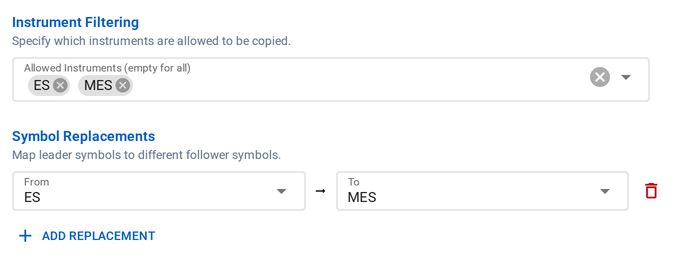
Instrument Filtering & Replacement
Both features exist on the Tradovate Copier with a slightly different surface. Filters accept * for everything, exact roots such as ES,MES, or root globs such as ES*,N*, and non-matching leader trades are skipped and logged. Replacements match an exact symbol first, then fall back to a root swap that preserves the month and year suffix. One important limit: replacements apply to unbracketed market orders only. When a replacement is configured and the leader sends a limit, stop, or bracketed order on that instrument, the follower skips the copy rather than placing prices computed for a different contract. See Tradovate Copier.
Filtering
A filter is a white-list. Name the instruments a copier is allowed to act on, and any leader trade outside that list is skipped and recorded in the copier log. Filtering is per copier, so one follower can take only your ES trades while another takes everything.
Replacement
A replacement swaps the contract the follower trades. You map a leader root to a follower root, for example ES to MES, and the copier resolves the front-month contract of the target root at copy time. You map roots, not specific contracts, so the mapping keeps working across rollover without being re-edited.
Mapping ES to MES sends the follower the same number of contracts on the smaller product, sized by your ratio or fixed quantity as normal. It does not scale the order to match notional value. If you want a different size on the micro, set it explicitly in Position Sizing.
When the front month cannot be resolved
If the copier cannot find a front-month contract for the target root, it does not skip the trade. It logs a warning and copies the order on the leader's original instrument instead.
That is worth knowing, because the failure is quiet: the trade goes through, just on the contract you were mapping away from. If a replacement seems not to be applying, check the copier log for a front-month warning before assuming the mapping is wrong.
NT8 order mode only allows related products
In the NT8 copier's order mode, a replacement must be between a contract and one of its own standard, mini, or micro siblings, such as ES to MES or CL to MCL. The copier editor rejects anything else with an error naming the pair. NT8 execution mode does not carry this restriction.
The reason is that order mode preserves order types, including limits and stops. Prices calculated for one product are not meaningful on an unrelated one.