Position Sizing
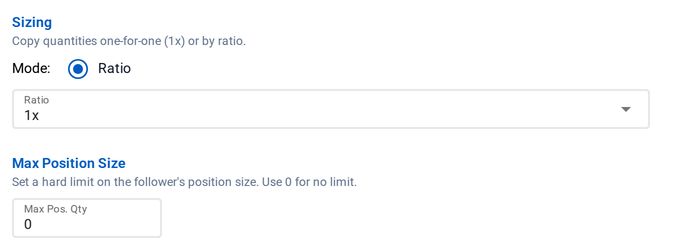
Ratio and fixed sizing work the same way on the Tradovate Copier, and it carries fractional remainders like NT8 does. One difference is worth knowing: Tradovate's carry is signed and tracked per copier, leader, and contract, so it applies to entries and exits in both directions rather than exits only, and if that carry state cannot be read safely the follower placement is withheld rather than guessed. Max Position Size is the same ceiling on Tradovate, with two differences: an entry that would cross it is trimmed to fit rather than skipped (it is skipped only when nothing fits), and if the follower's position cannot be read in time, that copy proceeds with a per-order clamp only and a warning is written to the copy log. See Tradovate Copier.
Ratio sizing
Set a follower's size as a multiple of the leader's: 0.5 halves it, 2 doubles it. The editor offers 0.25× to 1.75× in quarter steps, then whole numbers up to 10×.
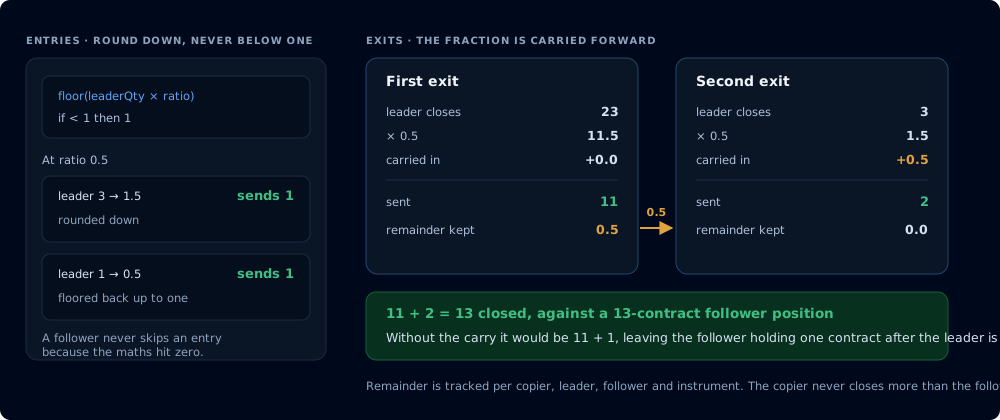
The follower quantity is rounded down, then floored at one contract:
followerQty = floor(leaderQty × ratio)
if followerQty < 1 then followerQty = 1
So at 0.5×, a 3-contract leader entry copies as 1 contract, and a 1-contract leader entry still copies as 1. A follower never sits out an entry because the maths rounded it to zero.
Fixed sizing
Instead of a ratio, pin the follower to a constant quantity regardless of what the leader traded. Useful when the follower has its own risk budget that has nothing to do with the leader's sizing.
What happens to the fraction on exits
Rounding down on every fill would leak contracts. Close a 23-contract position at 0.5× in two pieces and naive flooring gives you 11 then 1, leaving the follower holding 1 contract after the leader is flat.
The copier avoids this by carrying the remainder. Each exit fill adds the leftover fraction from the previous one before rounding:
Entries round down; exits carry the fraction so the follower converges to flat
| Leader exit | Raw follower qty | Carried in | Sent | Remainder kept |
|---|---|---|---|---|
| 23 | 11.5 | 0.0 | 11 | 0.5 |
| 3 | 1.5 | 0.5 | 2 | 0.0 |
That is 13 contracts closed against a 13-contract follower position, not 12. The remainder is tracked per copier, leader, follower, and instrument, and two guards apply: the copier never closes more than the follower actually holds, and the carry resets when the position is flat.
The practical consequence is that scaled exits converge to flat. You do not need to square up a follower by hand after a multi-stage close.
Maximum position size
The maximum is a ceiling on the follower's total position, not on any single order. Before copying, the copier adds the incoming quantity to the follower's current signed position, and if the result would exceed the maximum it skips the whole order and logs why (a MAX_QTY entry in the copier log). It does not partially fill up to the ceiling. Auto-Sync corrections are capped at the maximum too.
This is what makes it a real risk control: the follower cannot be walked past the ceiling by a series of small entries, however large the leader gets.
Contract size mapping
A replacement changes which contract the follower trades, not how many, so ES to MES at ratio 1 sends the same number of micros; use ratio 10 for comparable exposure. See Instrument Filtering and Replacement.