Cup and Handle Pattern
The cup and handle is a bullish continuation pattern: a rounded "cup" formation followed by a smaller, tighter "handle" pullback before breaking out to new highs. Popularized by William O'Neil for stock breakouts, it works on futures and indices as well, particularly on daily and weekly charts. A confirmed breakout above the handle's high signals continuation of the prior uptrend.
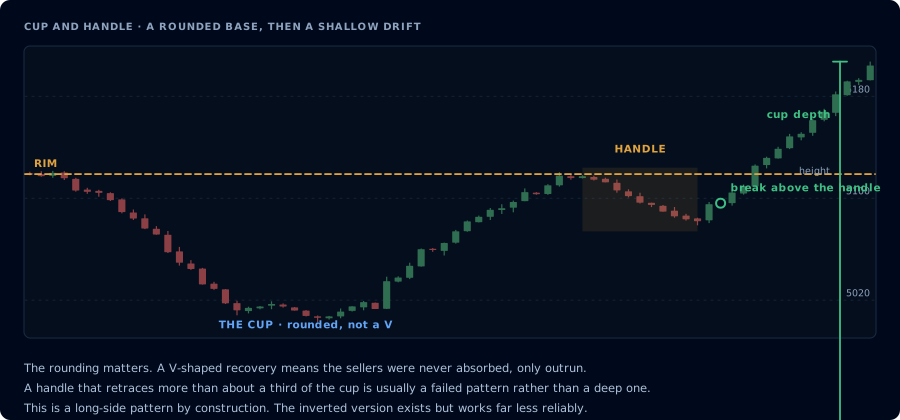
The rounding matters. A V-shaped base means the sellers were outrun, not absorbed.
Anatomy
Two parts:
- The cup — a rounded, U-shaped pullback from a prior high. Price drops, consolidates, and rallies back to the prior high. Should be smooth (rounded), not sharp (V-shaped).
- The handle — a smaller pullback after the cup completes its rally. Tighter consolidation, drifting slightly lower or sideways, before breaking out.
Visually: a coffee cup shape, with the handle on the right side.
Classic O'Neil criteria (for stocks; adapted for futures)
William O'Neil set strict rules in How to Make Money in Stocks. Adapted for futures:
- Cup depth: 12-33% from the prior high. Deeper cups are weaker patterns.
- Cup duration: 7-65 weeks on weekly charts (7-65 days on daily).
- Cup shape: U-shaped (rounded), not V-shaped.
- Handle: 1-2 weeks (1-2 days on daily). Drifts slightly lower or sideways, not strongly down.
- Handle depth: should not exceed 50% of the cup's depth. Tighter handles are stronger.
- Volume: declining during the cup formation, expanding on the breakout.
For futures (especially indices), these are guidelines, not strict rules. The pattern's geometry matters more than the exact percentages.
How to trade it
Entry. On a close above the handle's high.
Stop. Below the handle's low. Tight by design — the handle is small.
Target. Two methods:
- Measured move = the depth of the cup, projected from the breakout above the handle.
- Trailing stop = trail with an EMA or ATR multiple, letting the trend extend.
Aggressive traders use measured moves. Trend-followers prefer trailing.
Why it works
The rounded cup represents prolonged consolidation — buyers and sellers reaching equilibrium at lower prices, then gradually working back up. The handle is a final shake-out where weak hands sell into the resistance at prior highs, leaving strong hands holding before the breakout.
It's a distribution-then-accumulation pattern: the cup distributes the prior peak, the rally absorbs the supply, the handle clears the last weak holders, and the breakout extends.
Realistic stats
For confirmed cup-and-handle breakouts on daily/weekly charts:
- Win rate after handle break: 65–75%
- Average move: ~70% of measured cup depth
- Failure rate: 25–35%, often when the broader market reverses
- Best setting: trending market with the cup forming as a multi-week pullback
The pattern is more reliable on weekly charts than daily; daily more reliable than intraday.
Inverse cup and handle
A bearish version exists — inverted cup (rounded top), then a small handle that drifts higher, then breakdown. Less commonly named in technical literature but works the same way in reverse. Use it cautiously; classical patterns work better in their original direction.
Common mistakes
- Calling V-shaped pullbacks "cups." A V-shape is not a cup. Real cups are rounded — they show that selling pressure exhausted gradually, not sharply.
- Trading cup-only without the handle. The handle is what marks the breakout zone. Without it, you're just breaking a prior high — different setup.
- Tight handles in a weak market. Beautiful pattern + bad market = failure. Always check the broader trend.
- Anticipating the breakout from inside the handle. Wait for the close above the handle high. Pre-breakout entries fail more often.
Frequently Asked Questions
Does the cup and handle pattern work on futures?
Yes, particularly on daily and weekly charts of liquid index futures (ES, NQ, YM). The pattern is more associated with stocks because William O'Neil's work focused there, but the underlying psychology — accumulation through a rounded base — works on any market with sufficient depth and time.
How long should the cup take to form?
On daily charts, 7–65 days is the classical range. On weekly charts, 7–65 weeks. Faster cups are weaker patterns. For intraday cup-and-handle on 15-minute or 1-hour charts, expect 7-30 bars in the cup with shorter handles.
Cup and handle vs. double bottom — what's the difference?
A double bottom has two distinct lows at the same price. A cup is a rounded base — many prices hit roughly the same low without two clearly separated valleys. They're related families of base patterns, but a cup is smoother and longer-developing.
Where do I enter on a cup and handle?
On a close above the handle's high, ideally with volume expansion. Entering during the handle is anticipation — handles can deepen unexpectedly. The breakout above the handle is your confirmation.