Double Top and Double Bottom
A double top is two peaks at roughly the same price with a valley between them — looks like an "M". It signals bearish reversal when price breaks below the valley. A double bottom is the inverse — two valleys at the same price ("W"-shape) signaling bullish reversal when price breaks above the peak between them. Both are simpler and more common than head and shoulders.
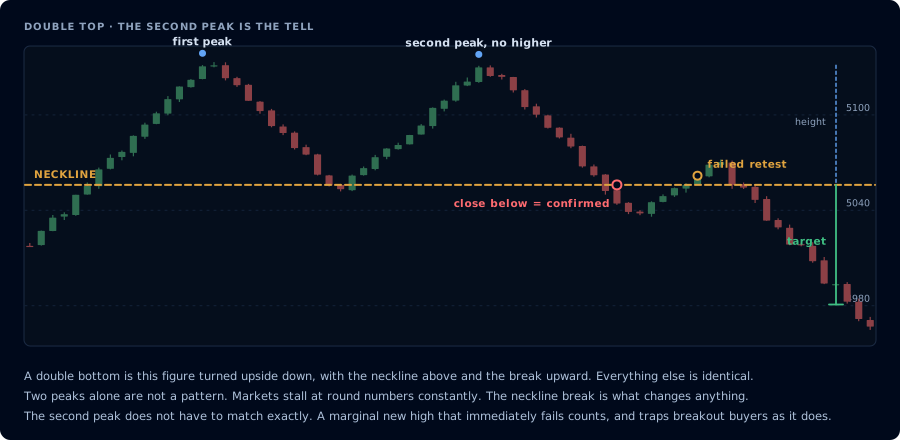
The second peak failing to exceed the first is the tell. The neckline is the trigger.
What forms each pattern
Double top. Price reaches a high, pulls back, rallies again to roughly the same high, then fails to break it. The pullback continues, and a break of the prior pullback's low confirms the pattern.
Three reference levels:
- First peak
- Pullback (the "neckline" or trigger level)
- Second peak (≈ first peak height)
Confirmation = close below pullback low.
Double bottom. Mirror image. Price reaches a low, rallies, falls back to roughly the same low, then bounces. A break above the prior rally's high confirms.
Why they form
Double tops form because the prior peak attracted strong selling — when price returns to that level, the same sellers (plus new ones who saw the first failure) defend it again. Failed breakouts at the same price = a clear ceiling.
Double bottoms have the inverse logic — the level acted as support twice, and a third test breaks it (or the bounce confirms it as a floor and short covers exit).
How to trade them
Entry.
- Aggressive: enter on the second peak's failure to break the first
- Conservative: wait for confirmation close beyond the trigger level (pullback low for double top, rally high for double bottom)
Stop.
- Above the second peak (for double top short)
- Below the second valley (for double bottom long)
Target. Measured move = the height of the pattern (peak to trigger), projected from the trigger break in the direction of the trade.
Time frame matters
Double tops on daily and weekly charts are reliable. Double tops on 1-minute charts are noise — almost every consolidation looks like a double top if you squint.
Rule of thumb: the pattern needs at least 5-10 bars between the peaks to be meaningful. Faster than that, you're often just looking at intra-bar wiggles.
Realistic stats
For confirmed double tops/bottoms on daily charts of liquid futures:
- Win rate after confirmation: 60–70%
- Average move to target: ~75-85% of the projected measured move
- Failure rate: 30–40%, mostly from breakouts that get faded back through the trigger level
Higher win rate than head and shoulders, but smaller targets on average.
Validation criteria
- Pre-existing trend. Double tops only matter at the end of an uptrend; double bottoms at the end of a downtrend. In choppy ranges, they're just noise.
- Peak symmetry. The two peaks should be within a few percent of each other. Wildly different heights = not a clean pattern.
- Time between peaks. Days/weeks on higher timeframes; multiple bars on intraday. Very close peaks suggest a triple-test in formation, not a classic double top.
- Volume. Classic theory says volume should decline on the second peak and surge on the trigger break. Often holds in modern markets but isn't always clean.
Common mistakes
- Calling the pattern before confirmation. A second peak forming doesn't mean it'll fail. Wait for the trigger break.
- Trading every double top. In a strong uptrend, prices that look like double tops often break out higher. Use a higher-timeframe trend filter.
- Overly tight stops. Stops just above the second peak get hunted by stop-runs. Place stops 1-2 ATR above the peak, not 1 tick above.
Frequently Asked Questions
How do I confirm a double top?
Wait for price to close below the trigger level — the low of the pullback between the two peaks. Until that close, the pattern is just two peaks at similar prices, which can resolve as continuation as easily as reversal.
Are double tops more reliable than head and shoulders?
Slightly. Double tops have a 60–70% post-confirmation win rate vs. 55–65% for head and shoulders. The trade-off: head and shoulders typically targets larger moves. Choose based on the setup, not the win rate alone.
What's the difference between a double top and a triple top?
Triple top = three peaks at roughly the same price instead of two. Triple tops are rarer but, when confirmed, are stronger reversal signals because the level has held three times. Trading rules are similar: confirm with a trigger-level break, target a measured move.
Can double tops form intraday?
Yes, but with caveats. Intraday double tops on 5-minute and 15-minute charts of liquid futures (ES, NQ) can produce tradeable signals. On 1-minute charts they're usually noise. The shorter the timeframe, the more skeptical you should be.