Flags and Pennants
Flags and pennants are short consolidations following a sharp directional move (the "pole"). The pattern represents a brief pause before continuation in the original direction. Flags are rectangular consolidations with parallel boundaries; pennants are small symmetrical triangles. Both have high win rates (65–75%) when traded correctly because they appear in already-established trends.
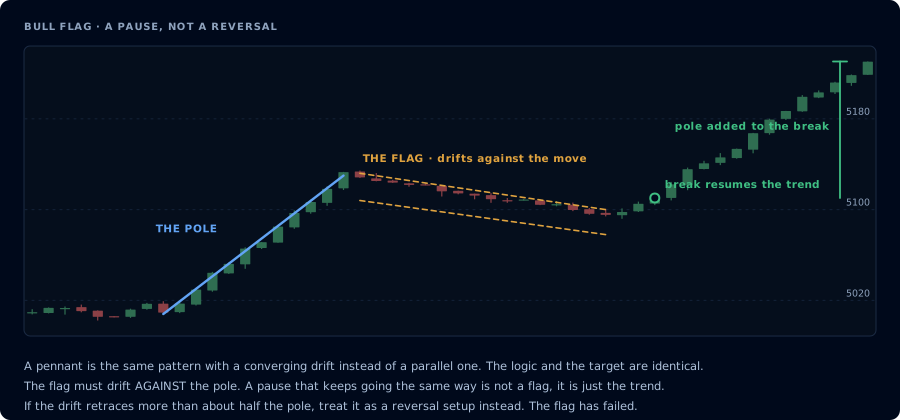
The drift has to lean against the pole. Anything else is just the trend continuing.
Anatomy of a flag
Two parts:
- The pole — a sharp, high-momentum move (often 5+ bars in one direction)
- The flag — a tight, sloping consolidation against the pole's direction
Bull flag: pole up, flag drifts down. Bear flag: pole down, flag drifts up.
The flag's slope is opposite the pole's direction. A small countertrend pause, not a real reversal — that's why it tends to break in the original direction.
Anatomy of a pennant
Same idea as a flag, but the consolidation is a small symmetrical triangle rather than a parallel channel. The boundaries converge instead of running parallel.
Pennants tend to be tighter and shorter than flags. Both work the same way in trading terms.
How to trade them
Setup.
- Identify the pole — clean, fast, strong move
- Wait for the consolidation to form — typically 5-15 bars
- The consolidation should be on lower volume than the pole
- Mark the upper and lower boundaries
Entry. On a close beyond the consolidation in the direction of the pole. Don't anticipate — wait for the break.
Stop. Inside the flag/pennant — typically below the lowest low (for bull) or above the highest high (for bear). Tight by design.
Target. Classic measured move = the height of the pole, projected from the breakout point in the direction of the pole.
So if the pole was a 30-point move and the breakout fires at 5,000, target = 5,030.
Why they have high win rates
Flags and pennants only form in already-trending environments. By the time you see one, the trend has done you the favor of confirming itself. You're trading with the trend, not against it.
Compare to reversal patterns (H&S, double tops) which require betting against the existing direction — those are inherently lower-probability bets.
Realistic stats
For confirmed flags/pennants in established trends:
- Win rate: 65–75%
- Average move to target: ~85% of measured move
- Typical R:R: 3:1 to 5:1 (pole height ÷ flag width)
- Failure rate: 25–35%, mostly when the broader trend has already exhausted
These numbers assume proper confirmation. Anticipating the breakout cuts the win rate significantly.
Validation criteria
- Strong pole. If the pole isn't sharp and clean, it isn't a flag. Don't pattern-match weak moves.
- Tight consolidation. Wide, sloppy ranges are not flags. Real flags are tight.
- Lower volume during the flag. Volume should drop noticeably during the consolidation. If volume stays elevated, the pattern is suspect.
- Breakout volume. A clean break should come on a surge of volume (returning to pole-level participation).
- Time. Flags last 5–15 bars usually. If consolidation extends past 20 bars, it's a different pattern (range, not flag).
Common mistakes
- Trading flags in chop. Without a pole, it's not a flag — it's a range. Trade ranges differently.
- Anticipating the breakout. "I think this flag will break up" → enter early → flag breaks down → loss. Wait for confirmation.
- Holding past the measured move. The classic target is reasonable. Holding past it without a new continuation pattern is greed.
- Using flag breakouts on news bars. Pre-news consolidations often look like flags but resolve based on the news, not the technical setup. Skip these.
Frequently Asked Questions
What's the difference between a flag and a pennant?
A flag has parallel upper and lower boundaries (looks like a small channel). A pennant has converging boundaries (a small symmetrical triangle). Both work the same way and have similar win rates. Pennants tend to be slightly tighter and shorter.
Can a flag fail?
Yes, about 25-35% of the time. Failures usually happen when the broader trend is already exhausted and the flag is forming late in the move. A flag in the third or fourth wave of a multi-week trend is more failure-prone than a flag in the first wave.
What time frame is best for flag patterns?
Flags appear on every timeframe but work best on the timeframe that gave you the pole. A 5-minute pole produces a 5-minute flag. Don't try to read flags on a different timeframe than the trend impulse — you'll see false patterns or miss real ones.
How do I identify a 'good' pole?
A strong pole is sharp, fast (5+ same-direction bars), on heavy volume, and ideally tied to a meaningful catalyst (news, breakout from a level, opening drive). Slow, choppy 'poles' produce weak flags.