Head and Shoulders Pattern
Head and Shoulders (H&S) is a three-peak reversal pattern: a left shoulder, a higher head, then a right shoulder roughly equal to the left. The "neckline" connects the two valleys. A confirmed neckline break — with volume — signals the prior uptrend is exhausted. Inverse H&S is the same pattern flipped, signaling reversal of a downtrend.
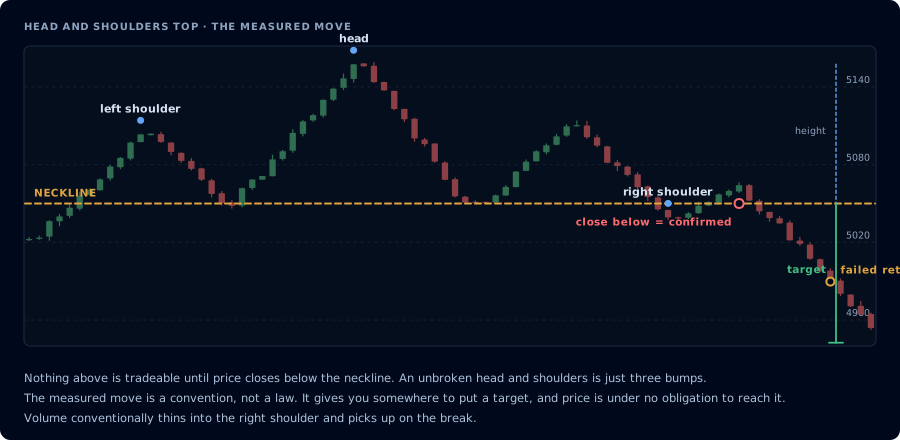
Three bumps until the neckline breaks. The break is the pattern.
What it looks like
Three peaks, in order:
- Left shoulder — a high in an uptrend, followed by a pullback
- Head — a higher high than the left shoulder, followed by another pullback
- Right shoulder — a lower high than the head (often roughly the same height as the left shoulder), followed by a break of the neckline
The neckline is a line drawn through the two valleys between the shoulders and head. It can be horizontal or slanted — slope doesn't disqualify the pattern.
Why it works
The progression tells a story:
- Left shoulder = bulls still in control, normal pullback
- Head = bulls push to a new high, but the pullback is similar in size to the prior one — suggesting weakening momentum
- Right shoulder = bulls fail to make a new high, signaling buying exhaustion
- Neckline break = sellers take control, reversal confirmed
It's a visual representation of distribution — large players unloading positions over the formation period.
How to trade it
Entry. Two schools:
- Confirmation entry: Wait for a close beyond the neckline. Lower risk, later entry.
- Anticipation entry: Short into the right shoulder peak. Higher risk, better R:R if it works.
Stop. Above the right shoulder high (for a bearish H&S short). Below the right shoulder low for an inverse H&S long.
Target. The classic measured move: height of the head above the neckline, projected down from the neckline break. So if the head is 50 points above the neckline, the target is 50 points below the neckline.
Realistic stats
From multiple decades of pattern research:
- Bearish H&S (in confirmed downtrends after the break): wins about 55–65% of the time
- Inverse H&S (after confirmed neckline break): similar 55–65%
- Average move to target: about 80% of the projected measured move
- Failure rate: roughly 35–45%, with most failures being neckline breaks that immediately reverse
It is not a sure thing. The pattern is widely watched, which means failures are often quickly faded by traders expecting it to work. Don't oversize.
Key validation criteria
Not every three-peak structure is a valid H&S. Check:
- Pre-existing trend. H&S only counts as reversal if there's a prior trend to reverse. Three peaks in chop = noise.
- Volume profile. Classic textbook says volume should decline on the head, with the heaviest volume on the neckline break. In modern futures, this often holds but isn't always clean.
- Symmetry. Right shoulder should be roughly the same height as left shoulder. Wildly asymmetric patterns are weaker.
- Time frame. H&S on daily charts works much better than on 1-minute charts. The shorter the timeframe, the more noise patterns you'll see.
Common failure modes
- Right shoulder higher than head. Pattern is invalidated — this is often a continuation, not reversal.
- Neckline break with no follow-through. Price breaks but immediately recovers above the neckline. Often a stop-hunt failure pattern. Honor your stop.
- Multiple necklines. If you have to twist the neckline to make the pattern fit, it isn't a clean H&S.
Frequently Asked Questions
What's the difference between head and shoulders and inverse head and shoulders?
Same pattern, opposite direction. H&S forms at the top of an uptrend and signals a bearish reversal (three peaks with the middle highest). Inverse H&S forms at the bottom of a downtrend and signals a bullish reversal (three valleys with the middle lowest). Trading rules mirror.
How reliable is the head and shoulders pattern?
Roughly 55–65% accuracy when fully confirmed by a neckline break with follow-through. Failure rate is 35–45%, often from premature breakouts that get faded. The pattern is one of the higher-quality classical patterns but is not a sure thing.
Where do I place a stop on a head and shoulders trade?
On a bearish H&S short, place the stop above the right shoulder high. On an inverse H&S long, place the stop below the right shoulder low. The right shoulder is the natural invalidation level — if price breaks back through it, the pattern is failing.
What's the target on a head and shoulders trade?
The classic measured move is the height of the head above the neckline, projected from the neckline break in the direction of the trade. Real-world fills often hit ~80% of this target rather than the exact level.