Rectangle Patterns
A rectangle is a horizontal consolidation between fixed support and resistance — price bouncing between two parallel levels. Two ways to trade: range-bound (fade the boundaries) while it holds, breakout when it eventually breaks. Direction of the breakout is biased toward the prior trend, but rectangles are the most direction-ambiguous pattern.
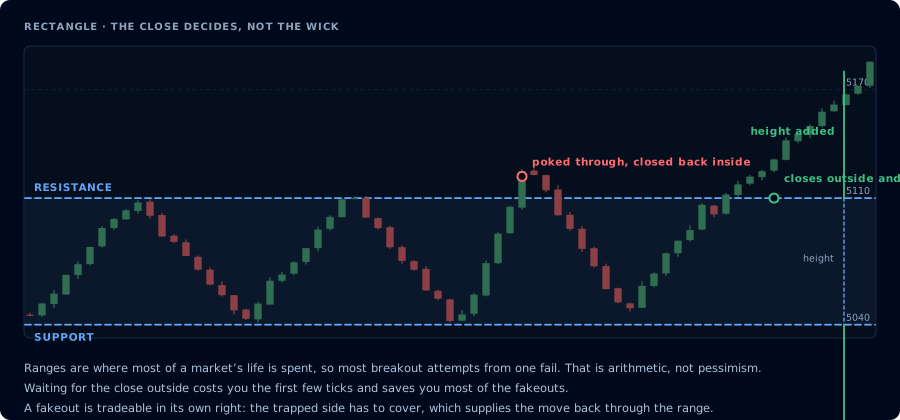
A poke through is not a break. The close decides which of these two you are in.
What forms a rectangle
A rectangle requires:
- At least 2 swing highs at roughly the same price (defining resistance)
- At least 2 swing lows at roughly the same price (defining support)
- Multiple bounces between the two — usually 4-6 visits to either side
- Roughly horizontal boundaries (not sloping)
The longer the rectangle persists and the more times each boundary is tested, the stronger the eventual breakout tends to be.
Two ways to trade
Range trading.
- Buy near support, sell near resistance
- Stop just outside the boundary (inside the range = wrong)
- Target = opposite boundary
- Win rate ~60-70% but small R:R per trade
Breakout trading.
- Wait for a close beyond the boundary
- Enter on the close
- Stop = inside the rectangle (typically the midpoint or the recent swing inside the range)
- Target = measured move (height of the rectangle, projected from the breakout)
- Win rate ~55-65% but larger R:R
Most traders specialize. Picking one approach and sticking with it beats trying to switch mid-rectangle.
Direction bias
Rectangles don't predict direction as cleanly as triangles or wedges. The bias rules:
- In a strong uptrend → breakout tends to be upward (continuation)
- In a strong downtrend → breakout tends to be downward (continuation)
- In a chop / no trend → ~50/50
This is why rectangles in clear trends are higher-conviction pattern setups than rectangles forming in random consolidations.
False breakouts are common
Rectangles produce more false breakouts than other patterns because so many traders watch the boundaries for breakout signals. Stop-runs above resistance and below support happen frequently before the actual move.
Two filters to reduce false signals:
- Require a candle close beyond the boundary, not just a wick. Wick-only "breakouts" reverse 50%+ of the time.
- Wait for a retest — after the breakout, price often comes back to test the broken level. A successful retest (price rejects the level and continues) is high-conviction.
The trade-off: waiting for a retest gets you in late but with much higher win rates.
Realistic stats
For confirmed rectangle breakouts (with close beyond boundary):
- Trend-aligned breakouts: 65–75% follow-through
- Counter-trend breakouts: 45–55% follow-through (often stop-runs that fade back)
- Range trading inside rectangles: 60–70% win rate, modest R:R
- Average breakout move: 75-85% of measured move
The asymmetry between trend-aligned and counter-trend breakouts is large. If you're going to trade rectangle breakouts, weight heavily toward those aligned with the broader trend.
How to size a rectangle
The "height" of a rectangle is the distance between support and resistance. This determines:
- Position size when range trading (smaller heights = wider position size at fixed dollar risk)
- Measured move target when breakout trading
- Realistic profit potential of the entire setup
Tight rectangles (small height) = many trades, small per-trade profit. Wide rectangles = fewer trades, larger per-trade profit.
Common mistakes
- Trading every bounce inside a rectangle. The middle of the range is dead zone — no edge. Only trade at the boundaries.
- Using overly tight stops on breakouts. Stops 1 tick beyond the boundary get hunted by stop-runs. Allow a 1-2 ATR buffer.
- Missing the regime shift. Once a rectangle breaks decisively and follows through, range-trading rules no longer apply. Don't try to fade the new trend.
- Overstaying inside the rectangle. A rectangle that has tested its boundaries 8-10 times is mature. The eventual breakout becomes more likely with each test, not less.
Frequently Asked Questions
What's the difference between a rectangle and a triangle?
Rectangles have horizontal upper and lower boundaries (parallel support and resistance). Triangles have at least one converging line. Rectangles signal indecision or pause; triangles signal compression with directional bias depending on which side of the triangle is sloping.
Are rectangles bullish or bearish?
Neither, by themselves. A rectangle inherits the bias of the prior trend — bullish in an uptrend, bearish in a downtrend. In a chopping market with no clear prior trend, rectangles have no directional bias and breakouts are roughly 50/50.
How long should a rectangle take to form?
Valid rectangles typically span 20-100+ bars and have at least 4-6 boundary touches. Shorter consolidations are usually flags or pennants. Longer consolidations may evolve into more complex bases (cup-and-handle, multi-month accumulation patterns).
How do I avoid false breakouts on rectangles?
Require a closing break beyond the boundary (not just a wick). Wait for a retest of the broken level for higher conviction. Trade only breakouts aligned with the broader trend. Allow stop-loss buffer beyond the boundary to survive stop-hunts.