Rounding Patterns
A rounding bottom (also called a "saucer") is a slow, U-shaped reversal pattern that takes weeks or months to form — gradual decline, broad consolidation, gradual recovery. The rounding top (inverse saucer) is the bearish mirror. They're the slowest reversal patterns in technical analysis but among the highest-conviction when they complete. Almost exclusively useful on weekly and monthly charts.
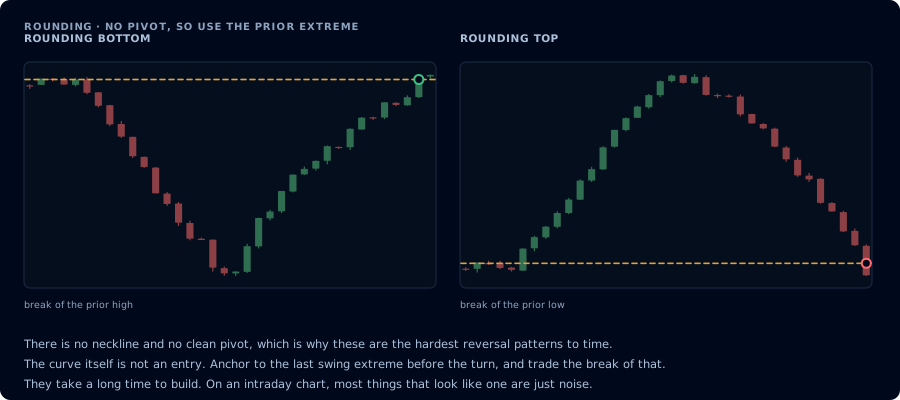
No pivot to anchor to, so the prior swing extreme becomes the confirmation.
What the pattern looks like
Rounding bottom (saucer).
- Price gradually declines from a high
- Decline rate slows, price flattens out at a "base"
- Price gradually starts to recover
- Eventually breaks above the level where the original decline began
The progression is smooth — not sharp like a V-bottom. The whole pattern looks like a shallow bowl or saucer.
Rounding top. Mirror image — gradual rally that flattens and rolls over into a gradual decline.
How long it takes
These are not intraday patterns. Real rounding bottoms take:
- Days/weeks on hourly charts (rare and rough)
- Weeks to months on daily charts (occasional)
- Months to years on weekly/monthly charts (most common)
If you see a "rounding bottom" on a 5-minute chart, it's probably just a curve in chop, not a real pattern.
Why rounding patterns matter
The slow, gradual nature reflects a regime shift rather than a sharp event. The market is gradually shifting from sellers in control to buyers in control (or vice versa) without any single dramatic catalyst.
Major bear markets often end with rounding bottoms — months of base-building before the next bull market begins. Major tops often roll over into rounding tops over a similar timeframe.
These patterns capture structural changes, not just technical setups. When they confirm, the moves that follow can be huge.
How to trade them
Entry. On a close above the prior high (for rounding bottoms) or below the prior low (for rounding tops). Some traders enter as the pattern matures, but the highest-conviction entry is the breakout above/below the formation's highest/lowest extreme.
Stop. Below the lowest point of the pattern (for longs) — though this is often a very wide stop because rounding patterns are large.
Target. Highly variable. Many rounding patterns precede multi-month or multi-year trends, so trailing stops often outperform fixed targets. A measured move from the pattern depth is a starting reference, but the real edge is in holding the trend that follows.
Realistic stats
For confirmed rounding bottoms on weekly/monthly charts:
- Win rate (price continues higher after breakout): 70–80%
- Average move: significantly larger than measured-move targets — often 200%+ of pattern depth over multi-month periods
- Failure rate: 20–30%, often when broader macro conditions reverse
These are the highest win-rate reversal patterns by most studies, but they take patience to form and longer to trade out.
Validation criteria
- Smoothness. A real rounding pattern is smooth, not jagged. If price made sharp swings inside the formation, it's not a true rounding pattern.
- Time scale. Long-form patterns on weekly/monthly charts. Anything claiming to be a rounding pattern on a fast intraday chart is suspect.
- Volume profile. Volume often declines through the bottom of the saucer and expands as the recovery begins. This isn't always clean but supports the pattern when present.
- Structural shift. A rounding bottom that ends a multi-year bear market is more meaningful than one that pops up in a normal market regime.
Common mistakes
- Calling rounding patterns intraday. They don't exist meaningfully on minute charts. Stop trying to find them there.
- Entering too early. "I think this is forming a rounding bottom" → entry inside the formation → multi-month sideways pain. Wait for confirmation breakout.
- Tight stops. The pattern is wide by definition. Stops have to be wide too. Either size positions accordingly or skip the setup.
- Setting fixed targets. Rounding bottoms often launch trends much larger than measured moves predict. Trailing stops capture more.
Frequently Asked Questions
Can a rounding bottom form intraday?
Almost never in a meaningful way. Rounding patterns require time for the regime shift they represent — that takes days, weeks, or months. Intraday curves that look like rounding patterns are typically just consolidations in chop, not true reversals.
How is a rounding bottom different from a double bottom?
A double bottom has two distinct lows at roughly the same price. A rounding bottom is smoother — many prices hit roughly the same low without two clearly separated valleys. Rounding patterns also take longer to form (weeks/months vs. days).
How reliable are rounding bottoms?
When confirmed by a breakout above the pattern's prior high, rounding bottoms have one of the highest reliability rates in technical analysis — 70-80% follow-through. The trade-off is they take much longer to develop than other reversal patterns.
Where do I set a target for a rounding bottom?
Measured-move targets often underestimate. Many rounding bottoms precede multi-month trends that go far beyond simple measured-move projections. Use a trailing stop (e.g., weekly close below the 20-week EMA) instead of a fixed target to capture the full move.