Triangle Patterns
Triangles form when price consolidates into a narrowing range — lower highs against rising lows, or vice versa. The three types are ascending (flat top, rising bottom), descending (flat bottom, falling top), and symmetrical (both lines converging). Triangles signal that volatility is compressing and a breakout is statistically near. Direction depends on type and prior trend.
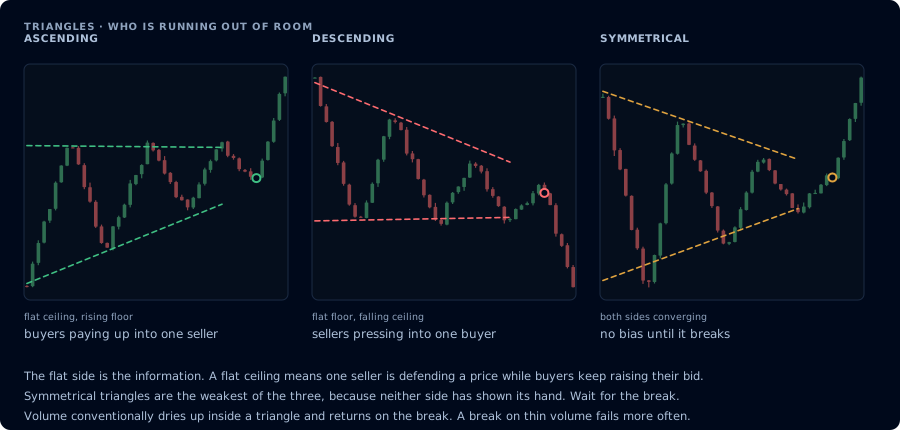
The flat side is the information: it shows who is defending a price and who is chasing.
The three triangles
Ascending triangle. Horizontal resistance at the top, rising trendline at the bottom. Each pullback makes a higher low while resistance holds. Buyers accumulating against a fixed selling level. Bullish bias — typically breaks upward.
Descending triangle. Horizontal support at the bottom, falling trendline at the top. Each rally makes a lower high while support holds. Sellers distributing while buyers defend a fixed level. Bearish bias — typically breaks downward.
Symmetrical triangle. Both lines converging — lower highs and higher lows. Indecision; could break either direction. Direction depends on the prior trend (continuation pattern in established trends).
Why they form
Compression. Two opposing forces are squeezing the price range. Eventually one side wins and the breakout fires.
In ascending triangles, sellers are repeatedly defending the same level but the floor under buyers keeps rising — the market is willing to pay more each pullback. That asymmetry usually resolves with buyers winning.
Descending triangles invert this: floor under sellers keeps falling while ceiling holds. Sellers gradually win.
Symmetrical triangles have no such asymmetry — both sides give ground equally. The prior trend is the tiebreaker.
How to trade triangles
Entry. Wait for a close beyond the triangle boundary. Don't enter inside the triangle anticipating a direction.
Stop. Inside the triangle, opposite the breakout. For a bullish ascending triangle break, stop just below the rising trendline at the breakout bar.
Target. Measured move = the height of the triangle at its widest point, projected from the breakout. So a triangle 30 points wide breaking up at 5,000 → target 5,030.
Realistic stats
| Triangle type | Win rate | Typical bias |
|---|---|---|
| Ascending | 60–70% upward | Bullish continuation |
| Descending | 60–70% downward | Bearish continuation |
| Symmetrical | 55–65% in trend direction | Continuation in prior trend |
The prior-trend bias matters. An ascending triangle in an established uptrend has a higher win rate than the same pattern in chop. Triangles that form against the trend are less reliable.
False breakouts
The most common triangle failure is the false breakout: price breaks the triangle, retraces back inside, then breaks the opposite direction. Often called a "spring" or "shakeout."
To filter false breakouts:
- Require a candle close beyond the boundary, not just a wick
- Require volume on the breakout bar (volume should expand)
- Wait for retest — in the strongest breakouts, price comes back to the boundary then continues. A retest that holds is high-conviction.
The trade-off: waiting for retest gets you in at a worse price but improves win rate.
Time and apex
A triangle's "apex" is where the two boundary lines would intersect if extended. Most triangles break before reaching the apex. As a rule of thumb:
- Breakouts in the first 50% of triangle length = strongest
- Breakouts in 50–75% = normal
- Breakouts after 75% = weak; pattern is losing energy
Triangles that compress all the way to the apex without breaking often resolve as continuation in the prior trend's direction but with low conviction.
Common mistakes
- Drawing triangles on wicks. Use closing prices for the boundaries when possible. Wick-based triangles fit too many patterns.
- Trading every triangle. In a chopping market, every consolidation looks like a triangle. Filter for prior-trend context.
- Ignoring volume. A breakout on dead volume is suspect. Real breakouts have participation.
- Holding past the measured move. Take the target. Don't get greedy on a continuation pattern — find a new setup for the next leg.
Frequently Asked Questions
Do ascending triangles always break upward?
No — they have a bullish bias (about 60–70% upward), but ~30% break downward. The bias is statistical, not deterministic. Always wait for the actual breakout direction before entering, and place your stop on the opposite side of the triangle.
What's the difference between a triangle and a pennant?
A pennant is a small, short symmetrical triangle that forms after a sharp pole move. A symmetrical triangle is generally larger and forms without a preceding pole. Pennants are continuation patterns in already-established trends; triangles can be continuation OR consolidation patterns.
How long should a triangle take to form?
Valid triangles typically span 10–50 bars. Shorter than 10 bars is usually a flag or pennant. Longer than 50 bars suggests the consolidation has matured into a range rather than a triangle. Most reliable: 15-30 bars.
What if the triangle breaks then immediately reverses?
That's a false breakout — common enough that experienced traders use them as setups. A break above the upper boundary that closes back below within 1-3 bars often signals a strong move in the opposite direction. The reversal trade has the original triangle's stop available — high R:R.