Wedge Patterns
A wedge is a triangle where both boundaries slope in the same direction. Rising wedges (both lines sloping up) signal bearish reversal — typically break downward. Falling wedges (both lines sloping down) signal bullish reversal — typically break upward. The key insight: even though price is making new highs (in a rising wedge), the rate of advance is slowing, signaling exhaustion.
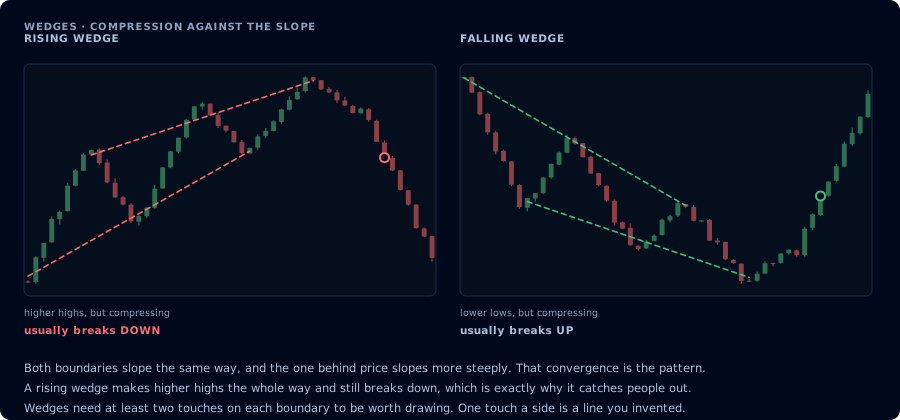
A rising wedge makes higher highs the whole way and still breaks down.
The two wedges
Rising wedge. Higher highs and higher lows, but the lines converge — meaning the lows are rising faster than the highs. Volatility is compressing on the upside. Often appears at the top of an uptrend or as a bear-flag-style countertrend pause inside a downtrend.
Falling wedge. Lower lows and lower highs, but the lines converge — the highs are falling faster than the lows. Volatility is compressing on the downside. Appears at the bottom of a downtrend or as a bull-flag-style countertrend pause inside an uptrend.
Why wedges signal reversal (usually)
The narrowing range while still trending tells you momentum is fading. Each new swing in the trend direction is smaller than the previous, while the counter-swings are not shrinking as much.
In Elliott Wave theory, wedges often appear as "ending diagonals" — the final exhaustion move before a major reversal.
In practical terms:
- Rising wedge in an uptrend = upside momentum exhausted → bearish reversal likely
- Falling wedge in a downtrend = downside momentum exhausted → bullish reversal likely
When wedges are continuation, not reversal
Wedges in counter-trend pullbacks can be continuation patterns:
- Falling wedge in an uptrend = a pullback that's losing steam → continuation upward
- Rising wedge in a downtrend = a counter-rally losing steam → continuation downward
This dual interpretation is what makes wedges trickier than pure triangles. Always read the wedge in the context of the broader trend.
How to trade them
Entry. Wait for a close beyond the wedge boundary. Anticipating the breakout has a worse win rate.
Stop. Inside the wedge, opposite the breakout direction. Wedge stops are tighter than triangle stops because the pattern is narrower.
Target. Two common methods:
- Measured move = the height of the wedge at its widest point, projected from breakout
- Major prior swing — wedges often retrace the entire prior move that built them. If a rising wedge forms after a 100-point uptrend, the breakdown often retraces all 100 points.
The second target is more aggressive but historically more accurate for reversal wedges.
Realistic stats
For confirmed wedges with proper trend context:
- Rising wedge (bearish): 60–70% downward break
- Falling wedge (bullish): 65–75% upward break
- Average move: 70-80% of measured move; ~50% of "major prior swing" target
- Failure rate: 25–35%, often when the broader trend is strong enough to overpower the exhaustion signal
Falling wedges have a slight edge in win rate over rising wedges in most studies — possibly because traders are quicker to fade obvious bearish patterns.
Validation criteria
- Both lines slope the same direction. If one's flat, it's a triangle, not a wedge.
- Lines converge. Parallel lines = a channel, not a wedge.
- At least 3 touches per line. Two-touch patterns aren't validated.
- Volume declines through the wedge. Pattern integrity is stronger when volume tapers.
- Trend context. Read whether it's reversal or continuation based on what came before.
Common mistakes
- Calling every consolidation a wedge. Not every narrowing range is a true wedge — both lines must slope the same way and converge.
- Trading without trend context. A rising wedge in a downtrend is continuation, not reversal. Wrong context → wrong direction → loss.
- Tight stops just inside the wedge. Fast wedge breaks often retest the boundary before continuing. Place stops with a buffer.
- Holding too long for the "major prior swing" target. Take partial profits at the measured move, trail the rest.
Frequently Asked Questions
Rising wedge — bullish or bearish?
Bearish. Even though price is making new highs, the narrowing range and slowing rate of advance signal momentum exhaustion. Rising wedges typically break downward 60–70% of the time when properly identified in an uptrend.
Falling wedge — bullish or bearish?
Bullish. The narrowing downtrend with shrinking lower lows signals seller exhaustion. Falling wedges typically break upward 65–75% of the time. Slightly more reliable than rising wedges by most studies.
What's the difference between a wedge and a triangle?
Triangles have at least one horizontal boundary (or boundaries sloping in opposite directions). Wedges have both boundaries sloping the same direction. The visual difference matters because wedges signal exhaustion of the trend they're built in, while triangles signal compression that can resolve either way.
Do wedges need to form at the end of a trend?
For reversal interpretation, yes — wedges at trend extremes are the classic setup. Wedges that form mid-trend (counter-trend pullbacks) are continuation patterns in the original trend direction, not reversal signals. Trend context determines interpretation.