What is Futures Contract Rollover?
Every futures contract has an expiration date. To stay exposed to the underlying market past that date, traders roll their position: close the expiring contract and open a matching one in the next expiration month. For equity index futures (ES, NQ, YM, RTY), this happens quarterly, on the Thursday before the third Friday of the expiration month.
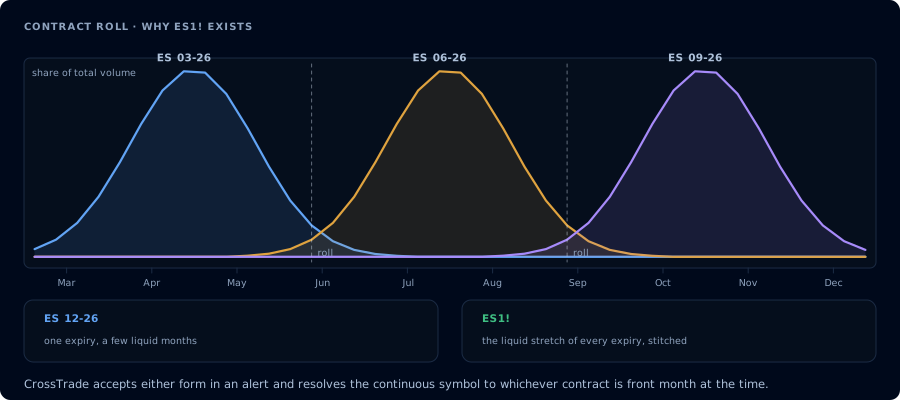
Volume migrates each quarter, which is why a single contract runs out of history.
The terminology
- Front month — the contract closest to expiration; typically has the most volume
- Back month — contracts with later expiration dates
- Roll date — the day most volume migrates from the expiring contract to the next
- Expiration date — the final trading day of the contract
Futures symbols include a letter/year code: ESM25 = ES June 2025 contract. ESU25 = ES September 2025. The letters follow the CME month code:
| Month | Code |
|---|---|
| January | F |
| February | G |
| March | H |
| April | J |
| May | K |
| June | M |
| July | N |
| August | Q |
| September | U |
| October | V |
| November | X |
| December | Z |
Equity index futures trade quarterly — H, M, U, Z.
The quarterly roll — ES, NQ, YM, RTY
Equity index contracts expire on the third Friday of March, June, September, December. But volume starts migrating about 8 days before expiration — the Thursday prior. That's the "roll day."
The roll process:
- Monday of roll week — front month is still dominant, but volume in the next month starts growing
- Thursday of roll week (≈8 days before Friday expiration) — volume officially migrates; the next month becomes the new front month
- Third Friday — expiring contract settles; any open positions cash settle at the final settlement price
If you're in a contract the Thursday of roll week, roll it. Don't hold a contract with declining liquidity.
How to roll a position manually
The old-school method:
- Close your position in the expiring contract (sell if long, buy to cover if short)
- Open the same direction in the next month at market
The risk: between the two orders, the spread between months can move. Most brokers offer a calendar spread order — buy one month, sell another, simultaneously. This eliminates leg risk and is typically what professionals use.
How to roll automatically
NinjaTrader has a "Rollover" checkbox that automatically switches data feeds and re-points open positions to the new contract on roll day. Enable it per instrument.
TradingView has continuous contracts (ES1! = "continuous ES"). When you set an alert on ES1!, TradingView tracks the front month and automatically adjusts signals at the roll. Your alerts keep firing across the rollover.
CrossTrade webhooks reference an instrument by explicit contract month (instrument=ES 12-26). After rollover, update the payload to instrument=ES 03-27 on or before the roll date. Some traders use an "instrument" field that CrossTrade interprets dynamically — check the CME instrument syntax guide.
What happens if you forget to roll
Depends on the contract type:
Cash-settled (ES, NQ, YM, index futures, Treasuries): the contract settles to a reference price at expiration. You receive or pay the dollar difference. No physical delivery.
Physically delivered (CL, GC, agricultural commodities): if you hold past first notice day, you may be obligated to take delivery of actual barrels, ounces, or bushels. Brokers auto-liquidate retail accounts before first notice — but this can still result in unplanned exits at unfavorable prices. Know your contract's first notice day.
Most brokers also force-close positions before cash-settlement expiration to prevent accounts from holding expired contracts. Don't rely on this; manage it yourself.
Rollover and charts
Historical charts are continuous by default (ES1! stitches front-month data across rollovers). This stitching uses one of two methods:
- Unadjusted — raw prices from each contract concatenated; creates visible gaps at each roll where the new contract's price differs from the old
- Adjusted (back-adjusted) — historical prices shifted so roll-day gaps disappear; creates a smooth continuous line but prices don't match what traders actually saw
For intraday trading, this rarely matters. For long-horizon backtesting, use back-adjusted data or the rollover gaps will invalidate your equity curve.
Roll-day volatility
Don't expect big directional moves from the roll itself — the spread between months is usually stable. But on roll day, both contracts are actively traded and sometimes one can whipsaw while the other is quieter. Stick to the higher-volume contract for execution quality.
Common mistakes
- Holding the wrong contract into expiration. The Thursday before expiration is the roll day. Be in the next month by then.
- Ignoring back-adjustment in backtests. Unadjusted continuous data produces artificial gaps and wrong P&L on multi-year backtests.
- Forgetting to update CrossTrade payloads. If your webhook references a specific expiration month, update it on roll day. A stale contract month might fail or route to a thin back-month.
Frequently Asked Questions
When do ES futures roll over?
ES rolls on the Thursday eight days before the third-Friday expiration of March, June, September, December. On that Thursday, most volume migrates from the expiring contract to the next one. By expiration Friday, liquidity in the old contract is nearly zero.
Do I have to roll my futures contracts?
Only if you want to stay in a position past expiration. If you're flat, there's nothing to roll. For cash-settled contracts, forgetting to roll results in automatic settlement — no delivery risk but you'll lose your position. For physically-delivered contracts, rolling on time is essential.
What's the difference between front month and back month?
The front month is the nearest-expiration contract that currently holds most trading volume — it's what you usually trade. Back months are future expirations with less volume. Price differences between front and back months create the 'term structure' or 'futures curve.'
Can I trade the same contract through rollover without closing?
No — each contract month is a separate symbol. You close the expiring one and open a new one in the next month. Calendar spread orders let you do both simultaneously, which is the cleanest way to roll.