Day Margin vs Overnight Margin
Day margin is the reduced amount a broker requires to open a futures position during the session, provided you close it before the day-session cutoff. Overnight margin is the CME-set requirement for holding a position through the settlement window. Day margins can be 5–10× lower than overnight, but if you hold past the cutoff, you're instantly subject to the full overnight requirement — often resulting in a forced liquidation.
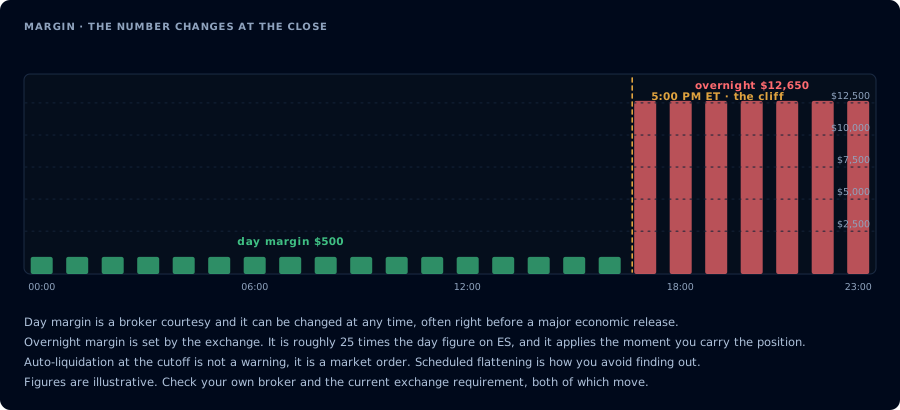
The requirement jumps roughly 25x at the close. Auto-liquidation is a market order.
The two margin numbers
Initial margin (exchange-set, overnight) — the minimum equity CME requires to open and hold a position. Set by the exchange, not the broker. Recalculated weekly based on volatility.
Day-trading margin (broker-set, intraday only) — a reduced margin offered for positions closed within the day session. Brokers extend this because intraday positions get squared up before the market closes — reducing their overnight exposure.
Example for ES (approximate, early 2026):
| Margin Type | Amount |
|---|---|
| Exchange initial (overnight) | ~$13,000 |
| Broker day margin | $400–$1,500 |
| Ratio | ~10:1 |
That's why retail futures trading is so accessible — the day margin is a fraction of the overnight requirement.
Why overnight margin is so much higher
Overnight, markets can gap. A geopolitical event, Fed statement, or earnings surprise can move futures 2–5% while most traders are asleep. The exchange sets overnight margin to cover a 2-day worst-case move — enough cushion to absorb a gap without breaking the clearing firm.
Day margin exists because intraday moves are capped: the CME has daily price limits, fast market circuit breakers, and the session is short. The broker can afford to extend lower margin.
The day-session cutoff
Every broker sets a specific time before market close when positions must be closed or automatically upgraded to overnight margin requirements. Common cutoffs:
- 3:45 pm ET for ES, NQ (15 minutes before the 4:00 pm close)
- 15–30 minutes before the 4:59 pm close for CL, GC
- Varies by broker and contract
If your day-margin position is still open at the cutoff and your account doesn't have the full overnight margin available, the broker will auto-liquidate the position (sometimes with a margin call fee). This is one of the most common accidents in futures trading — traders plan to close before the cutoff, get distracted, and come back to a force-liquidated account.
Mitigation: set an alert 10 minutes before the cutoff, or use a time-based auto-flatten order. CrossTrade's Account Manager can auto-flatten a position at a specified time — see the auto-flattening docs.
How to check your broker's margin
Every broker publishes a futures margin table. Common names:
- NinjaTrader Brokerage, Tradovate, AMP, Discount Trading, Optimus, Interactive Brokers, Edge Clear
Look for:
- Initial margin (overnight)
- Maintenance margin (overnight)
- Intraday / day-trading margin
- Any "volatility-based" margin surcharges during earnings, Fed days, major announcements
Brokers change margins when volatility spikes. Your $500 ES day margin can become $1,500 overnight if the VIX jumps. Watch for broker emails on these changes.
Margin calls
If your equity drops below maintenance margin (typically 90% of initial), the broker issues a margin call:
- Add funds, or
- Reduce position, or
- Be auto-liquidated at the broker's discretion
Auto-liquidation is brutal — brokers prioritize getting flat at any price. You often get worse fills than you'd get closing voluntarily. Never let it happen.
The psychological trap
Low day margins make it easy to over-leverage. A new trader sees "I only need $400 to trade one ES" and opens three contracts in a $5,000 account — suddenly controlling $750,000 of notional. One bad day wipes out the whole account.
Day margin is what the broker requires; it is not what risk management says you should commit. Size positions by dollar risk on the stop, not by "how many can I afford per the margin requirement." See Position sizing for futures.
Pattern day trader rule — does it apply?
No. The PDT rule is an SEC rule for stock and options accounts under $25,000. Futures are regulated by the CFTC and have no equivalent day-trading restriction. You can day-trade futures with any account size — though below $5,000 is realistically impossible given volatility and required risk per trade.
Frequently Asked Questions
What's the difference between day margin and overnight margin?
Day margin is the reduced capital a broker requires for intraday-only positions, closed before the session cutoff. Overnight margin is the full CME-set requirement for positions held through settlement. Day margin is typically 5–10× lower than overnight.
What happens if I hold a futures position past the day-margin cutoff?
Your position is instantly subject to full overnight margin. If your account doesn't meet that requirement, the broker auto-liquidates the position at market — often at unfavorable prices. This is a common and preventable accident. Set alerts and use auto-flatten rules.
Can I trade futures with a small account?
Technically yes — day margins on micros (MES, MNQ) can be $50–$150. Practically, an account below $5,000 can't absorb normal drawdowns. A realistic minimum for serious futures trading is $10,000+ on micros or $25,000+ on standards.
Does the PDT rule apply to futures?
No. The Pattern Day Trader rule is an SEC rule for equities. Futures fall under CFTC jurisdiction and have no PDT equivalent — you can day-trade them in any account size. You still need enough capital to withstand losses, though.