ES vs MES — Which E-mini Should You Trade?
ES is the standard E-mini S&P 500 futures contract, valued at $50 per index point. MES is the micro version, valued at $5 per point — exactly 1/10 the size. MES is the better starting point for most retail traders: smaller per-trade risk, lower margin, and the ability to scale up gradually. Serious volume lives in ES, but MES is more than liquid enough for retail.
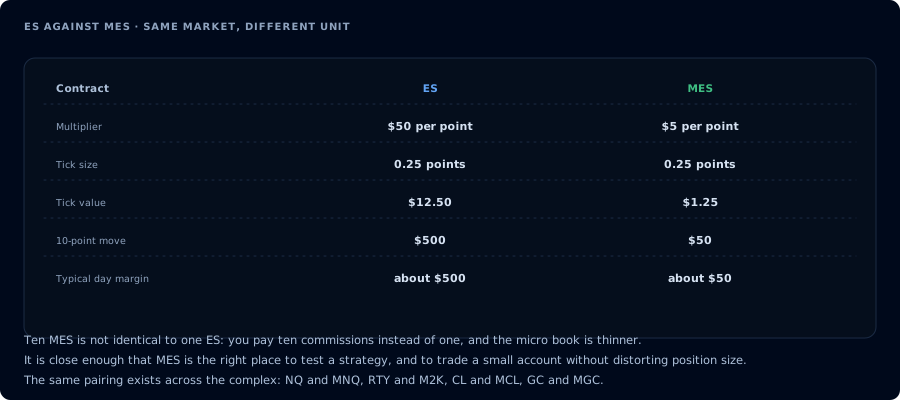
Same index, same chart, one tenth of the multiplier.
The side-by-side
| Spec | ES (E-mini S&P 500) | MES (Micro E-mini S&P 500) |
|---|---|---|
| Ticker | ES | MES |
| Point value | $50 | $5 |
| Tick size | 0.25 index points | 0.25 index points |
| Tick value | $12.50 | $1.25 |
| Notional @ 5,000 | ~$250,000 | ~$25,000 |
| Exchange | CME | CME |
| Trading hours | Sun 6pm – Fri 5pm ET | Sun 6pm – Fri 5pm ET |
| Expiration | Quarterly (H,M,U,Z) | Quarterly (H,M,U,Z) |
| Settlement | Cash | Cash |
| Typical day margin | $400–$1,500 | $40–$150 |
| Typical overnight margin | ~$13,000 | ~$1,300 |
Margins vary by broker and market volatility — these are ballpark 2026 values; check your broker's current margin requirements.
How to think about sizing
A 10-point move on ES = $500. The same move on MES = $50.
For a $10,000 account risking 1% per trade ($100), a typical 4-point ES stop costs $200 — that's 2% of the account on a single trade. Too much.
The same 4-point stop on MES costs $20 — 0.2%. Much more reasonable. And if you want more size, you can trade 5 MES contracts for exposure roughly half an ES contract, with precise sizing flexibility.
Rule of thumb: accounts under $25,000 should trade MES. Accounts $25k–$100k can trade MES or a mix. Accounts over $100k can trade ES comfortably.
The 10-to-1 relationship
MES is almost exactly 1/10 of ES in every dimension — price moves are identical, margins are 1/10, tick value is 1/10. This means:
- 10 MES ≈ 1 ES in exposure and P&L
- Slippage is slightly worse on MES in fast markets (smaller book at the top)
- Commission per contract is roughly the same $0.30–$2 range on both — meaning commissions as a % of notional are 10× higher on MES
That last point matters. Scalping 1-tick moves on MES while paying $2 round-trip per contract is brutal. Scalping the same on ES is reasonable. Commission drag punishes MES high-frequency scalping.
Liquidity check
Both are extremely liquid during RTH (9:30–16:00 ET):
- ES: typically 1,000–5,000 contracts bid/ask at top of book, tight spreads
- MES: typically 100–500 contracts bid/ask at top of book, same tight spreads
Overnight, ES has much deeper liquidity than MES. If you hold positions overnight, ES tends to fill better.
When to upgrade from MES to ES
Graduate from MES to ES when:
- Your account can absorb per-trade risk of at least $500 (one ES tick ≈ $12.50; a 4-point stop ≈ $200; a rough day's loss often ≈ 2–4× the stop).
- Commissions as a % of notional start to drag your strategy on MES.
- Your strategy is scaling to sizes where MES slippage during fast moves becomes noticeable.
Don't upgrade just because you're bored of MES. The contract size should match the account and strategy.
Mixing MES and ES
Some traders run a core-and-satellite setup: one ES contract for the core position, MES for scaling in/out of partial sizes. This gives you 10-level precision without having to trade only MES.
If your broker allows it, this is a solid middle-ground for accounts in the $50k–$150k range.
Pine Script / alert differences
From an automation standpoint, ES and MES are separate symbols with separate alerts. In your CrossTrade webhook payload, specify the full NinjaTrader instrument name:
key=YOUR-SECRET-KEY;
command=place;
account=Sim101;
instrument=MES 12-26;
action=buy;
qty=5;
order_type=market;
tif=day;
The instrument= field controls which symbol NinjaTrader trades — your TradingView chart can be on either ES1! or MES1!; what matters is what you write in the payload.
Frequently Asked Questions
Is MES the same as ES?
MES is 1/10 the size of ES in every dimension — point value ($5 vs $50), tick value ($1.25 vs $12.50), margin. Price moves are identical because they track the same S&P 500 index. Think of MES as a smaller slice of the same pie.
Which is better for beginners — ES or MES?
MES. Smaller per-trade dollar risk, lower margin, and the ability to size more precisely. A single ES trade gone wrong can erase days of small wins; MES keeps per-trade risk manageable while you develop a strategy.
How much money do I need to day-trade MES?
Day-trading margin at many brokers is $50–$150 per MES contract. But margin is not the risk — you need enough equity to absorb drawdowns. A realistic starting account for MES day trading is $5,000+, ideally $10,000.
Do ES and MES have the same expiration?
Yes. Both follow the quarterly cycle — March (H), June (M), September (U), December (Z). Front-month contracts roll on the same schedule, typically around the second Thursday of the expiration month.