NQ Futures — The Nasdaq-100 E-mini
NQ is the E-mini Nasdaq-100 futures contract, tracking the top 100 non-financial companies on the Nasdaq. It's more volatile and tech-heavy than ES, with a point value of $20 (vs. ES's $50). For day traders, NQ offers faster intraday ranges and more volatility per dollar of margin — which is good for scalpers and bad for the undisciplined.
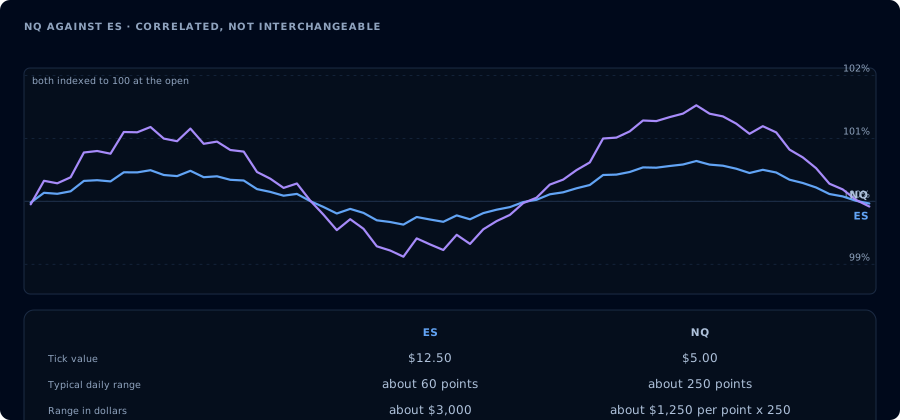
Correlated, not interchangeable. NQ travels further, so the same stop means less.
Contract specs
| Spec | NQ | MNQ (micro) |
|---|---|---|
| Underlying | Nasdaq-100 index | Nasdaq-100 index |
| Point value | $20 | $2 |
| Tick size | 0.25 index points | 0.25 index points |
| Tick value | $5.00 | $0.50 |
| Notional @ 18,000 | ~$360,000 | ~$36,000 |
| Day-trading margin | ~$500–$1,800 | ~$50–$180 |
| Overnight margin | ~$18,000 | ~$1,800 |
| Expiration | Quarterly (H, M, U, Z) | Quarterly (H, M, U, Z) |
| Settlement | Cash | Cash |
The Nasdaq-100 index is dominated by a handful of mega-cap tech names — Apple, Microsoft, Amazon, Nvidia, Meta, Google, Tesla — so NQ effectively tracks big tech sentiment.
NQ vs ES — the key differences
1. Composition. ES tracks 500 companies across all sectors. NQ tracks 100 non-financial tech-heavy names. When tech is hot, NQ outperforms. When defensive sectors lead, ES holds up better.
2. Volatility. NQ typically moves 1.5–2× more in percentage terms than ES during the regular session. A 1% ES day is often a 1.5–2% NQ day.
3. Tick math. ES: 4 ticks = 1 point = $50. NQ: 4 ticks = 1 point = $20. Though the dollar-per-point is lower on NQ, the number of points NQ moves intraday is much higher — often 100–300 NQ points vs. 10–40 ES points on the same day.
4. Correlation with ES. Daily correlation is ~0.85. Intraday correlation breaks down frequently, especially during tech-specific news.
Why traders like NQ
- More intraday movement. Wider ranges mean more opportunities per session.
- Cleaner trends. Tech stocks often lead both directions; NQ often trends harder than ES.
- Tighter tick-to-dollar ratio. $5/tick is an easier psychological scale than ES's $12.50/tick for position sizing.
- 24-hour action. Overnight NQ often telegraphs the next day's open.
Why NQ gets traders into trouble
- It moves fast. A 50-point NQ move (= $1,000/contract) can happen in minutes during news.
- Wider stops required. Using a 4-tick ES stop on NQ gets you stopped out on normal noise. Typical NQ stops are 15–40 points intraday.
- Bigger drawdowns per mistake. The same relative position size draws down faster on NQ than ES because of higher volatility.
Session behavior
- Asian session (6pm–3am ET): lower volume, often gentle trend or range. Fed-speaker or Asian headlines can move it.
- European session (3am–8am ET): volume picks up, broader moves possible.
- RTH / US cash open (9:30am ET): highest volume. Opening range often sets the tone.
- Lunch (11:30am–1:30pm ET): typically dull. Fade breakouts during this window.
- Afternoon drive (2pm–4pm ET): Fed days and triple-witching cause heightened activity.
- Closing auction (4pm ET): final imbalances resolve.
Strategies that work better on NQ than ES
- Breakout strategies. NQ breaks out of ranges more decisively.
- Momentum continuation. Strong directional days last longer on NQ.
- Volatility-expansion plays. NQ's willingness to move more in percentage terms means bigger extensions from VWAP and POC.
Strategies that work worse on NQ:
- Tight mean reversion. NQ's bigger ranges mean it extends farther from fair value before coming back.
- Low-tick-count scalping. Slippage on fast NQ moves can eat a 2-tick target.
Micro Nasdaq (MNQ)
MNQ is 1/10 the size of NQ — exactly the same as MES/ES relationship. $2/point, $0.50/tick. Use MNQ for accounts under $25k or when you want finer-grained sizing. See ES vs MES — the same logic applies.
Automating NQ with CrossTrade
key=YOUR-SECRET-KEY;
command=place;
account=Sim101;
instrument=NQ 12-26;
action=buy;
qty=1;
order_type=market;
tif=day;
For MNQ, change instrument=MNQ 12-26. Everything else is identical.
Frequently Asked Questions
What's the difference between NQ and ES?
NQ tracks the Nasdaq-100 (tech-heavy, 100 companies); ES tracks the S&P 500 (broader, 500 companies). NQ is typically 1.5–2× more volatile than ES on any given day. Point value is $20 for NQ vs. $50 for ES.
Is NQ harder to trade than ES?
It's faster and more volatile, which can be harder for new traders. Wider stops are required, and the dollar risk per trade adds up quickly. Many traders start on MES or MNQ for that reason — micros give you the same price action at 1/10 the size.
What are the trading hours for NQ?
NQ trades from Sunday 6pm ET to Friday 5pm ET, with a one-hour daily maintenance break (5–6pm ET). The US Regular Trading Hours session runs 9:30am–4pm ET, which sees the highest volume.
How much money do I need to day-trade NQ?
Day-trading margin is often $500–$1,800 per NQ contract at most brokers, but margin is not risk. Realistic account minimums for NQ day trading are $15,000–$25,000. With less, trade MNQ instead — day margin can be under $200 per contract.