Futures Tick Value Cheat Sheet
A tick is the smallest price increment a futures contract can move. The tick value is what that one tick is worth in dollars. Every position-sizing decision, stop placement, and P&L calculation depends on knowing these numbers cold. This is the reference table.
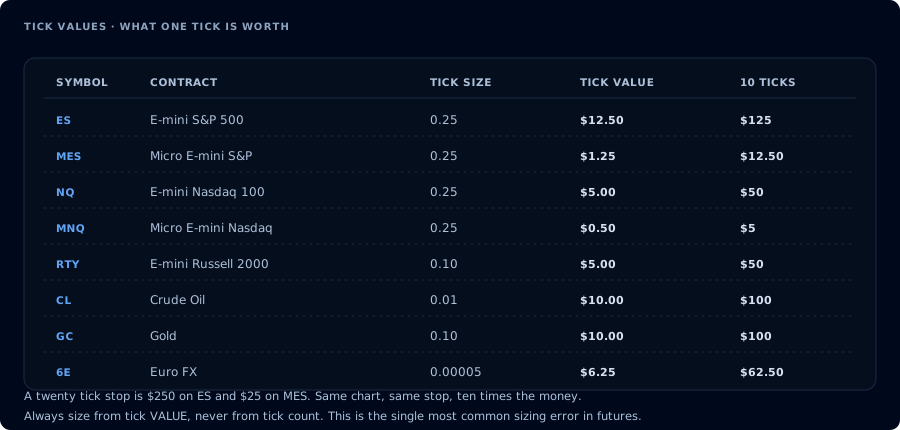
A twenty tick stop is $250 on ES and $25 on MES. Size from value, never tick count.
Equity index futures
| Symbol | Name | Point Value | Tick Size | Tick Value |
|---|---|---|---|---|
| ES | E-mini S&P 500 | $50 | 0.25 | $12.50 |
| MES | Micro E-mini S&P 500 | $5 | 0.25 | $1.25 |
| NQ | E-mini Nasdaq-100 | $20 | 0.25 | $5.00 |
| MNQ | Micro Nasdaq-100 | $2 | 0.25 | $0.50 |
| YM | E-mini Dow Jones | $5 | 1.0 | $5.00 |
| MYM | Micro Dow | $0.50 | 1.0 | $0.50 |
| RTY | E-mini Russell 2000 | $50 | 0.1 | $5.00 |
| M2K | Micro Russell 2000 | $5 | 0.1 | $0.50 |
Energy futures
| Symbol | Name | Point Value | Tick Size | Tick Value |
|---|---|---|---|---|
| CL | Crude Oil | $1,000 per $1 | 0.01 | $10.00 |
| MCL | Micro Crude Oil | $100 per $1 | 0.01 | $1.00 |
| NG | Natural Gas | $10,000 per $1 | 0.001 | $10.00 |
| RB | RBOB Gasoline | $42,000 per $1 | 0.0001 | $4.20 |
Metals
| Symbol | Name | Point Value | Tick Size | Tick Value |
|---|---|---|---|---|
| GC | Gold | $100 per $1 | 0.10 | $10.00 |
| MGC | Micro Gold | $10 per $1 | 0.10 | $1.00 |
| SI | Silver | $5,000 per $1 | 0.005 | $25.00 |
| SIL | Micro Silver | $1,000 per $1 | 0.005 | $5.00 |
| HG | Copper | $25,000 per $1 | 0.0005 | $12.50 |
Currency futures
| Symbol | Name | Point Value | Tick Size | Tick Value |
|---|---|---|---|---|
| 6E | Euro FX | $125,000 per 1.00 | 0.00005 | $6.25 |
| 6J | Japanese Yen | ¥12,500,000 per 1.00 | 0.0000005 | $6.25 |
| 6B | British Pound | £62,500 per 1.00 | 0.0001 | $6.25 |
| 6C | Canadian Dollar | CAD 100,000 per 1.00 | 0.00005 | $5.00 |
Interest rate (Treasury) futures
| Symbol | Name | Point Value | Tick Size | Tick Value |
|---|---|---|---|---|
| ZB | 30-year T-Bond | $1,000 per 1.00 | 1/32 | $31.25 |
| ZN | 10-year T-Note | $1,000 per 1.00 | 1/64 | $15.625 |
| ZF | 5-year T-Note | $1,000 per 1.00 | 1/128 | $7.8125 |
| ZT | 2-year T-Note | $2,000 per 1.00 | 1/256 | $7.8125 |
Agriculture futures
| Symbol | Name | Point Value | Tick Size | Tick Value |
|---|---|---|---|---|
| ZC | Corn | $50 per $1 (cent × 50) | 0.0025 ($0.25) | $12.50 |
| ZS | Soybeans | $50 per $1 | 0.0025 | $12.50 |
| ZW | Wheat | $50 per $1 | 0.0025 | $12.50 |
Cryptocurrency futures
| Symbol | Name | Point Value | Tick Size | Tick Value |
|---|---|---|---|---|
| BTC | Bitcoin | $5 per $1 | 5.00 | $25.00 |
| MBT | Micro Bitcoin | $0.10 per $1 | 5.00 | $0.50 |
| ETH | Ether | $50 per $1 | 0.50 | $25.00 |
| MET | Micro Ether | $0.10 per $1 | 0.50 | $0.05 |
How to use the cheat sheet
Calculate dollar risk on a trade:
Dollar Risk = Stop Distance (in ticks) × Tick Value × Contracts
Example: long NQ, 20-tick stop, 2 contracts:
Dollar Risk = 20 × $5.00 × 2 = $200
Calculate contracts to risk a fixed dollar amount:
Contracts = Risk Budget / (Stop Distance × Tick Value)
Example: want to risk $500 on CL with a 30-tick stop:
Contracts = $500 / (30 × $10) = 1.67 → round down to 1
Calculate point distance from dollar P&L:
Points = Dollar P&L / Point Value
Example: +$450 on an NQ trade:
Points = $450 / $20 = 22.5 points
Caveats
- Tick sizes change. CME occasionally updates tick sizes (as they did for ES pre-market hours years ago). Always verify current specs at CME Group's product pages for the symbol you trade.
- Day-trading margins vary. Tick value is fixed by the exchange. Margins are broker-specific and can change overnight based on volatility.
- Exotic contracts. Many less-traded contracts exist with different specs. This cheat sheet covers the retail-accessible mainstream.
Frequently Asked Questions
What is a tick in futures trading?
A tick is the minimum price movement a futures contract can make. It's set by the exchange and varies by product. For ES, one tick is 0.25 index points. For CL, one tick is $0.01. The tick value in dollars depends on the contract's multiplier.
How do I calculate dollar risk on a futures trade?
Dollar risk = (stop distance in ticks) × (tick value) × (number of contracts). Example: a 4-point stop on ES (16 ticks) × $12.50 × 1 contract = $200 risk. Always compute this before placing the trade.
Do tick sizes ever change?
Rarely, but yes. The CME has adjusted tick sizes for certain contracts over the years (like ES's pre-market tick size change). Check the current spec on the CME Group product page before sizing, especially if you haven't traded a contract in a while.
Why is NQ's tick value lower than ES's if NQ moves more?
NQ's point value is $20 vs ES's $50. NQ moves more points per day, but each point is worth less. The dollar range can still be larger on NQ because it might cover 200 points while ES covers 40 — 200 × $20 = $4,000 vs 40 × $50 = $2,000.