Futures Trading Hours
Most CME futures trade nearly 24 hours from Sunday 6pm ET to Friday 5pm ET, with a one-hour maintenance break each day (typically 5–6pm ET). The session breaks into sub-windows — Asian, European, pre-market, RTH, and evening — each with distinct volume and behavior. The Regular Trading Hours session (9:30am–4pm ET for index futures) is where 70%+ of retail volume lives.
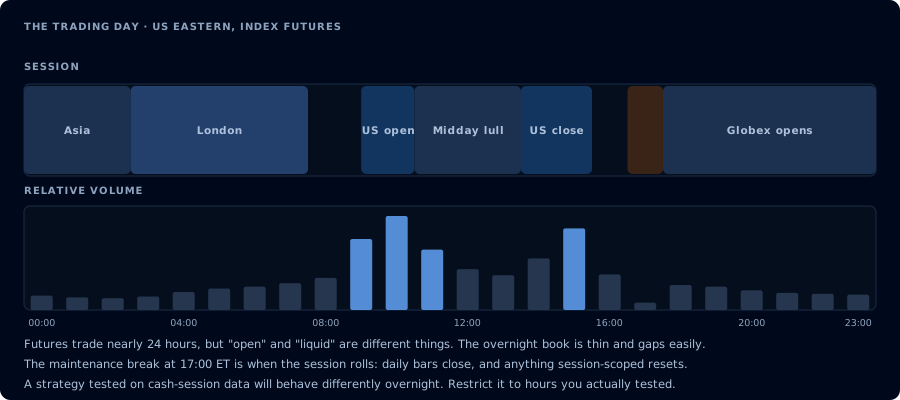
Open and liquid are different things. Almost all the volume is in two 90-minute windows.
The standard CME session (ES, NQ, YM, RTY)
All times ET.
| Session | Hours | Character |
|---|---|---|
| Asian session | 6pm – 3am | Low volume, often range-bound |
| European open | 3am – 4am | Volume picks up, overnight trend may reverse |
| European session | 4am – 8am | Steady flow |
| US pre-market | 8am – 9:30am | Economic data releases (8:30am is a major print hour) |
| RTH (cash open) | 9:30am – 4pm | Peak volume, primary trading session |
| US close / auction | 4pm – 5pm | Settlement window, end-of-day rebalancing |
| Daily break | 5pm – 6pm | Market closed |
Weekends: market closes Friday 5pm ET, reopens Sunday 6pm ET.
Why RTH matters most
The Regular Trading Hours session (9:30am–4pm ET) is when:
- Cash equity markets are open
- Volume is highest (often 3–5× overnight)
- Spreads are tightest
- Economic data most often has time to be priced in
- Institutional activity concentrates
If you're a retail day trader with a normal life, trade RTH. Overnight opportunities exist but have wider spreads, thinner books, and demand more specialized strategies.
The 9:30am opening drive
The first 30 minutes of RTH is typically the most volatile period of the day. This is when:
- Overnight moves get re-priced at the cash open
- Opening Range Breakout setups form
- Gap fills or gap-and-go decisions play out
- Early volume establishes the day's range
Many strategies focus exclusively on 9:30–10:30am ET — the "morning drive" — because the edge is highest there and fades through midday.
The midday chop
11:30am–1:30pm ET is typically the dullest stretch. Volume drops, ranges compress, and most intraday strategies underperform. Many professional scalpers stop trading during lunch and return for the afternoon session.
If you're a new trader, don't fight the chop. Walk away, eat lunch, and come back at 1:30pm.
Afternoon drive — 2pm ET onward
From 2pm ET through the 4pm close, volume rebuilds. Key windows:
- 2:00pm ET — FOMC press conferences begin on Fed days
- 2:30pm ET — Sometimes key speaker remarks or Treasury auctions
- 3:00pm ET — Last hour of cash trading begins; bond market closes
- 3:30–4:00pm ET — Settlement/auction activity can produce end-of-day swings
Non-index futures sessions
Sessions differ by product:
Crude Oil (CL) — Sun 6pm – Fri 5pm ET, with the most volume from 8:30am–2:30pm ET (EIA inventory at 10:30am Wednesday is the single biggest scheduled move).
Gold (GC) — Sun 6pm – Fri 5pm ET; peak activity during European and US sessions (3am–1:30pm ET).
Treasury futures (ZB, ZN, ZF) — Sun 6pm – Fri 5pm ET; cash Treasury market dictates rhythm, with volume heavy 8am–3pm ET.
Currency futures (6E, 6J, 6B) — Trade around forex session overlaps. Peak: 3am–11am ET (London/NY overlap).
Holiday schedule
US exchange holidays affect CME futures. Common 2026 closures:
- New Year's Day
- MLK Day
- Presidents' Day
- Good Friday (markets close; half-session before in some products)
- Memorial Day
- Independence Day
- Labor Day
- Thanksgiving (US holiday; shortened session the day after)
- Christmas Eve (early close)
- Christmas Day
Always check the CME holiday calendar before planning around a specific date — early closes affect margin cutoffs and order submission windows.
Time zones to know
All US futures session times are quoted in ET. If you're in:
- PT (Los Angeles) — subtract 3 hours. RTH open = 6:30am PT
- CT (Chicago) — subtract 1 hour. RTH open = 8:30am CT
- GMT (London) — add 5 (winter) or 4 (summer) hours
- JST (Tokyo) — add 13 or 14 hours
Daylight saving time shifts occur on different dates in the US vs. Europe and Asia, which can create a 3–4 week window each spring and fall where overlap windows drift by an hour. If you trade globally, track this explicitly.
Session in Pine Script
Restricting a strategy to RTH only:
//@version=6
strategy("RTH-only strategy", overlay=true)

// RTH for ES: 09:30 to 16:00 ET
inRTH = (hour * 100 + minute) >= 930 and (hour * 100 + minute) < 1600 and dayofweek != dayofweek.saturday and dayofweek != dayofweek.sunday

// Example signal — replace with your strategy logic
longSignal  = ta.crossover(close, ta.sma(close, 20))  and inRTH
shortSignal = ta.crossunder(close, ta.sma(close, 20)) and inRTH

if longSignal
    strategy.entry("Long", strategy.long)
if shortSignal
    strategy.entry("Short", strategy.short)

// Flat out of RTH
if not inRTH
    strategy.close_all()
Note: hour and minute in Pine Script respect the chart's timezone. Set the chart to "Exchange" timezone for CME alignment.
Frequently Asked Questions
What are CME futures trading hours?
Most CME products trade from Sunday 6pm ET through Friday 5pm ET, with a one-hour daily maintenance break (typically 5–6pm ET). Some contracts have slightly different breaks; always check the specific product spec page.
What are RTH hours?
Regular Trading Hours — for equity index futures, 9:30am–4:00pm ET, matching US cash equity market hours. This is when most volume concentrates and most retail day traders operate.
Can I trade futures on weekends?
No. CME markets close Friday 5pm ET and reopen Sunday 6pm ET. During that window, no futures trading occurs on CME — you can place orders at your broker but they sit in queue until the market reopens.
When is the best time of day to trade futures?
For most strategies, 9:30–11:30am ET and 1:30–4pm ET. The midday period (11:30am–1:30pm) is typically too dull to trade profitably. Overnight and pre-market hours are thinner and higher-risk without specific strategies for those conditions.