What is a Futures Contract?
A futures contract is a standardized agreement to buy or sell an asset at a specified price on a specified future date. When you trade futures as a retail speculator, you're not actually waiting for delivery — you're buying and selling the contract itself to profit from price changes. Futures offer leverage, long/short symmetry, and favorable tax treatment not available in stocks.
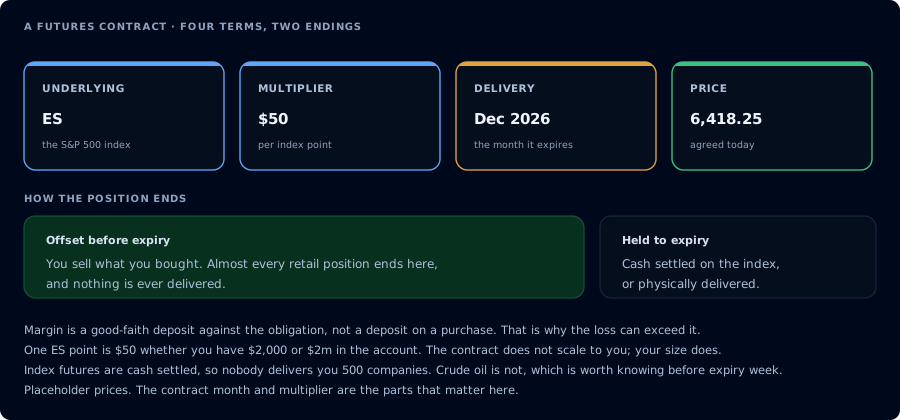
Four terms, two endings. Margin is a bond against the obligation, not a part payment.
The concept, using a real example
Imagine you're a corn farmer. Today it's April, and you'll harvest in October. You know corn prices fluctuate. You'd love to lock in today's $4.50/bushel price to guarantee your revenue.
On the other side, a cereal company needs to buy corn in October. They want to lock in costs too.
A futures contract is the legal instrument that lets those two parties agree today on a price for a transaction in October. The farmer sells a contract; the buyer buys it. In October, they settle.
That's it. Every futures market — gold, oil, stock indexes, currencies, crypto — works on this core principle.
Why retail traders trade them
Retail traders almost never take delivery. They close the position before expiration. The draw is what futures offer as a speculation instrument:
Leverage. A single ES (E-mini S&P 500) contract controls $250,000 of notional exposure. Day-trading margin is often $500–$1,500. That's 100–500× leverage — amplifies gains and losses equally.
Symmetry. Going long and going short are the same operation in futures. No "uptick rule" like in stocks. No borrow fees for shorts.
Extended hours. CME futures trade nearly 24 hours. You can react to news when the stock market is closed.
Tax treatment (US). Most futures contracts get 60/40 tax treatment — 60% long-term capital gains, 40% short-term, regardless of how long you held. Often significantly lower than stock day-trading taxes.
Liquidity. ES, NQ, CL, GC, and the euro futures are among the most liquid instruments on Earth. Tight spreads, deep order books.
Contract specifications
Every futures contract has specs — the standardized parameters:
- Underlying — what the contract represents (S&P 500 index, crude oil, corn)
- Contract size — the notional value per contract
- Tick size — the minimum price increment
- Tick value — the dollar value of one tick
- Expiration — when the contract settles
- Trading hours — when it's available to trade
- Initial margin — capital required to hold one contract overnight
Example — ES (E-mini S&P 500):
| Spec | Value |
|---|---|
| Underlying | S&P 500 Index |
| Contract size | $50 × index value (≈ $250,000 at 5,000) |
| Tick size | 0.25 index points |
| Tick value | $12.50 |
| Expiration | Quarterly (Mar, Jun, Sep, Dec) |
| Trading hours | Sun 6pm ET – Fri 5pm ET (with brief maintenance break) |
See Tick value cheat sheet for more.
Futures vs stocks
| Trait | Stocks | Futures |
|---|---|---|
| Asset ownership | Yes | No (contract only) |
| Dividends | Yes (if paid) | No |
| Short selling | Requires borrow | Built in |
| Leverage | 4:1 day / 2:1 overnight | 50–500:1 (varies) |
| Expiration | Never | Every contract expires |
| Tax (US) | Short/long-term | 60/40 (most) |
| Hours | 9:30–16:00 ET | Nearly 24/5 |
Expiration and rollover
Every futures contract expires. If you hold past expiration without closing, depending on the contract you either (a) go to cash settlement, or (b) are obligated for physical delivery (agricultural contracts, crude oil).
To stay exposed to the market long-term, traders roll — close the expiring contract and open a position in the next one. See Contract rollover.
Margin
You don't pay the full notional to open a futures position. You post a fraction as margin — effectively a good-faith deposit.
- Initial margin — required to open a position
- Maintenance margin — required to keep it open; fall below and you get a margin call
- Day-trading margin — reduced margin brokers offer for positions closed before the settlement cutoff; often much lower than overnight margin
See Day vs overnight margin for exact numbers.
Micro futures
For traders with smaller accounts, CME offers micro versions of its most popular contracts at 1/10 the size:
- MES = micro E-mini S&P 500 ($5/point vs ES's $50/point)
- MNQ = micro Nasdaq-100 ($2/point vs NQ's $20/point)
- MYM, M2K — micro Dow, micro Russell 2000
- MCL, MGC — micro crude oil, micro gold
See ES vs MES.
Common misconceptions
- "Futures are for farmers and commercials." Institutional and retail speculators account for a significant majority of daily volume in index futures. Hedgers are the original users, not the majority.
- "Futures always deliver physical product." Most retail-traded contracts (ES, NQ, currency futures, bond futures) are cash-settled. You never receive physical barrels of oil.
- "Futures expire worthless." Unlike options, a futures contract has a settlement price equal to the underlying's price at expiration. It doesn't expire worthless.
Frequently Asked Questions
Can beginners trade futures?
Yes, but cautiously. The same leverage that makes futures attractive also magnifies losses. Start with micro contracts (MES, MNQ), use a sim account for weeks before going live, and never risk more than 1–2% of your account per trade.
What's the difference between futures and options?
A futures contract is an obligation to buy or sell at expiration (or roll/close before). An options contract is a *right* without obligation. Futures have linear P&L; options have non-linear P&L that depends on strike price, time decay, and volatility.
How much money do I need to trade futures?
Day-trading margin for micro contracts (MES, MNQ) can be as low as $50–$100 per contract at some brokers. For a reasonable starting account, $5,000–$10,000 is a realistic minimum. Below that, a single bad trade can wipe you out.
Are futures riskier than stocks?
Not inherently — but the leverage makes them easier to lose money with faster. A futures account with well-sized positions and stops is no riskier than a stock account; a futures account with max leverage and no stops can blow up in a single day.