Max Drawdown: What Traders Get Wrong
Max Drawdown (MDD) is the largest peak-to-trough drop in account equity over a period. It's the best single estimate of "how bad has it gotten?" — but it's a sample statistic from a finite past and will almost certainly be exceeded eventually. Use it as a floor, not a ceiling.
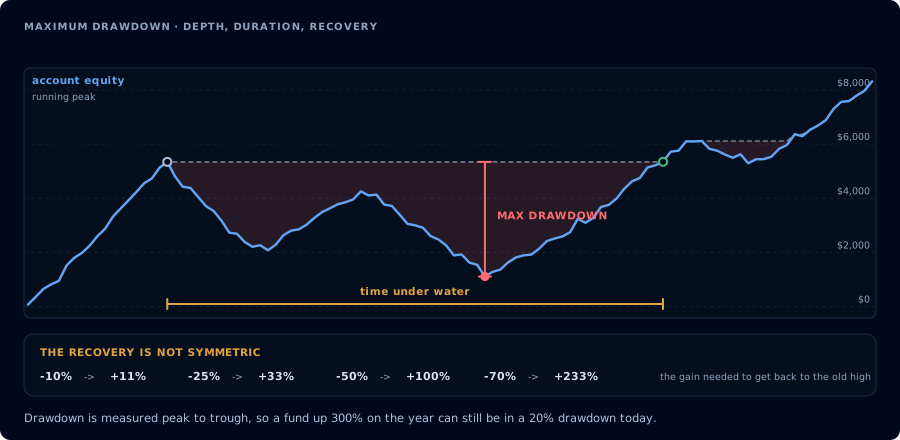
Depth, duration, and the asymmetric climb back out.
The definition
For each point in time, compute the running peak of equity. Drawdown at that point = (current equity − running peak) / running peak. Max Drawdown is the most negative value that series ever hit.
Expressed as a percentage. A $100k account that fell to $80k at its worst has a MDD of −20%.
Why MDD matters
Two reasons:
- Survival. Your strategy only has to break you once. An unexpected MDD that exceeds your risk capital = game over.
- Psychology. Most traders overestimate their drawdown tolerance. A backtested MDD of 25% feels abstract on a spreadsheet and devastating in real life, when it's your money and your family's.
Prop firms enforce strict MDD limits (often 4–5% trailing) precisely because MDD is the clearest failure boundary.
Why MDD is misleading
1. It's a single data point. MDD is the worst observed outcome in a finite backtest. Run the same strategy for another five years and MDD will almost certainly be exceeded. Expect it.
2. It depends on sample length. A 1-year backtest and a 10-year backtest of the same strategy will show very different MDDs. Longer samples find bigger drawdowns.
3. It ignores frequency. A strategy that hits MDD once per year and a strategy that hits similar drawdowns five times per year have the same MDD number — but very different day-to-day experience.
Average drawdown often matters more
If MDD is the worst-case, average drawdown is the typical experience. If your strategy's average drawdown is 3% and max is 15%, you'll spend most of the time in small dips and occasionally endure the big one.
A strategy with 15% MDD and 3% average drawdown is easier to trade than one with 15% MDD and 10% average drawdown — even though the MDD is identical.
Duration matters too
Drawdown duration = how long the strategy sits below the prior peak before recovering.
A 10% MDD that recovers in 2 weeks feels like nothing. A 10% MDD that takes 18 months to recover is psychological torture. Report both: depth and duration.
Recovery math
A 20% drawdown requires a 25% gain to recover (not 20%). A 50% drawdown requires a 100% gain. This is why protecting the downside matters more than chasing upside.
| Drawdown | Gain needed to recover |
|---|---|
| 10% | 11.1% |
| 20% | 25% |
| 30% | 42.9% |
| 40% | 66.7% |
| 50% | 100% |
| 70% | 233% |
Calculating MDD from a trade log
import numpy as np
import pandas as pd

trades = pd.read_csv("trades.csv").sort_values("timestamp")
trades["equity"] = 100_000 + trades["pnl"].cumsum()
trades["peak"]   = trades["equity"].cummax()
trades["dd"]     = (trades["equity"] - trades["peak"]) / trades["peak"]

mdd = trades["dd"].min()
avg_dd = trades.loc[trades["dd"] < 0, "dd"].mean()
print(f"Max Drawdown:    {mdd:.2%}")
print(f"Avg Drawdown:    {avg_dd:.2%}")
MDD and position sizing
One rule of thumb: set position size so your expected drawdown is at most 1.5× to 2× your backtested MDD. If backtest shows 10% MDD, size for 15–20% drawdown in live trading.
Why the multiplier? Because:
- Live slippage is worse than backtest
- Out-of-sample drawdowns typically exceed in-sample
- Markets regime-shift, and the shift always looks obvious in hindsight
Building that cushion in up front is the difference between surviving a bad period and blowing up.
Frequently Asked Questions
What is a good maximum drawdown?
Depends on the strategy style. Trend followers typically run 20–40% MDD. Mean reversion 10–20%. Scalping often under 10%. More important than absolute number is whether MDD is consistent with your risk tolerance and account size.
Is max drawdown the same as max loss?
No. Max loss is the biggest single-trade loss. Max drawdown is the cumulative peak-to-trough decline, often built from many losing trades in sequence. A strategy can have small individual losses but a large MDD if losers cluster.
How do I recover from a 50% drawdown?
Mathematically you need a 100% gain to return to the prior peak. Practically, most strategies that hit 50% MDD have either broken permanently or require substantial revision. Don't rely on a 'recovery' plan — avoid the 50% drawdown in the first place.
Does max drawdown always happen in backtests?
No — MDD is always an estimate based on the sample period. Run more data or a different market regime and MDD will change. Treat your backtest MDD as a lower bound for what live trading will show.