Monte Carlo Simulation: What Are the Actual Odds?
Monte Carlo simulation runs your trading stats through thousands of randomized futures — same win rate, same average win, same average loss, different order — and counts how often each outcome happens. CrossTrade uses it to answer one specific question: given how you've actually been trading, what's the probability you pass this prop eval before you blow the drawdown? The Pass % it shows is a probability, not a promise.
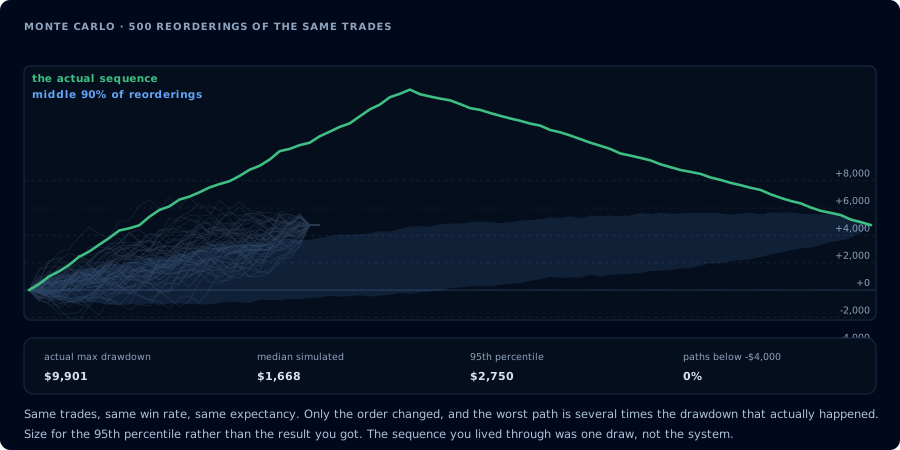
The same trades in a different order. Size for the bad draws, not the one you got.
The problem it solves
You've got a strategy. Maybe it's profitable — your win rate is 58%, average winner is $240, average loser is $180, and you take 4 trades a day. On paper the expectancy is positive.
Now you buy a $3,000-target / $2,500-trailing-drawdown prop eval. Can you pass it?
The honest answer isn't "yes" or "no." It's a probability. Even a strong strategy has losing streaks. A bad streak early in the eval can trip the drawdown before the edge has time to show up. A good streak can pass you in a week. Same strategy, different luck of the draw.
Monte Carlo is the tool that turns "probably fine" into a number.
How it actually works
The CrossTrade simulator replays your eval 500 times. Each replay:
- Starts with a fresh equity balance of $0.
- Simulates up to 60 trading days.
- Each day, runs
Ntrades whereN= your historical trades-per-day. - Each trade's outcome is drawn from your actual trade distribution — win/loss determined by your real win rate; P&L sampled from your real winners and losers.
- Applies your eval rules: daily loss limit, max drawdown (end-of-day, trailing, or static), and profit target.
- Records the outcome: Pass, Blow DD, or Ran Out of Time (hit the day cap without passing or failing).
After 500 replays, the simulator counts: what fraction passed, what fraction blew the drawdown, what fraction stalled out. That's your Pass %.
The equity paths you see on the spaghetti chart are the 500 replays themselves — green fades are replays that hit the profit target, red fades are replays that hit the drawdown. The bold blue line is the median path. The dashed lines are the 10th and 90th percentile paths.
What "your actual trade data" means
This is the part most traders miss. Monte Carlo is only useful if the inputs reflect reality.
CrossTrade pulls from your live trade history:
- Win rate — not a round number you chose, the actual percentage of winners in your logged trades.
- Average win / average loss — the real dollar magnitudes, commissions included.
- Trades per day — how many you actually take on a typical session.
- The full P&L distribution — the simulator samples your actual winners and losers, so fat tails (your one monster win, your one monster loss) influence the outcome the way they do in real life.
If your trade history is 30 trades, the simulation is extrapolating from a tiny sample and the Pass % is fragile. If it's 500 trades across several market regimes, the Pass % is meaningful. Sample size is everything.
Reading the result
| Pass % | What it probably means |
|---|---|
| < 25% | Your current trading pattern rarely clears this eval without tripping the drawdown. Changing size or rules beats retrying. |
| 25–50% | Coin-flip territory. Expect to retry the eval more than once. Good for honest expectations, bad for capital efficiency. |
| 50–75% | The edge is real but not bulletproof. You'll pass most of the time but expect the occasional bad run. |
| > 75% | Comfortable. If live trading matches your history, this eval is very likely to pass. |
Blow DD % is the flip side: the fraction of simulated runs that hit the max drawdown and failed. In evals where the drawdown limit is tight (Apex Intraday, most $50K accounts), Blow DD rate is usually higher than most traders guess.
Ran Out of Time % means the simulation hit the 60-day cap without passing or failing. A high value here (say >30%) usually means your strategy is profitable but slow — expectancy is positive but trade frequency is too low to compound to target in the day window. This is common for swing-style traders evaluating high-target accounts.
The spaghetti chart
Each thin line is one simulated replay of the eval. The chart tells you two things instantly:
- How much paths diverge. Tight clustering = consistent strategy, predictable outcomes. Wide fan-out = variance dominates your P&L, outcomes are luck-heavy.
- Where the median path goes. A median path that climbs steadily toward the target with a buffer from the drawdown line is the picture of a tradeable eval. A median path that flatlines or drifts toward the drawdown line tells you the edge isn't strong enough for this account size.
The 10th percentile (red dashed) is your bad luck trajectory — what happens in the worst 1 of 10 replays. If the 10th percentile blows the drawdown early, your eval has real tail risk even if the median passes comfortably.
What it won't tell you
Monte Carlo has blind spots. Respect them.
1. It assumes your past predicts your future. If you change markets, change strategies, or the market regime shifts, the inputs are stale. The simulator can't know you just switched from trading NQ to CL last week.
2. It assumes trade independence. In reality, trades cluster — a revenge-trade after a loss looks different from a disciplined trade. Monte Carlo shuffles trades as if each one is drawn fresh, so it understates the behavioral tails (tilt losses in a row).
3. Rare events are underrepresented. If your sample doesn't contain a flash crash or a Fed day gone wrong, the simulation won't either. The 10th percentile is probably optimistic on the downside.
4. The Pass % is not a recommendation. A 70% Pass % doesn't mean you should pay for the eval. It means if you pay for it, you'd pass about 7 out of 10 attempts. Whether the expected value clears the cost is a different question.
Using it before an eval
The practical workflow:
- Trade your sim account (or a funded account) for at least 100 trades with your intended eval strategy.
- Open the Monte Carlo tool on that account, configured against the eval you're about to buy.
- Look at Pass %. Under 50% means work on the strategy before paying. Over 65% means you're ready — but accept there's still meaningful variance.
- Look at Blow DD %. If it's over 20% on a drawdown-strict eval, your per-trade size is too aggressive. Halve it and re-run.
- Compare Pass % at different sizing. The tool is cheapest right before you pay the eval fee.
Using it on a live eval
You can also run Monte Carlo partway through a live eval to check whether your remaining trades can realistically close the gap. If you're $1,800 into a $3,000 target with $900 of your $2,500 drawdown used up, Monte Carlo on your recent trading will tell you whether to keep pushing or tighten up and slow-play.
Quick math: why more sims = more stable
500 simulations is enough for a stable Pass % to about ±2 percentage points. Fewer than 200 sims and the number wobbles noticeably between re-runs. More than 1,000 buys very little extra precision. CrossTrade uses 500 as the default because it's the sweet spot for responsiveness vs. stability — re-clicking the "Re-run" button shouldn't change Pass % by more than 2–3 points. If it does, your sample size is too small and the whole result is fragile.
One honest warning
Traders sometimes use Monte Carlo to justify a plan rather than evaluate it. If you re-run with different assumptions until you get a Pass % you like, you've stopped simulating and started cherry-picking.
Use Monte Carlo the way a pilot uses a flight simulator: to find the conditions where the plan fails, and then fix the plan. Not to make the plan feel safe.
Frequently Asked Questions
What is Monte Carlo simulation in trading?
A technique that runs your trading strategy through thousands of randomized futures using your actual trade statistics (win rate, average win, average loss, trades per day) to estimate the probability of different outcomes — typically whether you pass a prop firm evaluation before hitting the drawdown limit.
What's a good Monte Carlo pass rate for a prop eval?
Above 65% is comfortable. 50–65% is coin-flip — expect multiple attempts. Below 50% means your current trading pattern struggles against this eval's specific drawdown and target rules, and you're better off changing size or strategy before paying the fee.
How many simulations should I run?
500 is the sweet spot and what CrossTrade defaults to. Fewer than 200 produces unstable results (the Pass % wobbles on re-runs). More than 1,000 adds almost no precision. If your Pass % changes significantly between re-runs at 500 sims, your trade sample is too small to trust the result.
Why does the simulation show different numbers each time?
Monte Carlo is randomized by design. Each run draws different sequences from your trade history. A stable result at 500 sims should vary by about 2–3 percentage points on re-run. Bigger swings mean your underlying trade sample isn't large enough to produce reliable probabilities.
Can Monte Carlo predict whether I'll actually pass?
No. It estimates probability under the assumption that your future trading looks statistically like your past trading. If your strategy changes, the market regime changes, or your discipline slips under eval pressure, the actual outcome can differ from the simulation. Treat Pass % as a planning tool, not a prediction.