R-Multiple: The Only Metric That Scales
R is the dollar risk at trade entry (entry price minus stop-loss price, times contracts, times dollar-per-point). R-Multiple expresses the trade's outcome in units of R. A trade that made 2× the initial risk = +2R. A trade stopped out = −1R. R-multiple makes trades comparable across instruments, timeframes, and account sizes.
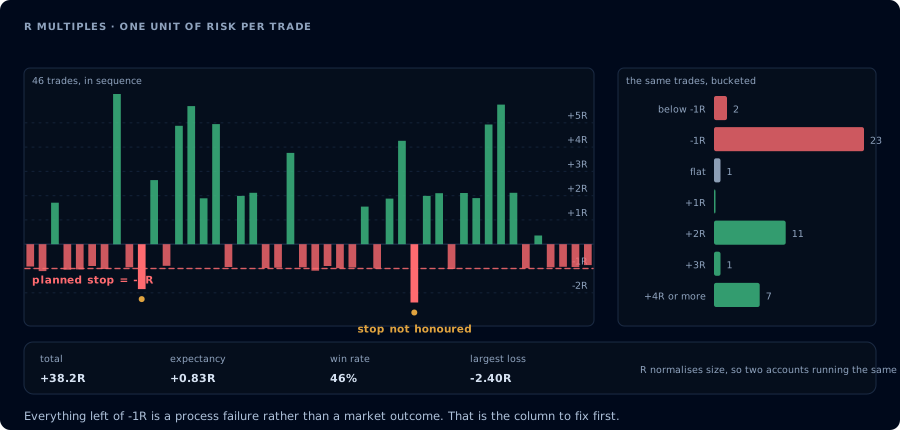
Normalised to risk, so size and account balance drop out of the picture.
The definition
R = initial risk on the trade in dollars.
- Long ES at 5,000 with stop at 4,990 = 10 points × $50/point × 1 contract = $500 initial risk
- R = $500 for that trade
If the trade exits at 5,020, profit = 20 points × $50 = $1,000. Outcome = +2R.
If the trade exits at 4,990, loss = $500. Outcome = −1R.
If the trade exits at 5,030, outcome = +3R. And so on.
Why R-multiples are better than dollars
Dollars change with contract size. $500 on one trade and $500 on another might have come from very different risk setups.
R-multiples are unit-free. +2R means the same thing on a 1-contract ES trade and a 10-contract CL trade. This makes everything comparable:
- Strategies across instruments
- Trades across days, weeks, months
- Performance across account sizes
- Your trades vs. another trader's trades
Popularized by Van Tharp, R-multiples are now the standard for professional trade journaling.
Expectancy in R
Re-expressing expectancy in R:
Expectancy (R) = (Win Rate × Avg Win in R) − (Loss Rate × Avg Loss in R)
For most strategies, Avg Loss in R is close to −1 (you risk 1R and get stopped, losing 1R). Avg Win in R varies widely — 1.5R, 2R, 3R — depending on your targets.
A strategy that averages +0.3R/trade across 200 trades has earned +60R in total. If each R was $500, that's $30,000 in profit — without caring about which instrument you traded.
How to record R-multiples
Every trade goes in a journal with:
- Entry price
- Initial stop price (required — no stop means no R)
- Position size
- Exit price
- R computed at entry
- Dollar outcome
- R outcome = outcome / R
A minimum journaling template:
| Date | Instrument | Entry | Stop | Exit | R ($) | $ Outcome | R-Multiple |
|---|---|---|---|---|---|---|---|
| 2026-04-14 | ES | 5,000 | 4,990 | 5,020 | 500 | +1,000 | +2.0 |
| 2026-04-14 | NQ | 18,100 | 18,080 | 18,070 | 400 | −600 | −1.5 |
| 2026-04-14 | CL | 82.50 | 82.30 | 83.00 | 200 | +500 | +2.5 |
After 100 trades, you have a distribution of R-outcomes. Graph it as a histogram. You'll see exactly what your strategy's payoff shape looks like.
Common questions about R
"What if I don't use stops?" Use your intended stop — the level at which you would admit the trade was wrong. Without that, R doesn't work and neither does position sizing.
"What if I scale in or out?" Compute R from the initial entry and initial stop. Partial exits reduce the effective R outcome (e.g., scaling out half at 2R and half at 3R → outcome = 2.5R).
"What about breakeven trades?" A trade exited at breakeven = 0R. Include it in the log; breakeven trades still cost you commission and slippage.
The 3R rule of thumb
Many profitable discretionary traders aim for an average trade outcome of +0.3R to +0.5R. This may sound small — but multiplied by 200–300 trades per year, it's a strong result.
Systematic futures strategies often target larger average R (0.8R to 1.2R) because trade frequency is lower and selection is stricter.
Position sizing with R
Once you use R, position sizing becomes one line of arithmetic:
Contracts = Risk Budget ($) / (Stop Distance × Dollar per Point)
If you're risking $500 per trade and the stop is 10 points on ES ($500/point risk), you trade 1 contract. If your stop is 5 points on the same trade, you trade 2 contracts. Your dollar R stays constant even though point distance changes.
See Position sizing for futures for a deeper walkthrough.
Frequently Asked Questions
What is an R-multiple in trading?
An R-multiple expresses a trade's outcome in units of the initial risk. A trade that makes twice the initial dollar risk is +2R; a trade stopped out at the initial stop is −1R. It makes trades comparable across instruments and size.
Who invented the R-multiple?
Van K. Tharp popularized R-multiples in his book 'Trade Your Way to Financial Freedom' in the 1990s. The underlying concept — normalizing by risk — is older, but Tharp codified and popularized it for retail traders.
What's a good average R per trade?
For active strategies, +0.3R to +0.5R average per trade is strong. Systematic trend-followers sometimes run +1R or higher because trade frequency is lower and selection is stricter. Below +0.2R, commissions and slippage consume most of the edge.
Can R-multiples be negative beyond -1?
Yes. If your stop slips or you hold past your intended exit, a trade can lose more than 1R. These 'tail losses' destroy long-term results — honoring stops is what keeps R consistent. This is a key argument for automation.