Win Rate vs Expectancy
Win rate = percentage of trades that are profitable. Expectancy = average dollars won or lost per trade, accounting for both frequency and size. Expectancy is the metric that determines whether a strategy makes money; win rate alone tells you almost nothing.
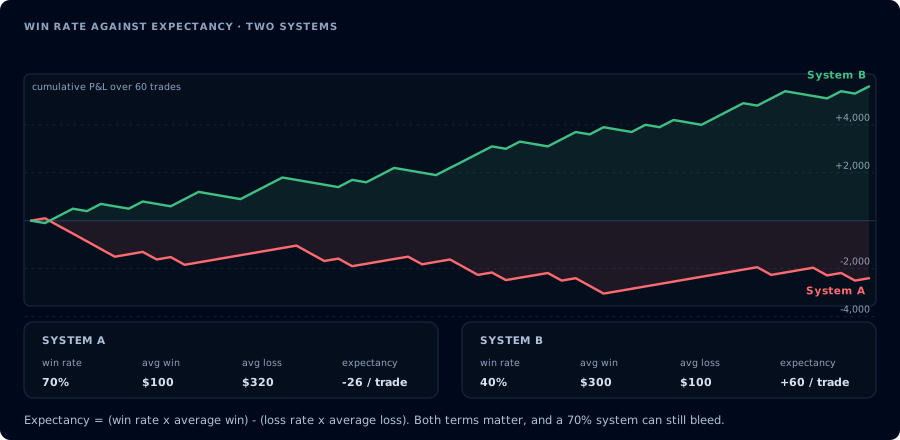
A 70% win rate losing money, and a 40% win rate making it.
The formulas
Win rate:
Win Rate = Winning Trades / Total Trades
Expectancy (per trade, in dollars):
Expectancy = (Win Rate × Avg Win) − (Loss Rate × Avg Loss)
Expectancy as an R-multiple (risk-normalized):
Expectancy (R) = (Win Rate × Avg Win/R) − (Loss Rate × Avg Loss/R)
See R-Multiple for why R-normalizing matters.
The 40% vs 70% example
Strategy A: 40% win rate, winners average $600, losers average $200.
Expectancy = (0.40 × 600) − (0.60 × 200) = 240 − 120 = +$120 per trade
Strategy B: 70% win rate, winners average $150, losers average $350.
Expectancy = (0.70 × 150) − (0.30 × 350) = 105 − 105 = $0 per trade
Strategy B wins more often. Strategy A makes more money. Over 1,000 trades, A earns $120k and B earns zero.
Why win rate alone is useless
A coin flip has a 50% win rate. So does a useless strategy that picks entries randomly. So does a brilliant strategy with carefully placed stops. Without knowing the size of wins and losses, win rate is a number without meaning.
Worse: most beginners prefer high-win-rate strategies because they feel better. Strategies that scalp small profits and occasionally take big losses show 80–90% win rates for months before one bad day erases everything. The high win rate masks the negative expectancy until it doesn't.
The shape of the distribution
Two strategies with identical expectancy can feel completely different:
Smooth: 55% wins of $100, 45% losers of $80 → expectancy +$19/trade Lumpy: 25% wins of $800, 75% losers of $60 → expectancy +$155/trade
The lumpy strategy is more profitable but psychologically brutal — you lose three trades in a row more than half the time. Most traders abandon lumpy strategies during normal drawdowns because they can't stomach the hit-rate.
Match the strategy's distribution to your own psychology. A profitable system you can't stick with is worthless.
Calculating from a trade log
import pandas as pd

trades = pd.read_csv("trades.csv")
wins   = trades[trades["pnl"] > 0]["pnl"]
losses = trades[trades["pnl"] < 0]["pnl"]

win_rate   = len(wins) / len(trades)
avg_win    = wins.mean()
avg_loss   = losses.mean()            # negative number
expectancy = (win_rate * avg_win) + ((1 - win_rate) * avg_loss)

print(f"Win Rate:   {win_rate:.1%}")
print(f"Avg Win:    ${avg_win:.2f}")
print(f"Avg Loss:   ${avg_loss:.2f}")
print(f"Expectancy: ${expectancy:.2f}/trade")
What's a good expectancy?
For futures, +0.2R to +0.5R per trade is realistic for most durable strategies. Per-trade dollar expectancy depends on contract size and risk per trade.
Volume matters too: a strategy with +$50 expectancy that trades once a day is worth $12,500/year (250 trading days). A strategy with +$20 expectancy that trades ten times a day is worth $50,000/year. Per-trade profitability × frequency = total profitability.
How to improve each
To improve win rate: tighter entry filters, wider stops, closer targets. All three reduce the frequency of being stopped out but also shrink the average win. Win rate improvements almost always come at expectancy's expense.
To improve expectancy: widen targets, tighten stops, or find better entries. Often requires reducing trade frequency to find higher-quality setups.
The best strategies aren't the ones with the highest win rate. They're the ones with the highest expectancy multiplied by frequency.
Frequently Asked Questions
Can I be profitable with a 40% win rate?
Absolutely. Most systematic trend-following strategies run 30–40% win rates and are highly profitable because winners are 2–4× the size of losers. Win rate means nothing without the reward-to-risk ratio.
What is a good expectancy for a trading strategy?
Realistic futures strategies run +0.2R to +0.5R per trade — meaning for every $1 risked, you expect to net 20 to 50 cents on average. Anything above +1R per trade is exceptional and worth auditing.
How many trades do I need before expectancy is reliable?
At least 100, ideally 200+. Below 50 trades, expectancy is dominated by the randomness of a few outlier wins or losses. As the trade count grows, expectancy stabilizes.
Win rate vs profit factor vs expectancy — which should I track?
Track all three. Win rate for frequency of wins. Profit factor for the dollar ratio. Expectancy for per-trade dollars. Each tells a different part of the story; together they describe the strategy.