Fair Value Gaps (FVGs)
A Fair Value Gap (FVG) is a 3-bar pattern where the wicks of the first and third bars don't overlap, leaving a "gap" in the middle bar's range. The thesis: price moved too quickly for normal two-sided execution, and the market often returns to "rebalance" the gap. A core concept in Inner Circle Trader (ICT) methodology and Smart Money Concepts (SMC) trading.
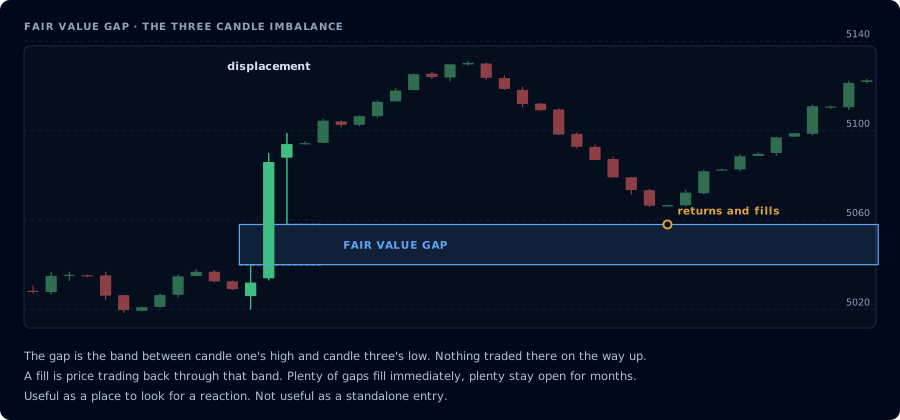
Candle one’s high to candle three’s low: a band nothing traded in.
What an FVG looks like
The 3-bar pattern:
Bullish FVG.
- Bar 1: any candle
- Bar 2: a strong bullish candle that gaps above Bar 1's high
- Bar 3: opens above where Bar 1's high closed
- The gap = the price range between Bar 1's high and Bar 3's low
In plain language: Bar 1's high < Bar 3's low. The middle bar moved so fast that there's a price range it traded through but where the surrounding bars never traded.
Bearish FVG. Inverse:
- Bar 1's low > Bar 3's high
- The gap = between Bar 3's high and Bar 1's low
Why FVGs form
Markets typically trade in a two-sided manner — buyers and sellers crossing each other in a continuous range. When price moves very fast (often on news, a stop run, or institutional aggression), the normal two-sided trading is interrupted. The gap represents prices that weren't "fairly traded" by both sides.
The theory: markets eventually return to fill these gaps because algorithmic liquidity providers want to capture spreads at every price level. The unfilled gap is unfinished business.
How traders use FVGs
Reaction zones. When price returns to an unfilled FVG, traders watch for rejection — entry signals in the direction of the original impulsive move.
Mitigation entries. A bullish FVG that price returns to after an uptrend = a buying opportunity (price has "come back to fill the gap" and may resume up).
Targets. Open FVGs in the opposite direction can act as targets — the market often moves to fill them.
Continuation signals. A strong impulse that creates an FVG and then continues without filling it = high-momentum trend.
How long do FVGs persist
Some fill within minutes; some take days, weeks, or never fill. There's no fixed timeframe.
In practice:
- Intraday FVGs typically fill within 1-3 sessions
- Higher timeframe FVGs (4H+) can persist for weeks
- Strong momentum FVGs (huge gaps left by news events) sometimes never fill
The closer the FVG is to the current price, the more likely it gets revisited. Distant FVGs may stay unfilled indefinitely.
How to trade them
Setup. Identify a clear 3-bar imbalance after a strong move.
Wait for return. When price comes back to the FVG zone, watch for confirmation:
- Rejection candle (pin bar, engulfing) at the FVG boundary
- Lower-timeframe CHoCH inside the FVG
- Volume reaction
Entry. On the rejection candle's close.
Stop. Beyond the FVG (just past the opposite side of the gap from your entry).
Target.
- Next opposing FVG
- Recent swing high/low
- Measured move based on the impulse leg that created the FVG
Realistic stats
For confirmed FVG retest setups with proper confluence:
- Win rate: 55–70% depending on timeframe and confluence
- Higher timeframe FVGs: better win rates (~65-70%)
- Lower timeframe FVGs (1m, 5m): closer to 50-55%
- Without confluence: closer to coin flip
FVGs alone are not a strategy. They're a setup that needs trend context, structure confirmation, or other layered confluence.
Variations and related concepts
Inversion FVG. When price closes through an FVG without filling it, the FVG sometimes "inverts" — what was a bullish FVG becomes resistance on the way back up. The market is treating the gap differently now that the original direction is broken.
Balanced Price Range (BPR). Two overlapping FVGs in opposite directions form a BPR. Price often visits BPRs as confluence zones — both buyers and sellers have orders near each other.
Liquidity void. A larger version of an FVG — a multi-bar zone of one-sided trading. Same idea, larger scale.
Common mistakes
- Marking every gap. Not every 3-bar pattern with a gap is a meaningful FVG. The gap should follow a strong impulsive move and ideally break structure.
- Trading FVGs in isolation. Without trend context, FVGs are 50/50. Always combine with HTF bias.
- Expecting all FVGs to fill. Many never do. Don't bet the farm on a gap fill that may take months — or never come.
- Tight stops just inside the FVG. Use the full gap as your stop boundary; FVGs are zones, not exact lines.
Frequently Asked Questions
What is a fair value gap?
A 3-bar pattern where the wicks of the first and third bars don't overlap, leaving a price range in the middle bar that the surrounding bars never traded. Bullish FVG = bar 1's high < bar 3's low. Bearish FVG = bar 1's low > bar 3's high. The gap represents 'imbalanced' price action that often gets revisited.
Do all fair value gaps get filled?
No. Many FVGs get filled within hours or days, but many never fill — especially those left by major news events that create sustained one-directional momentum. The closer an FVG is to the current price, the higher the probability it gets revisited.
How are fair value gaps different from regular gaps?
A traditional 'gap' refers to a price discontinuity between sessions (e.g., overnight gap on stocks). A fair value gap is a 3-bar pattern within continuous trading where a fast move left a price range untouched by the surrounding bars. FVGs can occur during normal session hours; traditional gaps usually appear at session boundaries.
Is FVG trading reliable?
It depends entirely on confluence and timeframe. Higher-timeframe FVGs (4H, daily) with structural alignment have measurable edge (60-70% win rates). Lower-timeframe FVGs in isolation are closer to coin flips. As with most price-action concepts, FVGs are setups, not standalone strategies.