Liquidity Sweeps and Stop Hunts
A liquidity sweep (or stop hunt) happens when price spikes through an obvious stop-loss level — just above a swing high or just below a swing low — then immediately reverses. Large players use these moves to execute their orders against the resting stop-loss liquidity of retail traders. Recognizing a sweep instead of falling victim to it is one of the most useful price-action skills a trader can develop.
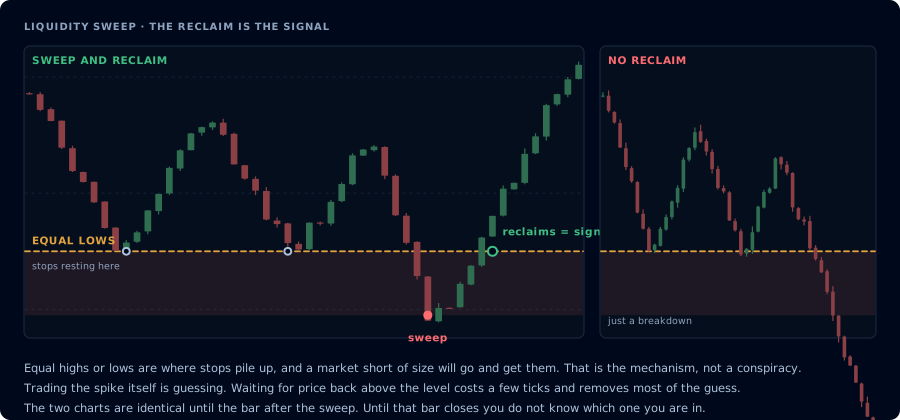
Identical charts until the bar after the spike. The reclaim is what separates them.
Why sweeps happen
Big institutional orders need counter-party liquidity to fill. Where does liquidity sit? Above swing highs (where shorts placed stops) and below swing lows (where longs placed stops).
When an institution wants to buy a large size, the cleanest fill is to push price above a recent swing high, triggering short stops (which become market buys) — and then absorb that buying with their large limit sell orders, while accumulating long inventory at advantageous prices.
After the sweep, the institution has filled their position and price often reverses back through the swept level. The traders who got stopped out watch helplessly as the move plays out without them.
Anatomy of a sweep
- Setup: Price approaches a clearly visible swing high (or low) — equal highs, prior session high, day's high
- Sweep: Price spikes through the level — typically a long wick, sometimes a single sharp candle
- Reversal: Within 1-3 bars, price closes back below (above) the swept level
- Continuation: Price moves in the reverse direction, often strongly
The candle that does the sweeping often has a very long wick in the swept direction and a small body — a classic rejection candle.
Where sweeps cluster
Equal highs / equal lows. Two or three swing points at exactly the same price create a stop-cluster magnet. These are textbook sweep targets.
Prior session highs/lows. Yesterday's high and low have many resting stops. Frequently swept early in the next session.
Round numbers. $5,000 on ES, $100 on CL — round numbers attract stops and therefore sweeps.
Asia-session range extremes. Many traders set stops outside the overnight Asian range. London or US opens often sweep these levels.
How to use sweeps as a trade setup
The setup, often called a "sweep and reverse":
- Identify a clear liquidity level (equal highs/lows, prior session high)
- Wait for price to spike through it
- Wait for the rejection — a candle that closes back inside (the swept level becomes resistance/support)
- Enter on the rejection bar's close, or on a lower-timeframe break of structure in the new direction
- Stop just beyond the sweep extreme
- Target the opposite side of the recent range
This is one of the highest win-rate setups in price-action trading — typically 65-75% — because you're trading with the institutional flow rather than against it.
How to avoid being swept
If you're the trader providing the liquidity, you're losing. Three habits:
- Don't place stops at the most obvious level. A stop 1 tick above the swing high is dinner. Place it 2-3 ATR above instead.
- Use ATR-based stops, not "just above the swing." ATR stops adapt to volatility and naturally place stops outside common sweep zones.
- Recognize equal highs/lows as warning signs. When you see equal highs and you're already short, expect a sweep — consider tightening your target before it happens.
Realistic stats
For confirmed sweep-and-reverse setups (sweep + close back inside + lower-timeframe confirmation):
- Win rate: 65–75%
- Average R:R: 2:1 to 4:1 because stops are tight (just beyond sweep extreme)
- Failure rate: 25–35%, often from sweeps that turn into actual breakouts (the level genuinely failed)
The pattern works particularly well at session opens (US, London) and around major economic releases, when institutional positioning shifts create predictable liquidity grabs.
ICT and SMC vocabulary
In Inner Circle Trader / Smart Money Concepts terminology:
- BSL (Buy-Side Liquidity) = stops above swing highs (would trigger as buy orders if hit)
- SSL (Sell-Side Liquidity) = stops below swing lows (sell orders if hit)
- Liquidity grab / Liquidity raid = the sweep itself
The vocabulary differs from generic price-action terminology but the underlying concept is identical.
Common mistakes
- Treating every wick as a sweep. A small wick beyond a level isn't necessarily a sweep — it might be a normal test. Real sweeps are sharp and quickly rejected.
- Entering before the rejection candle closes. If price is mid-sweep, you don't know yet whether it's a sweep or a real breakout. Wait for the close back inside.
- Trading sweeps against the broader trend without confluence. A sweep of a swing high in a strong uptrend is more likely to be a real breakout than a sweep-and-reverse. Use HTF context.
- Ignoring the trade after the sweep. Sweeps without follow-through aren't trades — they're noise. Wait for momentum confirmation in the reverse direction.
Frequently Asked Questions
What is a stop hunt in trading?
A move designed to trigger stop-loss orders clustered above swing highs or below swing lows, providing liquidity for large orders to execute against. After the stops are triggered, price often reverses, leaving the stopped-out traders watching the move continue without them. Also called a liquidity sweep or liquidity grab.
Are stop hunts real or a conspiracy theory?
They're real, mechanical, and well-documented. Large institutions and market makers actively target visible stop-loss clusters because that's where liquidity exists for their orders. It isn't malicious — it's just where the market's available liquidity sits. The defense is to place stops less obviously and to recognize sweep patterns when they occur.
How do I trade a liquidity sweep?
Wait for price to spike through an obvious swing high or low. Wait for the candle to close back inside (rejection). Enter on the rejection bar's close or on a subsequent lower-timeframe structure break. Stop just beyond the sweep extreme. Target the opposite side of the recent range.
Where should I place my stops to avoid being swept?
Avoid placing stops 1 tick above swing highs or below swing lows — those are the obvious sweep targets. Place stops 2-3 ATR beyond the level instead, or beyond a structural feature (the prior swing's full range, an order block, a fair value gap). Less obvious placement = fewer accidental stop-outs.