Market Structure
Market structure is the sequence of swing highs and lows that defines a trend. Uptrend = higher highs (HH) and higher lows (HL). Downtrend = lower highs (LH) and lower lows (LL). When a trend's structure breaks (an uptrend prints a lower low, or vice versa), the trend is changing character — often the earliest, cleanest signal of a reversal.
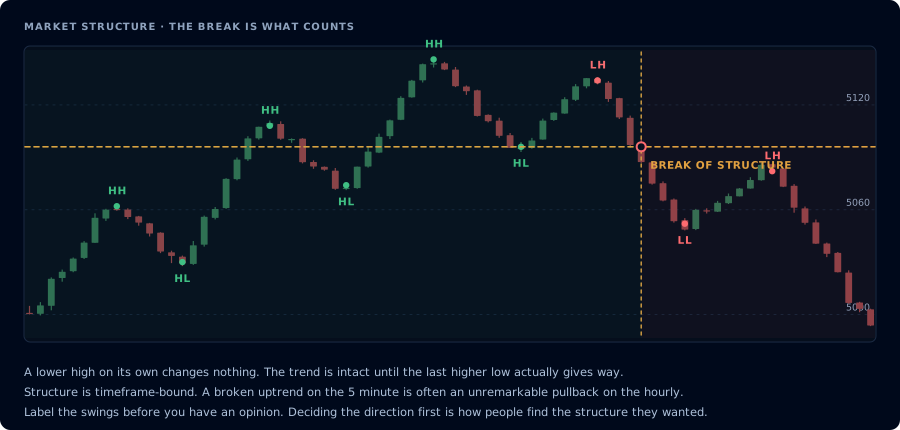
A lower high changes nothing. The trend ends when the last higher low gives way.
The four structure points
Every trend is built from these:
- HH — Higher High (current swing high > prior swing high)
- HL — Higher Low (current swing low > prior swing low)
- LH — Lower High (current swing high < prior swing high)
- LL — Lower Low (current swing low < prior swing low)
Uptrend = sequence of HH and HL. Downtrend = sequence of LH and LL. Range = no consistent direction; mixed structure.
Reading market structure
To read structure, identify the swing highs and lows on your chart. A swing high is a peak with lower bars on both sides; a swing low is a trough with higher bars on both sides.
Once you have your swings, ask:
- Is each new high higher than the prior high?
- Is each new low higher than the prior low?
Both yes → uptrend. Both no → downtrend. Mixed → transition or range.
Structure break (Change of Character)
The most important signal in price-action trading: when an established trend prints a swing point that violates the structure.
Bearish change of character (CHoCH). An uptrend prints a lower low — its first LL after a series of HHs and HLs. The uptrend is officially broken; a downtrend may be starting.
Bullish change of character. A downtrend prints a higher high — its first HH after a series of LHs and LLs.
A CHoCH is not the same as a single counter-bar move. It requires a swing point that breaks structure. This filters noise — random pullbacks don't qualify, only meaningful structure violations.
Why structure matters
1. Defines the trend objectively. "Trend" is often subjective; structure makes it concrete. HH+HL = up. LH+LL = down. No interpretation required.
2. Provides clear invalidation. In an uptrend, the most recent HL is your line in the sand. Break below = trend in question. This makes stop placement obvious.
3. Anchors all other tools. Indicators, patterns, and strategies should be applied within structural context. A mean-reversion setup in a strong uptrend is a setup for failure.
Trading with structure
Trend continuation. In an uptrend, buy pullbacks to prior HLs that hold. The pattern: price makes a new HH, pulls back to a new HL, and you enter on the bounce. Stop below the HL.
Structure break entries. When a downtrend prints a HH (bullish CHoCH), look to enter long on the next pullback. The first counter-trend HH is often the most reliable reversal signal.
Liquidity sweeps. Price often runs just above a prior HH (taking out stops) before reversing. These sweep + reversal patterns are bread and butter for price-action traders. See liquidity sweeps.
Internal vs. external structure
Two timeframes always matter:
External structure = the swing points on your higher timeframe (e.g., 1-hour swings) Internal structure = the swing points on your lower timeframe (e.g., 5-minute swings inside that 1-hour swing)
Pro traders read both. External structure determines the bias; internal structure provides entry timing. A bullish external trend with internal bearish CHoCH = wait for the internal CHoCH back to bullish before entering.
Common mistakes
- Using too small a timeframe for structure reads. 1-minute structure is mostly noise. Read structure on the timeframe where each swing represents meaningful market action.
- Mistaking corrections for CHoCH. A normal pullback in an uptrend can dip below the most recent low without invalidating the broader structure. Read multiple swing points, not just one.
- Drawing structure inconsistently. Be systematic about identifying swings — same rule across the chart, not "this looks like a swing to me."
Frequently Asked Questions
What does HH HL LH LL mean in trading?
HH = Higher High, HL = Higher Low, LH = Lower High, LL = Lower Low. They're the four building blocks of market structure. An uptrend consists of consecutive HH and HL prints. A downtrend consists of LH and LL prints. The first contradiction (HH in a downtrend, or LL in an uptrend) signals a potential trend change.
What is a change of character (CHoCH)?
A change of character is the first swing point that violates the existing trend's structure. In an uptrend, the first LL after a series of HHs and HLs is a bearish CHoCH — the uptrend is broken. In a downtrend, the first HH after LHs and LLs is a bullish CHoCH. Often the earliest reliable reversal signal.
How do I identify a swing high or low?
A swing high is a bar with lower highs on both sides (typically 2-3 bars left and right). A swing low is a bar with higher lows on both sides. The exact lookback depends on timeframe — a 5-bar swing on a 5-min chart and a 5-bar swing on a daily chart represent very different time horizons.
Is market structure better than indicators?
Different tools, complementary use. Market structure tells you the trend's state objectively. Indicators measure things structure doesn't (momentum, volatility, volume). Pros use structure as the foundation and indicators as confirmation, not the other way around.