Order Blocks
An order block (OB) is the last opposing candle before an impulsive move — the last bearish candle before a bullish push (bullish order block) or the last bullish candle before a bearish push (bearish order block). The thesis: institutions place large orders in those candles, leaving residual liquidity that price often returns to. Popularized by Inner Circle Trader (ICT) and Smart Money Concepts (SMC) traders.
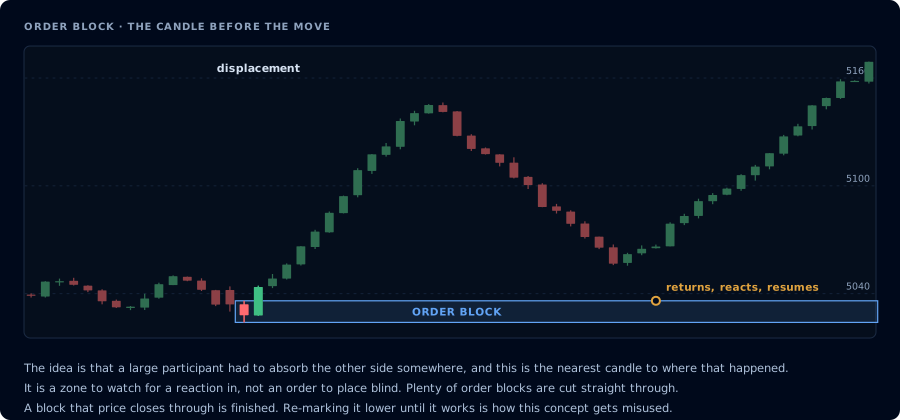
The last opposing candle before the move. A zone to watch, not an order to place.
How order blocks form
The setup:
- Market is moving in one direction (let's say down)
- An opposing candle prints (a bullish candle in the downtrend)
- Price then breaks that candle's low and continues impulsively lower
That last bullish candle (just before the bearish impulse) is a bearish order block. The reasoning: institutions absorbed buying interest in that candle while accumulating short positions, then unleashed selling once they were filled.
The mirror — last bearish candle before a strong bullish push — is a bullish order block.
How to identify them
- Find the impulsive move. Strong, fast, multi-bar move in one direction.
- Look at the last candle of opposite color before the move.
- That candle is the order block.
- Mark its high and low — that's the OB zone.
A "valid" order block in ICT/SMC theory typically also requires:
- The move out of the OB breaks structure (creates a CHoCH or BOS — Break of Structure)
- The move out is not just a single bar — should be a multi-bar impulsive move
- Volume during the impulse should be elevated
How they differ from supply/demand zones
| Order block | Supply/demand zone | |
|---|---|---|
| Granularity | Single candle | Range of base bars |
| Width | Narrow (one bar's range) | Wider (base range) |
| Validation | Often requires structure break | Just requires impulsive move |
| Vocabulary | ICT/SMC | Sam Seiden / generic |
Order blocks are essentially a more precise version of supply/demand zones — picking out the single candle of interest rather than the broader base.
How to trade them
Wait for retest. When price returns to a fresh order block, watch for:
- Rejection candle (pin bar, engulfing) at the OB
- Lower-timeframe structure break in the OB's direction
- Confluence with other levels (HTF S/R, fib, VWAP)
Entry. On the rejection bar's close, or on a lower-timeframe CHoCH inside the OB.
Stop. Beyond the order block — typically just past the OB's high (for a bearish OB short) or low (for a bullish OB long).
Target. Common targets:
- The opposite end of the recent range
- The next significant order block in the opposite direction
- A measured move equal to the impulse leg
Mitigation blocks
A related concept: a mitigation block is a failed order block — one where price returned, "mitigated" the orders, and continued in the original (impulsive) direction.
In trading: when a mitigation block forms (price returns to the OB and rejects), it's confirming the original move's institutional footprint. The trade is often into the impulsive direction, not against it.
This nuance is what separates the more technical SMC traders from the casual users.
Realistic stats
Order block trading is heavily promoted on social media but the actual edge depends entirely on context, timeframe, and discipline. From practical observation:
- Higher timeframe OBs (4H, daily): 60-70% rejection win rates with proper confirmation
- Lower timeframe OBs (5min, 15min): 50-60% — much noisier, more failures
- OBs without confluence: closer to 50/50 — coin flip
- OBs with HTF structural confluence: 65-75% — clearly tradeable edge
The numbers people promote on Twitter (80%+ win rates) are typically cherry-picked. Real OB trading requires patience and confluence.
Common mistakes
- Marking every opposing candle as an OB. Without a strong impulsive move and structure break, it's not a valid OB.
- Using OBs without HTF context. A bullish OB inside a daily downtrend is a low-quality setup. Always read higher timeframe first.
- Tight stops just inside the OB. Order blocks are zones, not lines. Allow a buffer.
- Trading every retest blindly. Wait for confirmation — rejection candle, internal CHoCH, volume surge. The OB is a setup; the confirmation is the trigger.
Frequently Asked Questions
What is an order block in trading?
An order block is the last opposing-color candle before an impulsive move in the new direction. Bullish order block = last bearish candle before a strong rally. Bearish order block = last bullish candle before a strong drop. The theory is that institutions placed orders in those candles, leaving residual liquidity to react to on retest.
How is an order block different from supply and demand?
An order block is a single specific candle. A supply/demand zone is the broader base of multiple candles before an impulsive move. Order blocks are a more precise (narrower) version of the same underlying idea — institutional orders absorbed at a specific price area.
Do order blocks really work?
When properly identified and combined with higher-timeframe context, order blocks have measurable edge — 60-75% rejection win rates with proper confluence. Without context, they perform much closer to 50/50. The marketing-promoted '80%+ win rate' figures are typically cherry-picked and not representative.
What's the difference between order blocks and ICT?
ICT (Inner Circle Trader) is a trading methodology that includes order blocks as one of its core concepts, alongside fair value gaps, liquidity sweeps, and other Smart Money Concepts (SMC). Order blocks predate ICT but were popularized through that methodology.