Supply and Demand Zones
Supply zones are price areas where heavy selling has driven price down sharply, leaving unfilled sell orders behind. Demand zones are price areas where heavy buying has driven price up sharply, leaving unfilled buy orders behind. They differ from generic support/resistance because they're identified by the strong move that followed, not by repeated price tests. The thesis: institutional orders left in those zones may still be active when price returns.
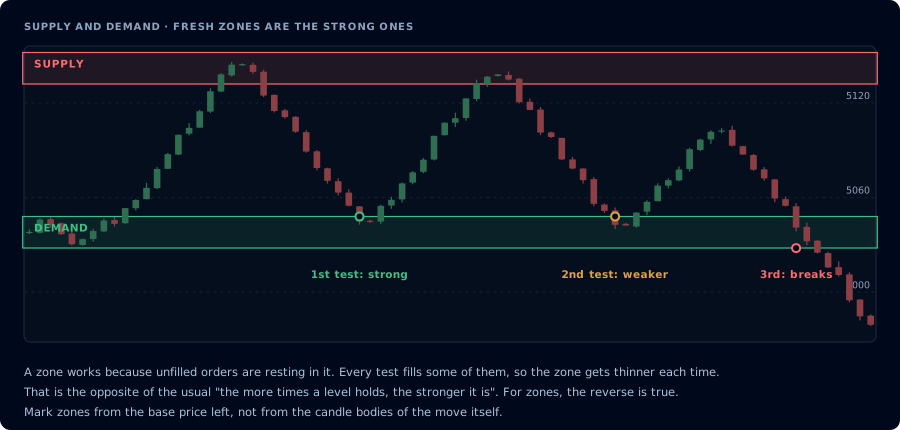
Each test consumes the orders that made the zone work. Fresh zones are the strong ones.
How zones differ from support/resistance
| Support/Resistance | Supply/Demand zones | |
|---|---|---|
| Identified by | Multiple price tests | Single sharp move away |
| Width | Usually a thin level | A range (zone) |
| Strength | Increases with tests | Decreases with tests |
| Source | Memory, round numbers, MAs | Institutional order absorption |
The key insight: a level that's been tested 8 times is weaker as supply/demand than a level that price visited once and then exploded away from. Repeated testing eats up the unfilled orders. A clean, untested zone has the most unfilled liquidity sitting in it.
How to identify zones
Demand zone formation:
- Price consolidates briefly in a small range
- Price explodes upward sharply on heavy volume
- The base from step 1 = the demand zone
Supply zone formation:
- Price consolidates briefly in a small range
- Price drops sharply on heavy volume
- The base from step 1 = the supply zone
The "explosive move" is the key signal. A move that's clearly impulsive — multiple consecutive same-direction bars on volume — left orders behind. A meandering move did not.
Zone naming conventions
Supply/demand traders categorize zones by the move that created and preceded them:
- Rally-Base-Rally (RBR) — uptrend that paused, then continued up. The base = demand zone in the uptrend continuation.
- Drop-Base-Drop (DBD) — downtrend that paused, then continued down. Base = supply zone in the downtrend.
- Rally-Base-Drop (RBD) — uptrend that paused, then reversed down. Base = supply zone (reversal).
- Drop-Base-Rally (DBR) — downtrend that paused, then reversed up. Base = demand zone (reversal).
The four types tell you what reaction to expect when price returns.
How to draw them
- Find the impulsive move. A clear 3-bar+ explosion in one direction.
- Identify the base. The 1-3 bars immediately before the impulsive move.
- Draw the zone. Top and bottom of the base (or top of the base to the highest opposite-color body inside it).
- Mark it as fresh. Until price returns and reacts, the zone is "fresh." Each time it's tested, it weakens.
How to trade them
Reaction entry. When price returns to a fresh zone, look for rejection. Enter on the first reaction bar.
Stop. Beyond the zone — outside the base of the formation. Tighter stops fail because zones are zones, not exact prices.
Target. Often the next opposing zone, or a measured move equal to the size of the original impulsive leg.
Win rate for fresh zone entries with rejection confirmation: typically 60–70%. The win rate drops sharply with each subsequent test of the same zone.
Validation criteria
- Strong departure. The move out of the zone must be impulsive — fast, large, on volume. Slow drifts don't count.
- Tight base. The base before the impulse should be tight (1-3 bars, narrow range). Wide bases produce diffuse zones.
- Untested. Fresh zones are highest-conviction. After 1-2 tests, the zone is weaker. After 3+, treat it as broken.
- Higher timeframe context. A demand zone that aligns with a higher-timeframe trend or structural support is much stronger than one in isolation.
Common mistakes
- Treating every consolidation as a zone. Without a strong impulsive move out of the base, it's not a zone — it's just chop.
- Using zones in isolation. Pair with broader trend (don't take demand-zone longs in a daily downtrend).
- Drawing zones too wide. A zone that's 30 points wide on ES is essentially "anywhere." Tight bases produce tight zones.
- Re-using broken zones. Once price has decisively traded through a zone, the orders are gone. Don't keep trying to use it.
Frequently Asked Questions
What's the difference between supply/demand zones and support/resistance?
Support/resistance levels are identified by repeated price tests — they get stronger with more touches. Supply/demand zones are identified by a single explosive move away from a base — they get weaker with more touches. Different evidence, different lifecycle.
How wide should a supply or demand zone be?
As wide as the base that produced the impulsive move — typically 1-3 bars' worth of range. Tight bases (5-10 ticks on ES) produce tight, high-conviction zones. Wide bases (30+ ticks) produce diffuse zones with weaker reactions.
Are supply and demand zones the same as order blocks?
Closely related but with different vocabulary. Order blocks (popularized in ICT/SMC trading) typically refer to the last opposing-color candle before an impulsive move. Supply/demand zones use the entire base. Both rely on the same underlying idea: institutional orders left at a specific area.
How long do supply and demand zones stay valid?
Until they're meaningfully tested. A fresh zone can stay valid for weeks if price doesn't return. Once tested 1-2 times with reaction, it remains usable but weaker. After 3+ tests or a decisive close through the zone, it's typically broken.