Support and Resistance
Support is a price level where buying pressure has historically been strong enough to halt declines. Resistance is a level where selling pressure has historically been strong enough to halt advances. They're the two most important concepts in technical analysis — every other tool (indicators, patterns, strategies) is ultimately about finding where price is likely to react and which direction it's likely to react.
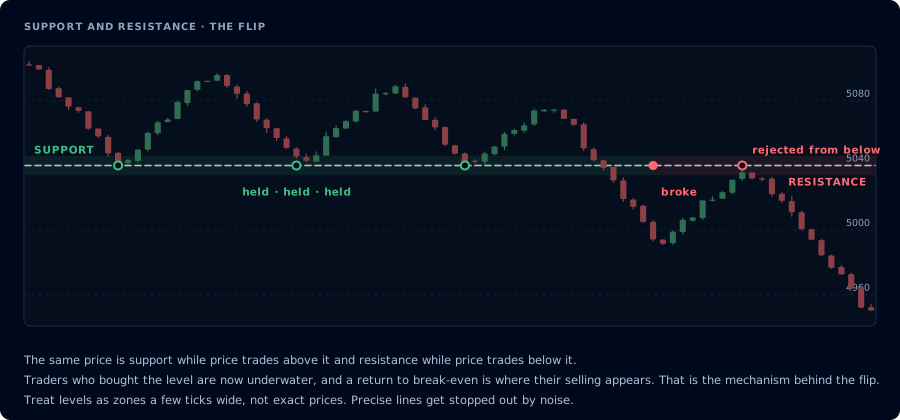
The level never moved. What changed is which side of it price is trading on.
What creates support and resistance
Three sources:
1. Memory. Traders remember prices. A level where many people bought becomes psychological support — sellers hesitate to push below it, buyers eagerly defend it.
2. Order resting at levels. Limit orders pile up at round numbers, prior highs/lows, and pivot levels. When price reaches them, those orders execute and create real buying or selling pressure.
3. Algorithmic reaction. Many trading algorithms are programmed to react at specific levels — moving averages, pivot points, prior swing highs/lows. Their participation reinforces the level's behavior.
The combination makes certain prices "sticky" — price reaches them and stalls.
Types of support/resistance
Horizontal levels. Drawn through prior swing highs (resistance) and swing lows (support). The most basic and most-watched type.
Trendlines. Sloping lines connecting a series of higher lows (uptrend support) or lower highs (downtrend resistance). Less precise than horizontals but capture trend dynamics.
Moving averages. The 20, 50, and 200-period MAs (especially the 200-day) act as dynamic support/resistance. Price often respects them, especially the 200-day.
Round numbers. $5,000 on ES, $100 on CL, $2,000 on GC — round numbers attract orders and reactions.
Pivot levels. Pivot Points compute mathematical S/R based on the prior session's range.
Prior session high/low. Yesterday's high and low frequently act as today's S/R.
VWAP and POC. VWAP and Volume Profile POC act as intraday institutional reference levels.
The role-reversal principle
When support breaks, that level often becomes resistance on the way back up. Conversely, when resistance breaks, it often becomes support on a pullback.
The logic: traders who bought at the now-broken level are underwater. When price returns to that level, they're often eager to "get out at breakeven" — creating selling pressure that turns the former support into resistance.
This is why retests of broken levels are some of the highest-conviction trade setups. The old level + new role + clear invalidation point = clean R:R.
How to draw S/R
Three rules:
- Use closing prices, not wicks. A level that closed at 5,000 multiple times is stronger than a level that wicked through 5,003 once.
- Multiple touches strengthen the level. A line touched 5 times is stronger than a line touched 2 times. But 10+ touches usually means the level is about to break.
- Higher timeframes win. Daily levels override intraday levels. Weekly levels override daily.
How to trade them
Bounce trades. Enter on a rejection of S/R. Stop just beyond the level. Target the next opposite level.
Breakout trades. Enter on a close beyond S/R. Stop inside (just back through the level). Target measured move or next level.
Retest trades. After a breakout, wait for price to retest the broken level. Enter on a hold/rejection in the breakout direction. Tighter stops, higher win rates than initial breakouts.
Common mistakes
- Drawing too many levels. A chart with 15 S/R lines is useless. Focus on 3-5 levels per timeframe.
- Treating exact prices as exact. S/R is a zone, typically 2-5 ticks wide. Plan for that.
- Trading every touch without confirmation. A level alone is not a trade. Wait for price action confirmation (rejection candle, volume).
- Ignoring timeframe context. A 5-minute resistance is meaningless if it sits inside a daily range. Check the bigger picture.
Frequently Asked Questions
How do I find support and resistance levels?
Look for prices where price has previously stalled, reversed, or consolidated — multiple swing highs at the same price = resistance; multiple swing lows = support. Then layer in moving averages (especially the 200-day), round numbers, prior session highs/lows, and pivot points.
Do support and resistance levels always hold?
No. S/R levels eventually break — sometimes after one test, sometimes after ten. The key is recognizing breaks vs. holds: a breakout closing beyond the level with volume signals a true break; a wick beyond that closes back inside is usually a stop-hunt failure.
What is role reversal in support and resistance?
When support breaks, that level frequently becomes resistance on subsequent pullbacks. The reverse is also true — broken resistance often becomes new support. This is one of the most reliable concepts in price-action trading and forms the basis of high-probability retest setups.
Are support and resistance lines or zones?
Zones, in practice. A level you've drawn at exactly 5,000 might see reactions anywhere from 4,997 to 5,003. Build that 2-5 tick buffer into your stop placement and entry criteria. Treating S/R as exact prices leads to stop-outs on normal noise.