Daily Loss Limits
A daily loss limit is a hard stop on cumulative losses within a single trading session. When hit, you stop trading — no exceptions, no "one more trade." It's the single most effective tool against the pattern where a bad morning becomes a catastrophic day via revenge trading. Set it, enforce it with automation, and treat it as non-negotiable.
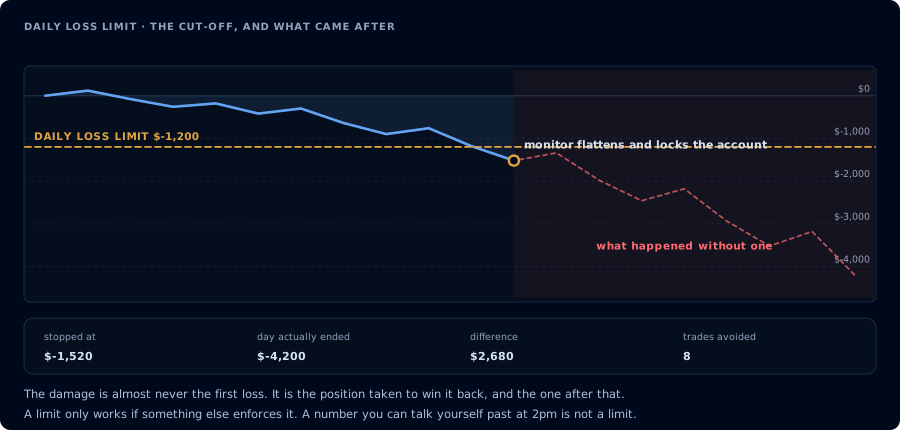
The damage is never the first loss. It is the position taken to win it back.
Why daily limits exist
Most blown accounts don't come from a single bad trade. They come from days — cascades where a trader loses on the first setup, tries to make it back, doubles down, breaks rules, and by the close has lost 10× what a normal bad day would cost.
Daily loss limits break this cascade. When the limit is hit, trading stops. The account lives to fight tomorrow. Over a career, this one rule prevents more catastrophic drawdowns than any other.
How much is a reasonable daily limit
A common formula: Daily Loss Limit = 3× per-trade risk.
If per-trade risk is $500 (1% of a $50k account), daily loss limit = $1,500 (3%).
This assumes:
- You can absorb 3 losing trades in a row without panicking
- Three losses is an unusual day but not catastrophic
- After that, the edge case for the day is probably broken and you should step away
Some traders prefer 2× per-trade risk (more conservative) or 5× (more aggressive). The right number is the one that feels stringent but achievable.
Prop firm context
If you're trading at a prop firm (Lucid, Tradeify, Take Profit Trader, etc.), the firm enforces its own daily loss limit — often 2–4% of the combine/funded balance. Violating it results in:
- Immediate termination of the combine, or
- Reset back to starting balance, or
- Loss of the funded account
Prop firm daily limits are non-negotiable. Internal daily limits should be inside the prop firm limit — stop yourself before the firm does.
Types of daily limit triggers
Dollar drawdown limit. Stop when cumulative P&L is down $X for the day. Most common form.
Trailing daily limit. Stop when you've given back $X from the day's high-water mark. Prevents the common pattern of being up money at 10am and giving it all back by the close.
Consecutive-loss limit. Stop after N losing trades in a row. Complements dollar limits — catches cases where small but relentless losses erode discipline before the dollar limit fires.
Time-based limit. Stop trading after a certain time (e.g., 2pm ET). Prevents fatigue-based mistakes during slow afternoon hours.
The strictest version uses all of the above — whichever trigger fires first.
Enforcement is the hard part
Setting a daily limit is easy. Enforcing it when you're down money is where most traders fail. The human brain, under loss pressure, produces an endless stream of "just one more trade" justifications.
Three levels of enforcement, from weakest to strongest:
1. Personal rule (weakest). Tell yourself you'll stop at −$1,500. Under stress, you'll revise.
2. Physical friction (medium). Log out of the platform when the limit hits. Turn off the monitor. Leave the house. Adds friction that most "one more trade" impulses can't overcome.
3. Automated kill switch (strongest). Software that flattens your positions and prevents new orders when the limit triggers. No willpower required.
Automated enforcement with CrossTrade
CrossTrade's Account Manager supports hard daily loss limits that:
- Flatten all open positions automatically when the P&L threshold is breached
- Reject new order placement for the rest of the session
- Reset at the start of the next trading day
This is the closest thing to a prop-firm-grade kill switch a retail trader can configure. Set it once, forget it until tomorrow. See the daily loss limit documentation for configuration.
Revenge trading — the pattern you're fighting
The loop goes:
- First trade loses (−1R)
- "I know I can make it back" → second trade, larger size
- Second trade loses (−2R or worse)
- Emotion escalates. Trade quality degrades. Size grows.
- By the close, down −10R to −30R on a day that should have been −1R or −2R
The daily loss limit is designed to stop the loop at step 3 or 4. Not to prevent the first loss (you can't) — to prevent the first loss from becoming a catastrophe.
Pairing with weekly and monthly limits
Some traders stack:
- Daily limit: 3× per-trade risk, e.g., −$1,500 on $50k account
- Weekly limit: 2× daily limit, e.g., −$3,000 on the week
- Monthly limit: 2× weekly limit, e.g., −$6,000 on the month
Hit a weekly limit and you take the rest of the week off to review. Hit monthly, take the rest of the month off. This prevents a single bad week from compounding into a career-ending month.
Frequently Asked Questions
What's a good daily loss limit for futures trading?
Roughly 3× your per-trade risk, or about 2–3% of account equity. For a $50,000 account risking 1% per trade ($500), a reasonable daily limit is $1,500. Stricter is better than looser — the goal is to stop before a bad day becomes a catastrophic one.
How do I enforce a daily loss limit?
Three levels: (1) personal rule (weakest), (2) physical friction like logging out and walking away (medium), (3) automated kill switches that flatten positions and block new orders (strongest). Only automation reliably overrides the stress-driven 'one more trade' impulse.
Do prop firms have daily loss limits?
Yes — every major prop firm (Lucid, Tradeify, Take Profit Trader, etc.) enforces a strict daily loss limit, usually 2–4% of the starting balance. Violating it results in termination, reset, or loss of the funded account. Your internal limit should be tighter than the firm's.
Should I include commissions in the daily loss calculation?
Yes. Commissions are real losses. A day where you scratch breakeven on prices but pay $200 in commissions is a −$200 day, not a flat day. Track gross P&L minus fees as the number that triggers the limit.