The 1% Rule
The 1% rule says: risk no more than 1% of your account equity on any single trade. Simple to state, easy to violate. The most common mistake is measuring "risk" as position size or notional value instead of max loss if the stop hits. Get this one definition right and your account will survive almost any strategy.
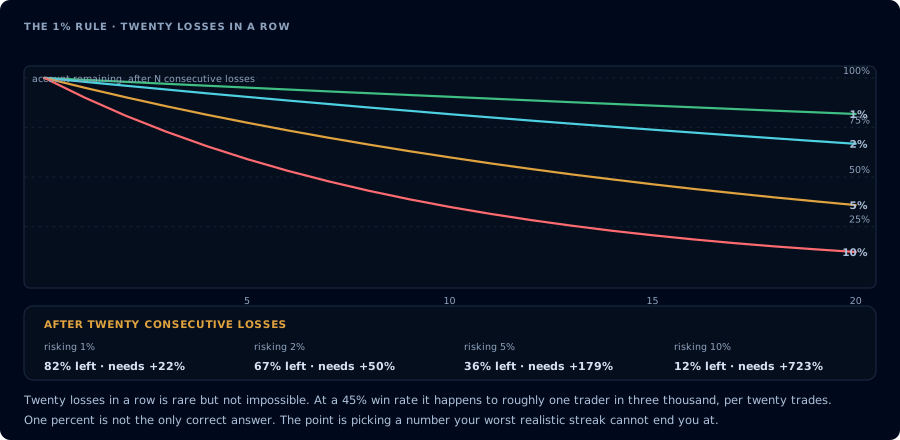
Twenty losses in a row: survivable at 1%, effectively terminal at 10%.
The correct definition
Risk = dollars you'd lose if your stop-loss executes at the planned stop price.
Not your position size. Not your margin requirement. Not the notional value of the contract.
Example: $50,000 account. 1% rule allows $500 max loss per trade.
- Long 2 ES at 5,000 with stop at 4,996 (4 points): risk = 4 × $50 × 2 = $400. Within 1% rule.
- Long 4 ES at 5,000 with stop at 4,996: risk = 4 × $50 × 4 = $800. Exceeds 1% rule.
- Long 10 MES at 5,000 with stop at 4,996: risk = 4 × $5 × 10 = $200. Within 1% rule.
Same entry, same market move — the only thing that changes the 1% compliance check is the dollar amount you'd lose to the stop.
Why 1% and not 2% or 5%
Math of survival. Assuming a 50% win rate (which is high for many strategies) and a series of independent losing trades, the probability of hitting a catastrophic drawdown shrinks sharply as per-trade risk drops:
- At 5% per trade, 10 losing trades in a row = 40% drawdown (compounded), which is extremely painful and common
- At 2% per trade, 10 losses = 18% drawdown, still tough but recoverable
- At 1% per trade, 10 losses = 9.6% drawdown, manageable
- At 0.5% per trade, 10 losses = 4.9% drawdown, trivial
Your worst streak in a year of trading is probably 7–12 consecutive losses. Size so that streak doesn't end your career.
Common misapplications
1. Sizing by margin. "I have $5,000, day margin is $500 per ES, so I can trade 10 contracts." No — that's not what the 1% rule says. Risk is about the stop distance, not the margin.
2. Ignoring correlation. Four long ES, CL, GC, NQ at 1% each = 4% total correlated dollar risk if equity goes up across risk-on days. Aggregate simultaneous risk matters as much as per-trade risk.
3. Sizing off a stale account balance. Using your high-water mark to size risk while in a 20% drawdown means you're still risking pre-drawdown dollars against a smaller equity base. Size off current equity, re-evaluated periodically.
4. Ignoring slippage. Stop at 4,996 doesn't guarantee a 4,996 fill. In fast markets, you may fill at 4,994 — losing 6 points instead of 4. Budget a 10–20% cushion to absorb realistic slippage.
Professional pushback on 1%
Many profitable traders risk less than 1% — often 0.25% to 0.5% per trade. They accept smaller per-trade gains in exchange for much smoother equity curves and longer careers.
Conversely, some aggressive hedge fund strategies target 3–5% per trade — but with uncorrelated diversification across dozens of positions and significant tail-risk hedging. Retail traders with 1–3 concentrated futures positions should not mimic this.
The 1% number is a reasonable default for retail futures. Edge toward 0.5% if you're new or running one strategy. Edge toward 2% only if you have diversified strategies and edge you've actually measured (not imagined).
What 1% looks like at different account sizes
| Account | 1% Risk |
|---|---|
| $5,000 | $50 |
| $10,000 | $100 |
| $25,000 | $250 |
| $50,000 | $500 |
| $100,000 | $1,000 |
| $250,000 | $2,500 |
Smaller accounts often can't trade full-size contracts while respecting the 1% rule — which is why MES and MNQ exist. A $10,000 account risking $100 on a 4-point stop means at most:
Contracts = $100 / (4 × tick-value × ticks-per-point)
          = $100 / (4 × $12.50 × 4)    [ES math]
          = $100 / $200 = 0.5 → can't trade ES at this stop
vs. MES:
Contracts = $100 / (4 × $1.25 × 4) = $100 / $20 = 5 MES contracts
This is the single best argument for micros: they let small accounts comply with 1%.
Integrating with automation
In a TradingView strategy, cap risk explicitly:
//@version=6
strategy("1% Rule Sizing", overlay=true, initial_capital=50000)

riskPct    = input.float(1.0, "Risk %")
stopPoints = input.float(4.0, "Stop Distance (points)")
pointValue = input.float(50,  "Point Value of 1 Contract")

riskDollars = strategy.equity * (riskPct / 100)
qty         = math.max(1, math.floor(riskDollars / (stopPoints * pointValue)))

if ta.crossover(close, ta.sma(close, 20))
    strategy.entry("Long", strategy.long, qty=qty)
    strategy.exit("Stop", "Long", stop=close - stopPoints)
The strategy re-computes size on every trade based on current equity — as the account grows, size grows; as it shrinks, size shrinks.
Frequently Asked Questions
What does the 1% rule mean in trading?
Risk no more than 1% of your account equity on any single trade. 'Risk' is specifically the dollar amount you'd lose if your stop-loss executes — not position size, not margin, not notional value.
Is the 1% rule too conservative?
For retail futures traders, 1% is a solid default. Professional desks often run tighter (0.25–0.5%) with much larger accounts; aggressive strategies with true diversification can run 2%+. For most retail traders with 1–3 concentrated positions, 1% or below is the right answer.
How is the 1% rule different from risk-of-ruin calculation?
The 1% rule is a fixed ceiling. Risk-of-ruin is a probability calculation — how likely is your strategy to blow up, given win rate, loss rate, and per-trade risk. They're related: a 1% per-trade risk typically produces negligible risk-of-ruin for any reasonable strategy, while 5% per-trade risk produces meaningful ruin probability.
Can I risk 1% on each of ten correlated trades?
Only if you're comfortable that those trades can all go wrong together — which, for correlated instruments, they can. Aggregate correlated risk should be treated as one position's risk, not ten. Cap total simultaneous correlated risk at 2–3% of equity.