Position Sizing for Futures Traders
Position sizing answers one question: how many contracts do I trade so that if my stop hits, I lose exactly my risk budget — no more, no less. The formula is: Contracts = Risk Budget / (Stop Distance × Tick Value). Everything else in trading is secondary. Size wrong and the best strategy in the world will eventually ruin you.
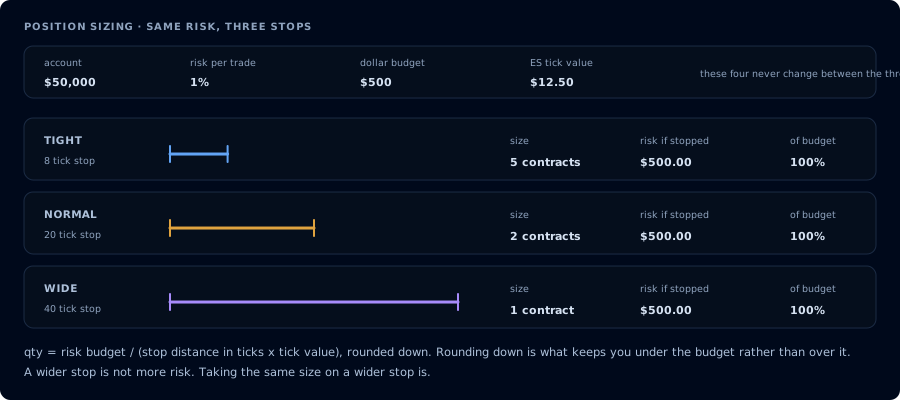
Same account, same 1%, three stops. Size is the output, not the input.
The single formula
Contracts = Risk Budget ($) / (Stop Distance in ticks × Tick Value per contract)
Or equivalently, using points:
Contracts = Risk Budget ($) / (Stop Distance in points × Point Value)
That's the whole thing. Every other sizing method is a wrapper around this.
Worked examples
Example 1 — ES day trade
- Account: $50,000
- Risk per trade (1%): $500
- Instrument: ES ($50/point, $12.50/tick)
- Planned stop distance: 4 points (16 ticks)
Contracts = $500 / (16 × $12.50) = $500 / $200 = 2.5 → round down to 2 contracts
Trade 2 ES contracts. If stopped out: 4 × $50 × 2 = $400 (just under the $500 budget). If the round number doesn't work, round down, never up.
Example 2 — NQ with tighter stop
- Account: $50,000
- Risk per trade (1%): $500
- Instrument: NQ ($20/point, $5/tick)
- Planned stop distance: 25 points (100 ticks)
Contracts = $500 / (100 × $5) = $500 / $500 = 1 contract
One contract exactly risks $500.
Example 3 — MES with small stop
- Account: $10,000
- Risk per trade (1%): $100
- Instrument: MES ($5/point, $1.25/tick)
- Planned stop distance: 4 points (16 ticks)
Contracts = $100 / (16 × $1.25) = $100 / $20 = 5 MES contracts
Five micros. Same market exposure sizing as one full ES — but at a tenth the dollar risk per point.
Why fixed-contract sizing is broken
"I always trade 1 contract" is the most common mistake. It hard-codes dollar risk to whatever the stop distance is that day. A 4-point ES stop = $200 risk. A 12-point ES stop = $600 risk. Same strategy, 3× the exposure, just because volatility was higher one day.
Sizing by dollar risk (not by contracts) keeps risk constant across regimes. Your stop adapts; your contract count adapts; your dollar exposure stays fixed.
Risk budget as a percentage of account
The classic rule: risk no more than 1–2% of account equity per trade.
| Risk % | Account | Max loss per trade |
|---|---|---|
| 0.5% | $50,000 | $250 |
| 1% | $50,000 | $500 |
| 2% | $50,000 | $1,000 |
| 1% | $100,000 | $1,000 |
| 1% | $10,000 | $100 |
Below 1% is conservative and sustainable. 2% is aggressive — a 5-trade losing streak costs 10% of equity. Anything above 2% per trade is gambling.
A common adjustment: base risk % on equity at the start of the week (or month). This prevents compounding gains into bigger risks immediately, and it prevents death spirals when equity shrinks (you're still sizing off the high-water mark, not a drawdown-reduced base).
Scaling — when to add more contracts
As account grows, let risk scale proportionally:
- $10,000 account at 1% → $100 risk → 5 MES or 1 MNQ
- $50,000 account at 1% → $500 risk → 2 ES or 1 NQ
- $100,000 account at 1% → $1,000 risk → 4 ES or 2 NQ
Never let the absolute dollar risk mutate because of a winning streak. "I'm hot, let me go up to 4 contracts" is how traders give back gains.
Adapting to volatility (ATR-based sizing)
Instead of fixed stop distance, use ATR:
Stop Distance = N × ATR(14)
Contracts = Risk Budget / (Stop Distance × Point Value × N)
When ATR is high (volatile days), stops widen and contract count shrinks automatically. When ATR is low (quiet days), stops tighten and contract count grows.
This keeps dollar risk constant across volatility regimes — which is what "good risk management" actually means. See ATR explained.
Correlation risk
If you run five strategies — all on ES — and they all go short at the same time, you don't have five 1% positions. You have one 5% position in a trench coat.
Correlated positions amplify drawdown. Either:
- Cap total simultaneous risk at 2–3% across all correlated positions, or
- Diversify across uncorrelated instruments (ES long + CL long + GC long = different drivers)
Solo futures day traders often ignore this. Professional allocators obsess over it.
Automating correct position sizing
In a TradingView strategy() script, compute size inline:
//@version=6
strategy("Position-sized entry", overlay=true, pyramiding=0)

riskBudget  = input.float(500, "Risk per trade ($)")
pointValue  = input.float(50,  "Point value of 1 contract")
stopPoints  = input.float(4.0, "Stop distance in points")

contracts = math.max(1, math.floor(riskBudget / (stopPoints * pointValue)))

longCond = ta.crossover(close, ta.sma(close, 20))

if longCond
    strategy.entry("Long", strategy.long, qty=contracts)
    strategy.exit("Stop", "Long", stop=close - stopPoints)
Then forward the computed quantity through your CrossTrade webhook via {{strategy.order.contracts}}.
Frequently Asked Questions
How much should I risk per trade?
Most sustainable traders risk 0.5–1% of account equity per trade. 2% is aggressive; beyond 2% is gambling. The lower your risk per trade, the more losing streaks your account can absorb without catastrophic drawdowns.
Should I size by contracts or dollars?
Size by dollars. 'I always trade one contract' ignores stop distance and ties dollar risk to volatility. Size by dollar risk on the stop, and your contract count will automatically scale with volatility.
How do I size positions across multiple strategies?
Cap total simultaneous risk at 2–3% of equity across all open positions — not per-trade. If three strategies are all long ES, that's one 3% position, not three 1% positions. Track total correlated exposure, not per-position.
Can I use leverage fully just because my broker allows it?
You can. You shouldn't. Broker leverage allowances are the maximum you're permitted to take — not the amount you should take. Size by dollar risk and stop distance, not by 'how many contracts can I afford per the margin requirement.'