Risk of Ruin
Risk of ruin (RoR) is the probability that a series of losing trades reduces your account to zero (or below a usable threshold) before it recovers. It depends on three inputs: win rate, reward-to-risk ratio, and per-trade risk as a % of account. A strategy with a positive expectancy can still have meaningful risk of ruin if per-trade risk is too high.
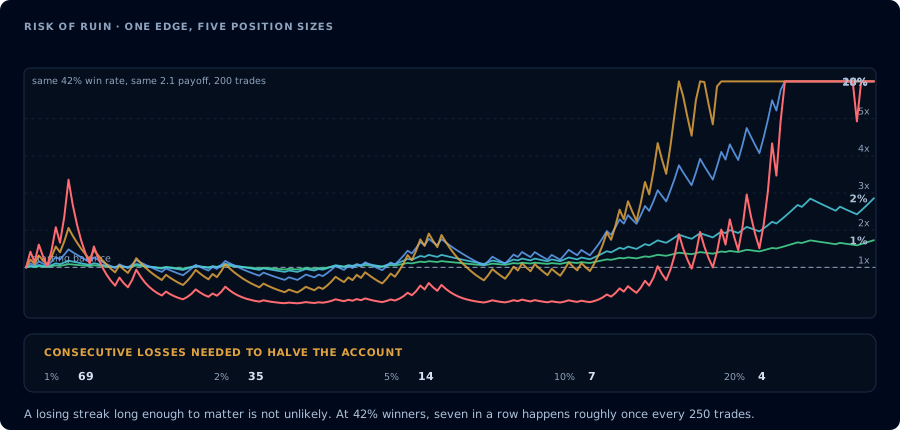
One winning edge, five position sizes. Two of them go to zero.
Why RoR matters
Profit factor, Sharpe, expectancy — all measure average performance. They don't answer: "what's the chance this blows up before it pays off?"
RoR does. A strategy with profit factor 1.5 and 1% per-trade risk might have RoR under 0.01% — essentially zero. The same strategy with 10% per-trade risk might have RoR of 20% — one in five accounts blow up. Same strategy, dramatically different fate.
The simple formula
For equal-size wins and losses (1:1 R:R):
RoR = ((1 − W) / W)^N
Where W = win rate (as decimal), N = the number of units of capital at risk relative to per-trade risk.
Example: W = 60%, and you risk 1% per trade → N = 100 (100 units of 1% each = your whole account):
RoR = (0.4 / 0.6)^100 ≈ 2.5 × 10^-18
Effectively zero. A 60%-win strategy risking 1% per trade has essentially no chance of ruin.
Same strategy at 10% per-trade risk → N = 10:
RoR = (0.4 / 0.6)^10 ≈ 0.017 = 1.7%
About 1 in 60 chance of blowing up. Not zero, not negligible.
Same strategy at 25% per-trade risk → N = 4:
RoR = (0.4 / 0.6)^4 ≈ 0.198 = 19.8%
One in five. Ruinous.
Generalizing for unequal R:R
Most strategies don't have 1:1 reward-to-risk. The general formula requires a recursive calculation, but a close approximation:
RoR = ((1 − A) / (1 + A))^N
Where A = trader's edge = (W × avg_win − L × avg_loss) / avg_loss, essentially expectancy expressed as R-multiple.
Rough guide:
| Edge (per-trade R) | Per-trade risk | Approx RoR |
|---|---|---|
| +0.1R | 1% | < 0.1% |
| +0.1R | 5% | ~5% |
| +0.3R | 1% | effectively 0 |
| +0.3R | 5% | ~1% |
| +0.3R | 10% | ~10% |
| 0 (no edge) | any | 100% over time |
Key insights from RoR math
1. Edge matters, but per-trade size matters more. Doubling your edge shrinks RoR modestly. Halving your per-trade risk shrinks RoR dramatically.
2. With zero edge, ruin is inevitable. If your expectancy is 0R or negative, RoR approaches 100% given enough trades. No amount of position sizing can fix a losing strategy.
3. Small per-trade risk buys margin for error. At 0.5–1% per trade, a moderately positive-edge strategy has negligible RoR for all practical purposes. This is why conservative sizing dominates retail trading advice.
4. Losing streaks are normal. Even a 60%-win strategy has a ~0.5% chance of 5 losses in a row and a ~3% chance of 4 in a row. Over a year, these streaks are expected, not exceptional.
Kelly Criterion and its caveats
Kelly Criterion computes the per-trade size that maximizes geometric growth rate:
Kelly % = W − ((1 − W) / RRR)
For W = 60%, RRR = 1.5: Kelly% = 60% − (40% / 1.5) = 33%. Kelly says bet 33% per trade.
Do not actually do this. Full Kelly sizes produce wild drawdowns — typically 40–60% drawdowns are normal at full Kelly. Most professionals trade at ¼ Kelly to ½ Kelly (so 8% to 16% per trade in the above example). Most retail traders should stay at fractional Kelly equivalents of 1–2% per trade regardless.
Kelly assumes:
- You know your edge exactly (you don't)
- Returns are independent trial-to-trial (they're not — regimes persist)
- You can compound continuously (you can't with discrete contract sizes)
Treat Kelly as a theoretical ceiling, not a target.
Practical RoR targets
For retail futures traders: aim for RoR under 0.5% across 100 trades. This is comfortably achieved with per-trade risk ≤ 1% and positive expectancy.
For prop firm traders: RoR needs to be under the firm's drawdown limit probability. If the firm liquidates at 5% drawdown, per-trade risk needs to be small enough that a losing streak doesn't hit it — typically 0.25–0.5% per trade max.
For swing traders: fewer trades per year → smaller N → RoR calculations less sensitive to small parameter changes. You can size slightly larger (1.5–2% per trade) if edge is well-established.
RoR and psychology
Low RoR also produces psychologically tradeable equity curves. A strategy with RoR 0.01% typically has smooth, low-drawdown equity. A strategy with RoR 15% has terrible drawdowns even when it survives. Most traders quit long before ruin actually arrives — the drawdowns break them first.
Sizing for low RoR is sizing for behavioral survival, not just mathematical survival.
RoR calculator in Python
def risk_of_ruin(win_rate, rrr, risk_per_trade_pct, initial_capital=1.0):
    """Approximate RoR using the Kelly-style formula."""
    edge = win_rate * rrr - (1 - win_rate)
    if edge <= 0:
        return 1.0  # eventual ruin guaranteed
    advantage = edge / max(rrr, 1)  # trader's edge relative to per-trade risk
    N = 1 / risk_per_trade_pct       # number of per-trade risk units in capital
    return ((1 - advantage) / (1 + advantage)) ** N

# Example
print(f"{risk_of_ruin(0.55, 1.5, 0.01):.4%}")  # 55% win, 1.5:1 RRR, 1% per trade
print(f"{risk_of_ruin(0.55, 1.5, 0.05):.4%}")  # 5% per trade
Frequently Asked Questions
What is risk of ruin in trading?
The probability that a series of losing trades reduces your account to zero (or an unusable threshold) before it recovers. It depends on win rate, reward-to-risk ratio, and per-trade risk as a percentage of account.
How do I reduce my risk of ruin?
The single most effective lever is reducing per-trade risk as a percentage of your account. Going from 5% per trade to 1% per trade shrinks risk of ruin from meaningful levels to near-zero for any positive-edge strategy. Improving win rate or RRR helps, but not as dramatically.
Can a profitable strategy still have ruin risk?
Yes — if per-trade risk is too high relative to account size. A 55%-win strategy risking 10% per trade has ~15% ruin probability even though it has positive expectancy. Profitable strategies blow up via oversizing more often than via loss of edge.
Is Kelly criterion the right position size?
Full Kelly is too aggressive for real trading — it produces 40–60% drawdowns as a matter of course. Most professionals use ¼ to ½ Kelly. Most retail traders should stay at 1–2% per trade, which is typically a small fraction of full Kelly for a reasonable-edge strategy.