Stop Loss Placement
Stop-loss placement is the single decision that does the most to determine your win rate, expected R, and overall profitability. The three dominant methods are ATR-based (volatility-adaptive), fixed (a constant point distance), and structure-based (beyond a swing low/high, prior support). Structure stops are the most effective but require practice; ATR is the best default.
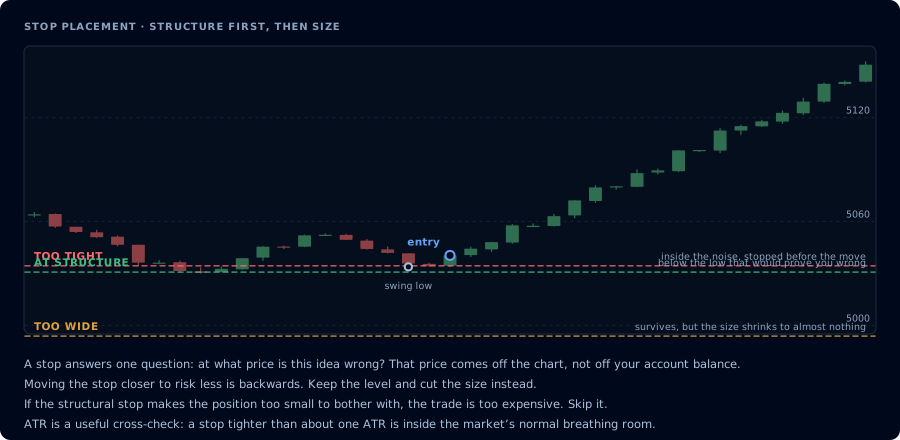
The chart picks the level, the account picks the size. Never the other way round.
Why stop placement matters more than entry
Most new traders fixate on entries. The truth: a great entry with a bad stop is worse than a mediocre entry with a great stop. Stop placement governs:
- Win rate (loose stops win more often)
- Average loss size (defines your "R")
- Risk-to-reward ratio
- Psychological ease of holding a trade
Spending 80% of your study time on stops instead of entries is a profitable inversion of priorities.
Method 1: ATR-based stops
Place stops at a multiple of ATR beyond entry.
Long stop  = Entry − (N × ATR)
Short stop = Entry + (N × ATR)
Typical N: 1.5× to 2× for day trading, 2× to 3× for swing.
Pros:
- Self-adjusts with volatility (wider on volatile days, tighter on calm days)
- Works across all instruments without tuning
- Simple to automate
Cons:
- Can place stops in meaningless locations (not tied to price action)
- Doesn't respect important chart levels
Best for: systematic strategies, traders who want a hands-off sizing rule, multi-instrument portfolios. See ATR explained.
Method 2: Fixed stops
A constant point or tick distance regardless of market state.
Long stop  = Entry − 8 ticks
Short stop = Entry + 8 ticks
Pros:
- Dead simple
- Predictable risk per trade
- Easy to backtest
Cons:
- Doesn't adapt to volatility — a fixed 8-tick stop on ES is too wide in quiet markets and too tight in volatile ones
- Ignores price structure entirely
Best for: scalping strategies in consistent-volatility regimes, beginners learning the mechanics.
Method 3: Structure stops
Place stops beyond a meaningful price structure: a recent swing low (for longs), a swing high (for shorts), below support, above resistance.
Pros:
- Stops are invalidated only when the setup itself is invalidated
- Tends to produce the highest win rates of the three
- Aligns with how professional traders actually think
Cons:
- Requires skill in identifying real structure (not every wiggle is a valid swing)
- Stop distance varies — sizing is less predictable
- Some structures are too far away, forcing tiny positions or a rethink
Best for: discretionary traders, swing setups, any trade where the "idea" has a clear level that, if broken, proves the idea wrong.
Hybrid approaches
Most professional traders combine methods:
Structure + minimum ATR floor. Use structure stops, but never tighter than 1× ATR. Prevents getting stopped out on noise inside the structure.
ATR + visual sanity check. Compute the ATR stop programmatically, then visually inspect — if it sits in the middle of a recent range, adjust to the nearest structural level.
Trailing stops combining both. Enter with a structure stop; once the trade is +1R, trail with an ATR-multiple below price. Capture trend moves without giving back open profit.
What stops are NOT
Stops are not "how much I'm willing to lose." They are "where is this trade wrong?" If the answer to the second question is 15 points away, size down — don't move the stop closer and pretend the trade thesis holds.
Stops are not optional. "I'll just watch and pull out manually" fails. Manual stops get disregarded in the moment. Use hard stops or don't trade.
Stops are not set-and-forget on long moves. Trail them. Don't give back a 4R move to a −1R stop out.
Mental stops vs hard stops
Mental stop: you'll exit if price touches X, but no resting order is in the market. Hard stop: a stop-loss order sitting at price X, will fire automatically.
Hard stops win almost every time because:
- Mental stops get revised under stress ("I'll give it one more tick")
- Mental stops fail when you lose internet/power/discipline
- Hard stops execute faster than human reaction
The rare exception: markets so illiquid or gap-prone that hard stops get filled at disastrous prices during fast moves. In index futures, this is rarely an issue. In thin commodity markets, use discretion.
Stop-out rates and expectations
A good intraday futures strategy has a stop-out rate of 40–60%. Higher means stops are too tight; lower means stops are too wide (or you're secretly widening them in the moment, which you should stop doing).
Tracking stop-outs separately from losing trades in your journal reveals a lot: a strategy where 80% of losses are stop-outs but only 40% of entries trigger is asking for a small widening. A strategy where 30% of losses are stop-outs but you're bleeding via breakeven scratches has a different problem.
Automating stops in CrossTrade
When the signal fires a bracket order — entry + stop + target — send all three in the webhook. See the bracket orders guide for the exact payload. A TradingView strategy with strategy.exit("Stop", stop=..., limit=...) handles this natively.
Frequently Asked Questions
What's the best stop-loss strategy for day trading?
Structure-based stops (beyond recent swing highs/lows) generally outperform fixed or pure ATR stops because they align with where the trade thesis becomes invalid. The practical default: structure with a minimum 1× ATR floor. Fixed stops are easiest to code but leave performance on the table.
How tight should my stop be?
Tight enough that the trade has a defined invalidation, wide enough that normal noise doesn't stop you out. For ES intraday, 1–2 ATR (~3–8 points) is typical. Tighter only if you have a very short-timeframe strategy. Wider if the structure demands it.
Should I use mental stops or hard stops?
Hard stops. Mental stops fail under pressure — traders talk themselves out of them when the trade goes against them. Hard stops execute automatically. The small cost of occasional bad fills is far less than the cost of a runaway loss.
How do I set a trailing stop?
After the trade reaches profitability (typically +1R), trail a stop at a fixed distance behind price — often 1.5× ATR. Move only in the favorable direction, never backward. Many traders trail in discrete steps: breakeven at +1R, +1R at +2R, and so on.