NinjaTrader Trailing Drawdown: A Survival Guide for Funded Traders
Most funded futures accounts don't fail because the strategy stopped working. They fail because the trader didn't understand — mechanically, to the dollar — how the trailing drawdown floor moves during a session. This guide explains the math for every major NinjaTrader-compatible prop firm (Apex, Topstep, Take Profit Trader, My Funded Futures, Tradeify, Bulenox, Earn2Trade), shows the exact moment where a winning trade can blow a live account, and walks through the NinjaTrader 8 automation layer that enforces the rules automatically so you can't override them in a bad moment.
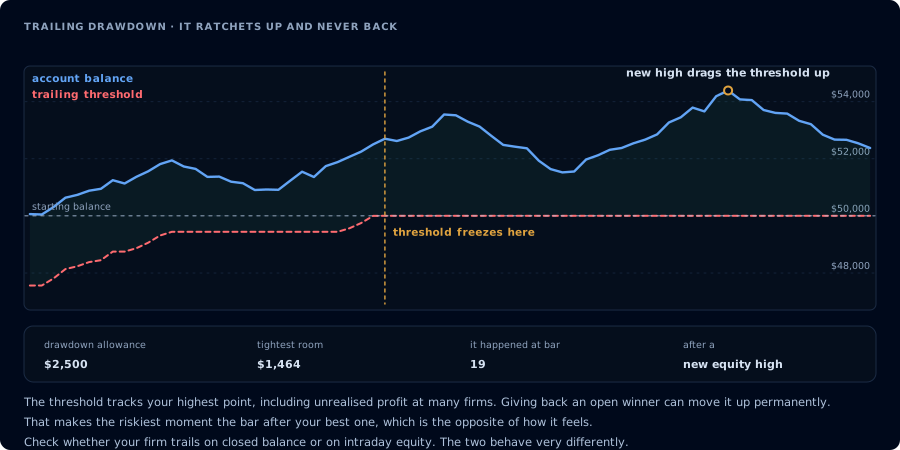
The threshold ratchets up and never back, so the riskiest bar follows your best one.
You passed the evaluation. You're in a funded account. You took a trade, it went your way, you had a $2,500 open winner. You took some off, let the rest run, and the market pulled back. You closed the session up $650 on the day.
Then you got the email. Account disabled.
If that's ever happened to you, or if it hasn't happened yet and you want to understand why it might, this guide is for you. The mechanics of trailing drawdown are genuinely counterintuitive — they punish you for having winning trades you don't close fast enough. Most of the content on the internet about them is affiliate marketing disguised as education. We're going to walk through the actual math, using the actual 2026 rules at each major firm, and then cover the NinjaTrader 8 configuration and CrossTrade Account Manager setup that enforces the rules before you can break them.
This is a long article. The interactive calculator below will handle the math for your specific account; the rest of the guide explains when and why each mechanic catches traders out.
Trailing drawdown calculator
Enter your firm preset or a custom account — see your current floor and buffer instantly.
Calculator reflects the mechanic as configured. Real prop firm rules may include additional conditions (consistency rules, daily loss limits, contract scaling). Always verify against the firm’s current documentation before trading.
What a trailing drawdown actually is
A trailing drawdown is a moving maximum loss limit. Your account has a balance floor — a number below which the account is considered failed — and that floor moves upward with your gains but never moves back down.
The important word is "upward." If you start a $50K account with a $2,500 drawdown, your initial floor is $47,500. Make $1,000, balance is $51,000, floor moves up to $48,500 (or higher, depending on the firm's mechanic). Lose $500, balance is $50,500, floor stays at $48,500. Make another $1,500, floor moves to $50,000. And so on.
The reason this exists is that prop firms are effectively underwriting trader variance. A trailing drawdown compresses how much room a trader has to lose after making money, which filters out traders who "give back" their profits. A trader who makes a big gain and then bleeds it away slowly in small losses — which is the most common profile of failure — will run out of floor eventually.
Where it gets dangerous is in how often the floor recalculates and what counts as a new high. That's where the intraday vs. end-of-day distinction comes in.
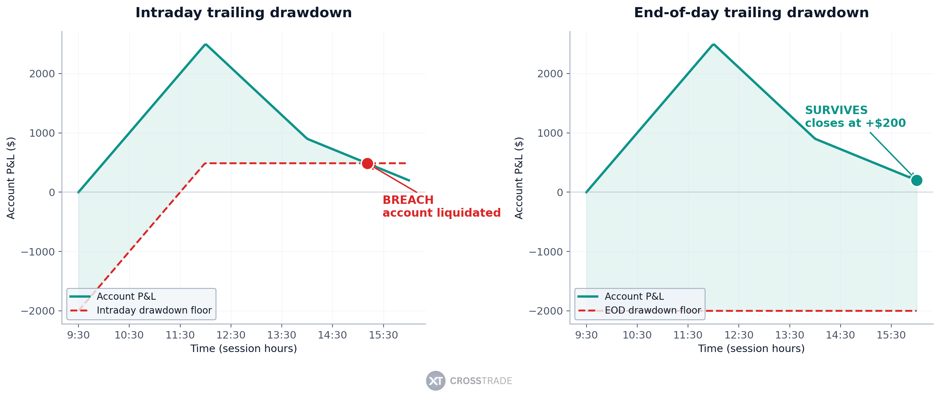
The left panel shows an intraday trailing drawdown in action. Every tick of unrealized profit raises the floor. When the trade pulls back, the floor doesn't follow — and the moment equity dips below the floor, the account is liquidated. Mid-day. On a winning position.
The right panel shows the same trade with an end-of-day trailing drawdown. The floor only recalculates at session close, based on realized balance. Intraday pullbacks are irrelevant. As long as you close the day above your floor, you survive. Same trade, same trader, same market — different firm, different outcome.
The trap: a worked example of a blown account on a winning trade
Here's a concrete scenario. A $50K Apex Intraday PA account with a $2,500 trailing drawdown.
| Time | Action | Balance (unrealized) | Floor | Buffer |
|---|---|---|---|---|
| 9:30 | Start of session | $50,000 | $47,500 | $2,500 |
| 12:00 | Long 2 NQ from 17,200 | $50,000 | $47,500 | $2,500 |
| 13:30 | NQ at 17,250 — up $2,000 | $52,000 | $49,500 | $2,500 |
| 14:30 | NQ at 17,262.50 — up $2,500 | $52,500 | $50,000 | $2,500 |
| 14:45 | NQ pulls to 17,235 — up $1,400 | $51,400 | $50,000 | $1,400 |
| 15:10 | NQ at 17,212.50 — up $500 | $50,500 | $50,000 | $500 |
| 15:25 | NQ at 17,200 — flat | $50,000 | $50,000 | $0 — BREACH |
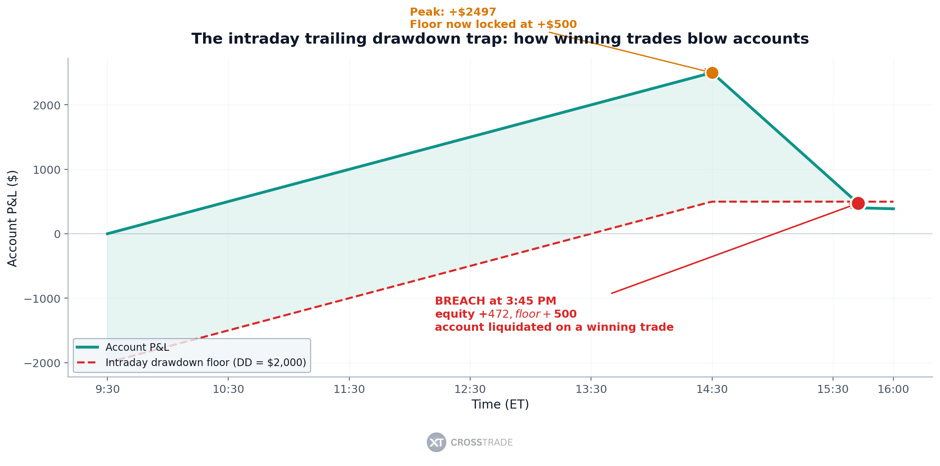
The trader never closed a single losing trade. They took a winning position, watched it run, watched it pull back, and the unrealized pullback ate through the trailing drawdown buffer. The floor locked in at the $52,500 equity peak minus $2,500 = $50,000. The moment the open position came back to scratch, the account balance matched the floor and the account was liquidated.
This is the single most common way funded accounts die on Apex, Tradeify, TPT PRO, and any firm that runs intraday trailing drawdown. Nothing went wrong with the trade idea. The trader just didn't have a mechanical floor — either mentally or automated — to force them to take profit before it evaporated.
Intraday vs. end-of-day: the single most important rule check
Before you trade any funded account, you need to know which one of these your firm uses. This determines everything.
Intraday trailing drawdown recalculates the floor tick-by-tick based on highest unrealized equity. The floor moves up the moment any open position moves into profit. It does not move back down. This is what kills accounts on winning trades.
End-of-day (EOD) trailing drawdown recalculates the floor only once, at session close, based on highest end-of-day balance. Intraday pullbacks are invisible to the rule. You can be up $3,000 at 2 PM, give it all back, close flat, and the floor stays where it was yesterday.
Static (non-trailing) drawdown doesn't move at all. The floor is set when the account is purchased and never changes. Rare but growing — Phidias, Apex on certain account types, and a handful of newer firms offer these.
Here's where every major NinjaTrader-compatible prop firm stands as of April 2026. Always verify against the firm's current documentation before you trade — this space changes monthly.
| Firm | Evaluation | Funded / Performance | Notes |
|---|---|---|---|
| Apex Intraday PA | Intraday trailing | Intraday trailing, locks at Safety Net | Safety Net = starting balance + drawdown + $100. Trail stops permanently once reached. |
| Apex EOD PA | EOD trailing | EOD trailing, locks at Safety Net | Same Safety Net mechanic, recalculated only at close. Much more survivable. |
| Topstep Combine / XFA | EOD trailing | EOD trailing, locks at starting balance | The signature rule. Moves with end-of-day balance only. |
| Take Profit Trader (Eval) | EOD trailing | n/a | Evaluation uses EOD. |
| Take Profit Trader (PRO) | n/a | Intraday trailing | The switch from EOD in eval to intraday in funded catches traders. |
| My Funded Futures | EOD trailing | EOD trailing (lower tiers switch to intraday on funded — verify) | Fixed drawdown on static accounts. |
| Tradeify | Intraday on lower tiers, EOD on higher | Same | Product-by-product basis. |
| Bulenox | EOD trailing | EOD trailing | Reset-based evaluations. |
| Earn2Trade (TCP / Gauntlet) | EOD trailing | EOD trailing | Structured programs. |
| FundedNext Futures | EOD trailing | EOD trailing | Newer entrant; rules evolve. |
| TradeDay | Intraday / EOD / static | Choose at purchase | Unusual flexibility. |
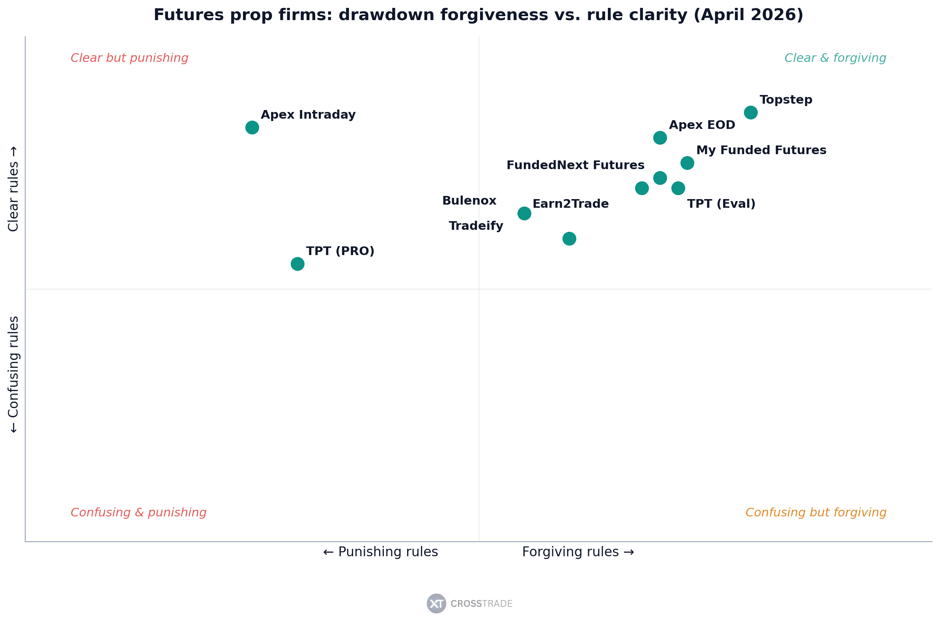
One thing that's not visible in the table is how the firm marks unrealized P&L. Some firms count only fills; some count marks on open positions. This matters a lot for multi-contract positions and partial fills. When in doubt, trade the firm's simulator first and watch the live drawdown number move.
The Apex "Safety Net" — the one mechanic worth understanding in depth
Apex uses a version of trailing drawdown called the Safety Net, and because Apex is the largest NinjaTrader-compatible prop firm in the industry, a significant percentage of funded NT8 traders encounter it. It deserves its own section.
The rule: the drawdown floor trails up at a 1:1 ratio with peak balance (unrealized on Intraday accounts, realized EOD on EOD accounts) until the peak balance hits Starting Balance + Drawdown + $100. Once you cross that threshold, the floor locks at Starting Balance + $100 — permanently.
For a $50K account with a $2,500 drawdown, that means:
- Starting floor: $47,500
- Safety Net threshold: $52,600
- Floor locks at: $50,100
From that point forward, the account balance simply has to stay above $50,100 to remain funded. Not above trailing, not above any moving number — above a fixed $50,100.
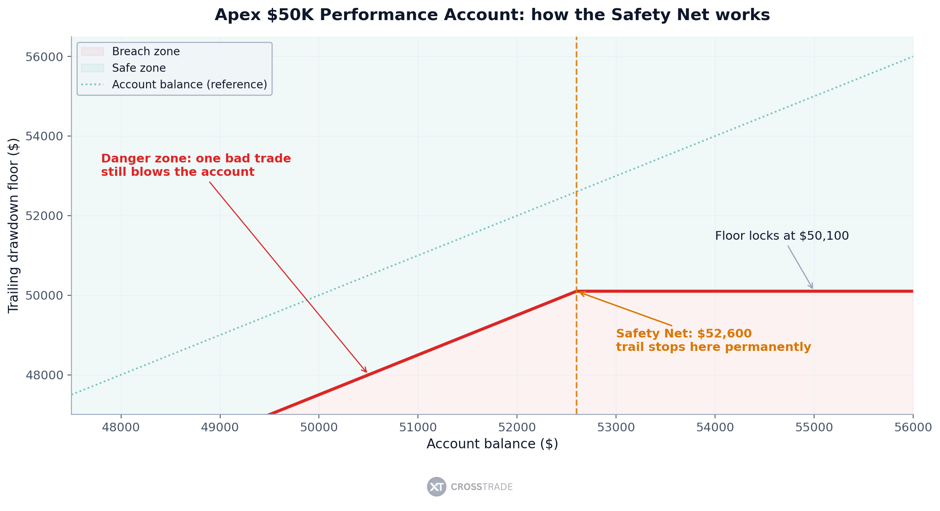
This is why Apex traders obsess over the first $2,600 of profit. The period between $0 and +$2,600 net profit is the most dangerous stretch of the account's life. During that period the floor is actively trailing; one bad trade can end the account. Above $2,600 in realized profit, the account is permanently anchored to $50,100 and you have enormous breathing room.
The strategic implication: on a brand-new Apex PA, the correct psychological frame is not "how much can I make today?" It's "how do I build a $2,600 buffer as quickly as possible without taking outsized risk?" Once the buffer exists, the game changes entirely — same strategy, same contracts, but the probability of blow-up drops by an order of magnitude.
The five mechanical mistakes that blow up most funded accounts
Most traders think they'll fail because their strategy stops working. In reality, the top causes of funded account failure are platform-level — mechanical mistakes that have nothing to do with the trade idea.
1. No stop loss attached at order entry
Apex made this a platform-level rule as of March 2026: orders without brackets are rejected by Rithmic and Tradovate. But most other firms still allow it, and NinjaTrader itself doesn't enforce it natively. You enter a trade with the intention of setting a stop "when I see the next pullback," the position moves against you, and by the time you manually set a stop the drawdown has already eaten your buffer.
Fix: require brackets in your workflow. Use NinjaTrader ATM strategies, CrossTrade bracket orders, or Opposing Position Protection to block bare entries.
2. TradingView strategy fires while NT8 is disconnected
This is the silent killer of automated traders. TradingView keeps firing alerts. CrossTrade receives them. If NT8 has disconnected — connection drop, data feed lapse, platform restart — the order doesn't execute. Your TradingView strategy thinks you're long; NT8 thinks you're flat; the next exit signal produces a short instead of a flat. Now you're short when you meant to close, and the drawdown is calculating against a position you didn't know you had.
Fix: Auto-Reconnect and Data Watchdog keep the connection alive. Strategy Sync with sync_strategy=true compares intended vs. actual position state and corrects mismatches before they compound.
3. Holding positions through the auto-flatten cutoff
Most firms require positions to be closed by 4:59 PM ET or similar. Some firms have auto-flatten as a "last resort" safeguard (Apex will flatten you at 4:59 ET) but warn you not to rely on it. If your strategy doesn't close positions before the cutoff and the firm's safeguard misses by even one second — server delay, data gap, whatever — you get marked for rule violation on top of any P&L impact.
Fix: use the Account Manager Auto-Flatten monitor to close all positions at a configurable time, independent of your strategy logic. Set it earlier than the firm's cutoff so you have a buffer.
4. Trade copier desync across multi-account setups
Running the same strategy across multiple funded accounts (common for prop farmers) multiplies the risk of any of the above problems. If the copier silently fails — network blip, rate limit, order rejection on one follower — you end up with some accounts long and some flat. Your "portfolio" is now asymmetric, and if the market moves against the long accounts, their drawdowns are eating while the flat accounts do nothing to hedge.
Fix: Auto-Sync with 3-second reconciliation on the Trade Copier catches drift and realigns follower positions before they diverge meaningfully.
5. Running multiple strategies on the same account
Two strategies firing on ES — one long, one short — produce a hedged position that costs commissions without making money. Worse, a strategy that fires an exit on a position that was opened by a different strategy (possibly a manual trade) can close the wrong thing. On a trailing-drawdown account, any unintended fills can eat buffer fast.
Fix: Strategy Lock / strategy tagging isolates each strategy's positions so no strategy can close or modify positions it didn't open.
The CrossTrade Account Manager enforcement stack
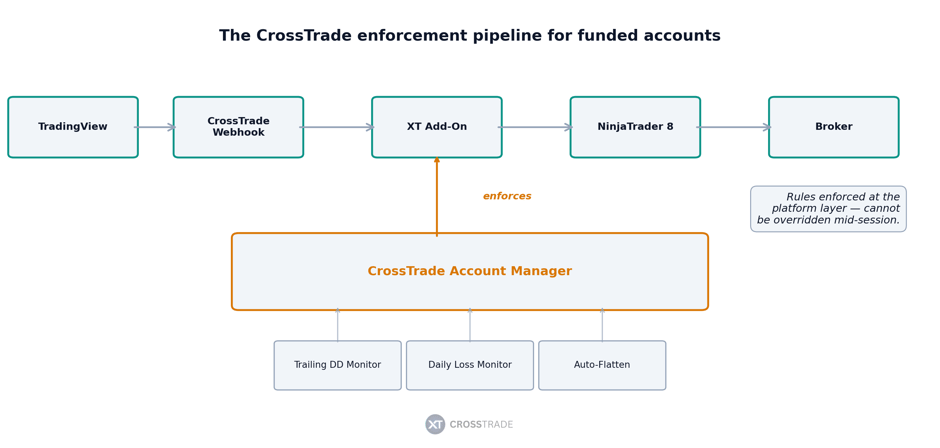
If you're trading funded accounts on NT8, the CrossTrade Account Manager is the layer that makes the above rules automatic rather than aspirational. Instead of "I'll stop trading if I hit -$500 today" (which works until it doesn't), the platform enforces the rules server-side, with auto-flatten and kill-switch actions that can't be overridden mid-session.
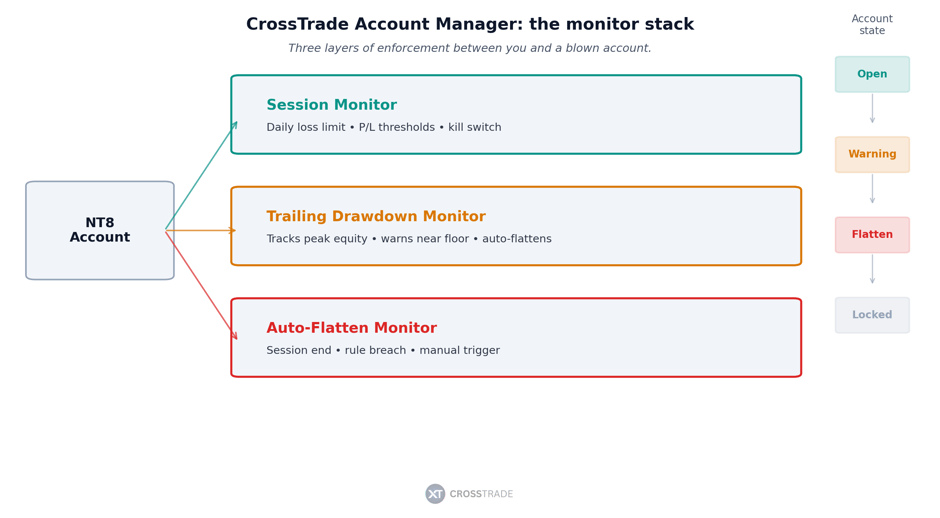
The stack has three layers. Each can be configured per account, so a $50K Apex Intraday and a $150K Topstep Combine can have completely different rule sets on the same NT8 install.
Session Monitor — session-scoped rules. Daily loss limit, daily profit target, kill switch. The moment any one fires, the account is flattened and locked until the next trading day.
Trailing Drawdown Monitor — tracks peak equity in real time and compares it to the firm's drawdown rule. Warns at a configurable distance from breach (e.g., 20% of buffer remaining). Auto-flattens at a tighter threshold before actual breach so you don't hit the firm's kill switch.
Auto-Flatten Monitor — session-end closure. Set it to 4:45 PM ET to close 14 minutes before Apex's 4:59 PM safeguard. Also fires on any rule breach from the other monitors.
Per-firm Account Manager configs
Here's how to configure the Account Manager for each of the major firms. These are starting points — tune for your risk tolerance.
Apex Intraday $50K PA
Starting Balance:           $50,000
Trailing Drawdown:          $2,500 (intraday)
Safety Net:                 $52,600
Final Floor:                $50,100

Daily Loss Limit:           $900       (configurable — Apex removed the platform DLL)
Daily Profit Target:        $600       (to front-load the Safety Net buffer)
Trailing DD Warning:        $500 from floor
Trailing DD Auto-Flatten:   $200 from floor
Auto-Flatten Time:          16:45 ET   (14 min before Apex cutoff)
Kill Switch on Breach:      Yes
Topstep $50K Combine / XFA
Starting Balance:           $50,000
Max Loss Limit:             $2,000 (EOD trailing, locks at starting balance)

Daily Loss Limit:           $600       (more conservative than Topstep's $1,000)
Daily Profit Target:        $300
Trailing DD Warning:        $400 from floor
Trailing DD Auto-Flatten:   $200 from floor
Auto-Flatten Time:          15:45 CT   (before session maintenance)
Kill Switch on Breach:      Yes
Take Profit Trader $50K PRO (the intraday switch)
Starting Balance:           $50,000
Trailing Drawdown:          $2,000 (intraday on PRO, was EOD in eval)

Daily Loss Limit:           $500       (TPT removed platform DLL in 2025)
Daily Profit Target:        $400
Trailing DD Warning:        $500 from floor
Trailing DD Auto-Flatten:   $250 from floor
Auto-Flatten Time:          16:45 ET
Kill Switch on Breach:      Yes
The TPT transition is the single most dangerous moment in the funded-account lifecycle. You passed an evaluation with an EOD floor, you're used to letting trades run, and your funded account silently changes the rule. Set the warning and auto-flatten tighter than you think you need to during the first two weeks of a PRO account.
My Funded Futures $50K
Starting Balance:           $50,000
Drawdown:                   $2,000 EOD (eval), may switch to intraday on some funded products

Daily Loss Limit:           $500
Daily Profit Target:        $300
Trailing DD Warning:        $400 from floor
Trailing DD Auto-Flatten:   $200 from floor
Auto-Flatten Time:          16:45 ET
Kill Switch on Breach:      Yes
Tradeify Straight-to-Sim $50K
Starting Balance:           $50,000
Drawdown:                   $2,500 (verify intraday/EOD per product)

Daily Loss Limit:           $500
Daily Profit Target:        $300
Trailing DD Warning:        $500 from floor
Trailing DD Auto-Flatten:   $250 from floor
Auto-Flatten Time:          16:30 ET
Kill Switch on Breach:      Yes
For the full configuration walkthrough, see Account Manager Overview and Creating Trailing Drawdown Monitors.
The daily survival workflow
Everything above is setup. The following is the daily playbook a funded NT8 trader should run, every session, for as long as they're on a trailing-drawdown account.
Pre-market (30 minutes before session open). Open NT8. Confirm the CrossTrade NT8 Add-On is connected (green status). Confirm Auto-Reconnect and Data Watchdog are enabled. Open the Account Manager dashboard and verify the Trailing Drawdown Monitor shows the correct floor for your account's current peak balance. If the floor looks wrong — typically because yesterday's peak didn't persist correctly — reset the monitor from the account settings panel.
Session open. Confirm your Trading Window is active. Verify any automated strategies have started their alerts on schedule. Note the current buffer (balance minus floor) on paper or in a journal — this is the only number that matters all day.
During the session. Watch the buffer. Not the P&L. The distance from floor is what determines whether you can take another position. If buffer drops below your Warning threshold, reduce position size. If buffer drops below Auto-Flatten, the platform will handle it.
Pre-close (15 minutes before session end). Verify all positions will close before the Auto-Flatten time. Cancel any resting orders that could fill in the last minutes and push the balance around. Check your end-of-day balance — on an EOD account, this is the number that sets tomorrow's floor.
Post-close. Review your Alert History and the Account Manager log. Confirm the floor recalculated correctly. Journal the session. Set tomorrow's strategy parameters if they differ.
This sounds like a lot. In practice, with the Account Manager configured correctly, 90% of this is automatic. You're doing five minutes of pre-market verification and five minutes of post-close review. The platform handles the rest.
What automation can't save you from
In the spirit of not overpromising: there are failure modes where the platform cannot help.
A gap through your stop. You're long 2 NQ, stop is 30 points below. NQ gaps down 80 points on an overnight news print. Your stop fills at whatever the next tick is, not where you wanted. No automation prevents this — only position sizing does.
A deleted Pine Script alert. You deleted the exit alert by accident, the entry fires, the position opens, and there's nothing to close it. CrossTrade can't execute an alert that was never configured.
A firm-side system bug. If Apex's risk server mis-calculates your floor and disables the account incorrectly, CrossTrade can't reverse that. File a ticket with the firm.
Black-swan moves that blow through the Auto-Flatten timing. If NQ drops 100 points in 30 seconds and your Auto-Flatten fires at the peak but fills 40 points lower because of the gap, the platform did its job — but the slippage still counted.
Your own discretionary overrides. If you disable the monitors during a session because you "know better," and then take the trade that blows the account, the platform won't save you. This is why the Account Manager supports locking monitor settings for the session with a separate password — so your future self can't argue with your past self.
The goal of automation is to reduce the frequency of blow-ups by an order of magnitude, not to eliminate them. A disciplined trader with the Account Manager configured properly will outlast an undisciplined trader by months or years.
Related reading
- Daily loss limits and how to set them
- Position sizing for funded accounts
- Risk of ruin — the math of blown accounts
- Running multiple prop firm accounts on NinjaTrader 8
- Strategy Sync — preventing TV/NT8 desync
- CrossTrade Account Manager — full documentation
Frequently Asked Questions
What is a trailing drawdown in prop firm trading?
A trailing drawdown is a moving account floor that rises with your gains but never falls back. If your account peaks at a new high, the drawdown floor moves up by the same amount. If you lose money, the floor stays where it was. Hit the floor and the account is failed. It is the primary risk rule on virtually every futures prop firm.
What is the difference between intraday and end-of-day trailing drawdown?
Intraday trailing drawdown recalculates the floor tick-by-tick based on unrealized equity peaks during the session. A single pullback on a winning trade can blow the account. End-of-day (EOD) trailing drawdown only recalculates at session close based on realized balance. Intraday pullbacks are invisible to the rule. EOD is significantly more forgiving.
Does trailing drawdown reset daily?
No. Trailing drawdown tracks your lifetime peak balance on the account, not just today's. A floor raised by last week's profit is still the active floor today. The only way the floor moves is up, as you set new equity highs.
What is the Apex Safety Net?
The Apex Safety Net is a fixed threshold where the trailing drawdown stops moving permanently. It equals starting balance + drawdown amount + $100. For a $50K account with a $2,500 drawdown, the Safety Net is $52,600. Once your balance reaches $52,600, the floor locks at $50,100 forever. Until you cross the Safety Net, the floor is actively trailing and the account is most vulnerable.
Which prop firms use end-of-day instead of intraday trailing drawdown?
As of April 2026, Topstep, Apex EOD accounts, Take Profit Trader evaluations (not PRO), My Funded Futures on most tiers, Bulenox, Earn2Trade, and FundedNext Futures use end-of-day or realized trailing drawdown. Apex Intraday and Take Profit Trader PRO use intraday trailing. Always verify the current rules on the firm's documentation before purchasing an account.
Can I automatically close NinjaTrader positions before breaching my trailing drawdown?
Yes. The CrossTrade Account Manager provides a Trailing Drawdown Monitor that tracks peak equity against your firm's drawdown floor in real time and auto-flattens positions at a configurable buffer before actual breach. This lets you pre-empt the firm's own kill switch and close positions at your chosen price rather than the firm's forced liquidation price.
Why do funded accounts blow up on winning trades?
Because intraday trailing drawdown marks the floor against unrealized profit peaks. A position that moves from +$0 to +$2,500 then pulls back to +$500 has locked in a new floor at +$500 (peak minus a $2,000 drawdown). If the position continues pulling back below +$500, the account breaches even though the trade was up the entire time. The trade was profitable, but the floor moved faster than the realized gains.
Does NinjaTrader 8 natively track trailing drawdown?
NinjaTrader 8 has basic risk settings including a static max drawdown, but it does not natively calculate the trailing-drawdown floor the way prop firms do. The floor logic — peak tracking, intraday vs EOD, Safety Net thresholds — has to be provided by an external layer like the CrossTrade Account Manager or a third-party risk add-on.
What happens if I exceed the trailing drawdown on an Apex Performance Account?
The account is immediately liquidated and disabled. Open positions are force-flattened, orders are cancelled, and the account becomes unusable. You do not lose real money (PAs are simulated), but you lose the activation fee and have to start over with a new evaluation. Some firms allow resets for a fee; check your firm's specific reset policy.
Is static drawdown safer than trailing drawdown?
Generally yes, but it depends on the size. A static drawdown is a fixed floor that never moves — Phidias Static and some Apex tiers offer it. The drawdown amount is usually smaller than a trailing equivalent ($500 static vs $2,500 trailing on a $50K account), but the rule is dramatically simpler. Traders who struggle with the cognitive overhead of trailing mechanics often do better on static accounts even with the smaller buffer.
How much buffer should I keep from the trailing drawdown floor?
A reasonable rule is to reduce position size when your buffer drops below 30-40% of your daily loss limit, and stop trading entirely when buffer is below one average-sized loser. If your typical losing trade is $150 and your buffer is $400, you have fewer than three trades of safety. On a new Apex PA, building buffer from $0 to the $2,600 Safety Net threshold should be your single priority — micro contracts and small targets until the buffer exists.
Can I run multiple funded accounts with the same trailing drawdown rules on NinjaTrader?
Yes, via the CrossTrade Account Manager with per-account monitor configurations. Each account gets its own Session Monitor, Trailing Drawdown Monitor, and Auto-Flatten Monitor. A $50K Apex Intraday and a $150K Topstep Combine can run simultaneously on the same NT8 install with completely different enforcement rules.