Backtesting Best Practices
Backtesting lets you see how a strategy would have performed on historical data. It's a critical step before going live — but it's also easy to get wrong.
What Backtesting Can Tell You
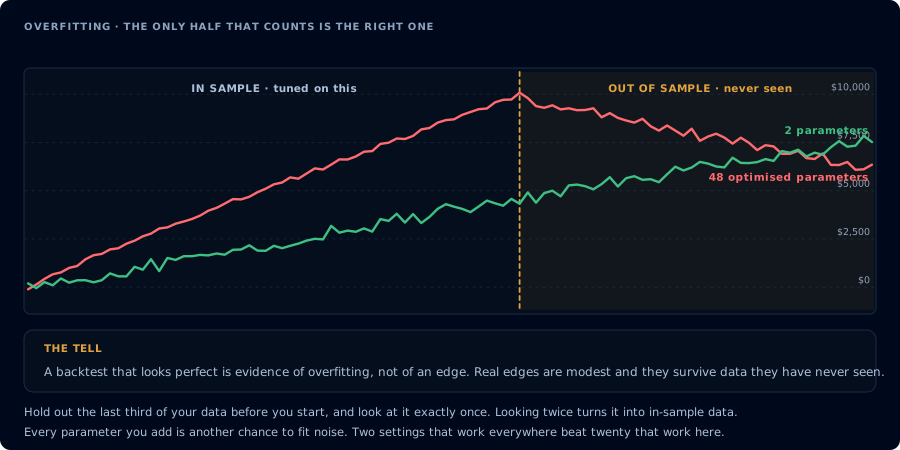
A perfect backtest is evidence of overfitting. Real edges are modest and they travel.
- Whether your strategy logic produces consistent signals
- Rough expectations for win rate, average trade size, and drawdowns
- How the strategy behaves in different market conditions (trending vs. ranging)
What Backtesting Cannot Tell You
- Future performance. Past results don't guarantee future returns.
- Execution quality. Backtests assume perfect fills. Real markets have slippage, partial fills, and latency.
- Emotional impact. A 20% drawdown looks fine on a chart. Living through one is different.
Common Mistakes
Overfitting
If you optimize 15 parameters to perfectly match 3 months of data, you haven't found a strategy — you've found a curve fit. It will likely fail on new data.
Rule of thumb: fewer parameters = more robust. A strategy with 2-3 inputs that works across multiple instruments and timeframes is more trustworthy than one with 10 inputs tuned to a single chart.
Survivorship Bias
If you only test on instruments that are currently active and successful, you're ignoring all the ones that failed or delisted. This inflates your results.
Ignoring Transaction Costs
Every trade has costs — commissions, slippage, spread. A strategy that makes $2 per trade on average but costs $3 in round-trip commissions is a losing strategy.
Testing on Too Little Data
A strategy that looks great over 30 trades is statistically meaningless. Aim for at least 100+ trades across varying market conditions before drawing conclusions.
A Better Approach
-
Start with a hypothesis. "I believe momentum persists in ES futures on the 15-minute timeframe." Then build a strategy that tests that hypothesis.
-
Use out-of-sample testing. Optimize on one time period, then validate on a completely separate period you didn't touch.
-
Walk-forward analysis. Instead of one big backtest, test in rolling windows — optimize on months 1-3, test on month 4, then optimize on months 2-4, test on month 5, and so on.
-
Sim before live. Even after backtesting, run the strategy on a sim account in real-time for at least 1-2 weeks. This catches issues backtesting can't — like alert timing, data feed differences, and connection reliability.