Fibonacci Retracements in Futures Trading
Fibonacci retracements are horizontal levels drawn between a significant high and low, at the percentages 23.6%, 38.2%, 50%, 61.8%, and 78.6%. These levels often act as support or resistance during pullbacks in a trending move. The 61.8% ("golden ratio") is the most-watched. Fib levels are a reference, not a signal — pair them with price action.
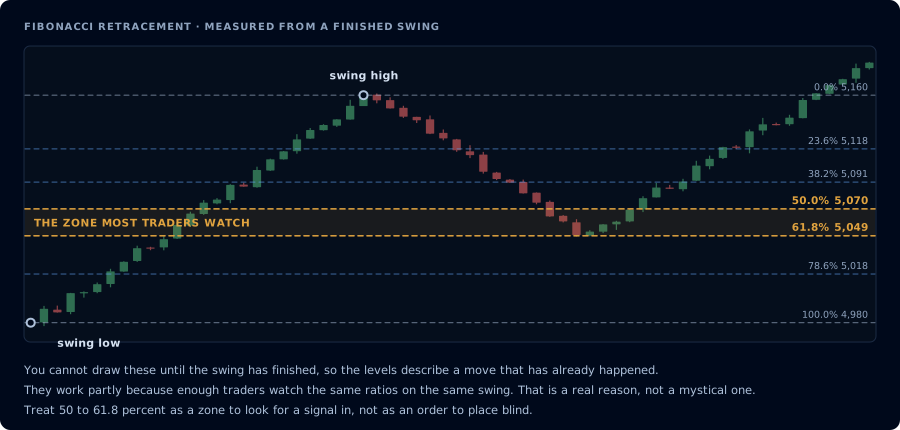
The levels only exist once the swing has finished. They describe, they do not predict.
Where the numbers come from
The Fibonacci sequence: 1, 1, 2, 3, 5, 8, 13, 21, 34, 55, 89… Each number is the sum of the previous two. As the sequence progresses, the ratio between consecutive numbers converges on 1.618 — the "golden ratio."
The retracement levels are derivatives:
- 23.6% = 1 − (1/1.618)^2
- 38.2% = 1 / 1.618^2
- 50% = not actually a Fibonacci number, but traditionally included because retracements often halt at the midpoint
- 61.8% = 1 / 1.618 (the golden ratio retracement)
- 78.6% = √(1 / 1.618)
Whether the universe cares about the golden ratio is above my pay grade. Whether thousands of traders draw fib levels and react to them is not — it does, they do, and that's what makes fibs self-fulfilling to some degree.
How to draw a fib retracement
- Identify a clear impulse move — a swing from a significant low to a significant high (or vice versa).
- Anchor the fib tool at the start of the move (low) and drag to the end (high).
- The tool plots horizontal lines at 23.6%, 38.2%, 50%, 61.8%, 78.6% between those two anchors.
For an uptrend, the fib levels are potential support as price pulls back. For a downtrend, they are potential resistance.
What actually works
- Look for confluence. A 61.8% fib that lines up with a prior swing low, a VWAP anchor, or the 200 EMA is a much better setup than a fib level in empty space.
- Wait for rejection. Price reaching a fib level is not a signal. Price rejecting it (pin bar, engulfing, volume spike) is.
- Respect the 61.8%. It's the line most traders watch. Bigger reactions happen there than at the shallower retracements.
Fibonacci extensions
Once a retracement completes and price resumes in the original direction, Fib extensions project where price might travel next. Common extension levels: 127.2%, 161.8%, 261.8%. These are target references, not prediction.
Fib levels in Pine Script (v6)
Drawing fib lines on arbitrary swings requires you to identify swings first. Here's a simplified implementation that draws fibs between the N-bar high and low and fires an alert when price touches the 61.8%.
//@version=6
indicator("Fib Retracement 61.8% Alert", overlay=true)

length = input.int(50, "Lookback (bars)")

hi = ta.highest(high, length)
lo = ta.lowest(low, length)

f236 = hi - (hi - lo) * 0.236
f382 = hi - (hi - lo) * 0.382
f500 = hi - (hi - lo) * 0.500
f618 = hi - (hi - lo) * 0.618
f786 = hi - (hi - lo) * 0.786

plot(hi,   color=color.gray, title="Swing High")
plot(f236, color=color.new(color.blue, 40), title="23.6%")
plot(f382, color=color.new(color.blue, 40), title="38.2%")
plot(f500, color=color.new(color.orange, 40), title="50%")
plot(f618, color=color.new(color.red, 0),  linewidth=2, title="61.8%")
plot(f786, color=color.new(color.blue, 40), title="78.6%")
plot(lo,   color=color.gray, title="Swing Low")

if ta.crossunder(low, f618)
    alert("Price tagged the 61.8% retracement on " + syminfo.ticker, alert.freq_once_per_bar_close)
TradingView's built-in Fib Retracement drawing tool is usually what traders actually use — manually anchoring it to significant swings. The Pine Script above is for automating alerts on programmatic swing detection.
Common mistakes
- Drawing fibs on arbitrary wicks. Anchor only to clear swing points with meaningful reactions.
- Trading the level itself. The level is a zone of interest. The trade is based on price action at the level, not the level alone.
- Using fibs on every timeframe at once. Fibs on the daily mean something; fibs on the 1-minute mean much less. Start with higher timeframes.
Frequently Asked Questions
What is the 61.8% Fibonacci level?
The golden ratio retracement — 1/1.618 of the distance from swing low to swing high. It's the most-watched fib level and often produces the strongest reactions during pullbacks.
Is 50% a Fibonacci number?
No, 50% isn't in the Fibonacci sequence. It's included by convention because retracements frequently stall at the midpoint of a prior swing — useful in practice even if it's mathematically an outlier on the fib tool.
Do Fibonacci levels actually work?
They work partly because thousands of traders watch them — which creates self-fulfilling reactions. They are not a standalone signal. Pair fibs with price action, moving averages, or VWAP for confluence.
Fibonacci retracement vs extension — what's the difference?
Retracements measure pullbacks inside a prior swing (0–100% of the move). Extensions project beyond the swing (127.2%, 161.8%, 261.8%) as potential targets once price resumes the original trend.