How to Use MACD for Futures Trading
MACD (Moving Average Convergence Divergence) is a trend-momentum indicator built from two EMAs. It fires signals three ways: signal-line crossovers, zero-line crossovers, and histogram divergence. It's best used as a trend confirmation tool on the 15-minute and higher, not as a standalone reversal signal on fast timeframes.
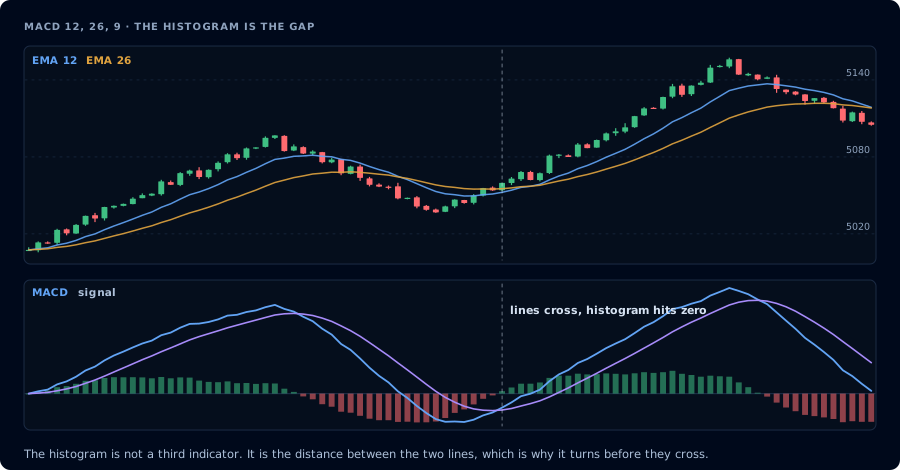
The histogram is the gap between the two lines, which is why it turns first.
What MACD actually is
MACD has three components:
- MACD line = 12-period EMA − 26-period EMA
- Signal line = 9-period EMA of the MACD line
- Histogram = MACD line − Signal line (bars above/below zero)
When the fast EMA pulls away from the slow EMA, MACD widens. When they converge, it tightens. The histogram is the speedometer — how fast the two lines are separating or closing.
The three MACD signals
Signal-line crossover. MACD line crosses above the signal line = bullish momentum shift. Crosses below = bearish. Most common MACD signal. Also the most over-traded.
Zero-line crossover. MACD line crosses above zero = short-term trend has flipped bullish (fast EMA > slow EMA). This is a slower, higher-conviction signal than the signal-line cross.
Divergence. Price prints a higher high, MACD prints a lower high → bearish divergence. Momentum is fading. The inverse works for bullish divergence. Divergence is where MACD earns its keep — it catches trend exhaustion that price alone hides.
Settings for futures
Default: 12, 26, 9. Leave it alone.
Almost every "optimized" MACD setting you'll find on forums is curve-fit noise. The default works because it's the default — it's what everybody else sees, which gives the signal weight. Tinkering with the periods is one of the least productive things a new trader can do with their time.
MACD in Pine Script (v6)
//@version=6
indicator("MACD Webhook Alert", overlay=false)

fastLen   = input.int(12, "Fast Length")
slowLen   = input.int(26, "Slow Length")
signalLen = input.int(9,  "Signal Smoothing")

[macdLine, signalLine, histLine] = ta.macd(close, fastLen, slowLen, signalLen)

plot(macdLine,   color=color.blue,   title="MACD")
plot(signalLine, color=color.orange, title="Signal")
plot(histLine,   color=histLine >= 0 ? color.green : color.red, style=plot.style_columns, title="Histogram")
hline(0, color=color.gray)

bullCross = ta.crossover(macdLine, signalLine)
bearCross = ta.crossunder(macdLine, signalLine)

if bullCross
    alert("MACD bullish crossover on " + syminfo.ticker, alert.freq_once_per_bar_close)
if bearCross
    alert("MACD bearish crossover on " + syminfo.ticker, alert.freq_once_per_bar_close)
Common mistakes
- Treating every crossover as a trade. MACD in a chopping market flips constantly. Use a trend filter (200 EMA, ADX > 20) to skip the garbage.
- Ignoring the histogram. The histogram rolling over before a crossover is often the earliest signal MACD gives. Watch the bars shrink before they flip.
- Using it on illiquid timeframes. MACD on a 1-minute ES chart during lunch hour is not a signal — it's noise.
How to automate MACD with CrossTrade
Convert the indicator into a strategy() script (see strategy vs. indicator), build the CrossTrade payload inside Pine Script, and pass it to strategy.entry() via alert_message=:
//@version=6
strategy("MACD — CrossTrade", overlay=false)

[macdLine, signalLine, _hist] = ta.macd(close, 12, 26, 9)
bullCross = ta.crossover(macdLine, signalLine)
bearCross = ta.crossunder(macdLine, signalLine)

if bullCross
    msg  = "key=YOUR-SECRET-KEY;"
    msg := msg + "command=PLACE;"
    msg := msg + "account=Sim101;"
    msg := msg + "instrument={{ticker}};"
    msg := msg + "action=BUY;"
    msg := msg + "qty=1;"
    msg := msg + "order_type=MARKET;"
    msg := msg + "tif=DAY;"
    msg := msg + "sync_strategy=true;"
    strategy.entry("MACD Long", strategy.long, alert_message=msg)

if bearCross
    msg  = "key=YOUR-SECRET-KEY;"
    msg := msg + "command=PLACE;"
    msg := msg + "account=Sim101;"
    msg := msg + "instrument={{ticker}};"
    msg := msg + "action=SELL;"
    msg := msg + "qty=1;"
    msg := msg + "order_type=MARKET;"
    msg := msg + "tif=DAY;"
    msg := msg + "sync_strategy=true;"
    strategy.entry("MACD Short", strategy.short, alert_message=msg)
Then in TradingView:
- Click Alerts → Create Alert on the chart
- Condition: select your strategy → "Order fills only"
- Message:
{{strategy.order.alert_message}} - Notifications tab: paste your CrossTrade webhook URL
See Pine Script webhook alerts for the full pattern.
Frequently Asked Questions
Is MACD a leading or lagging indicator?
Lagging. MACD is built from moving averages, which by definition lag price. The histogram and divergence signals lag less than the lines themselves, but MACD is not a leading indicator. Use it for confirmation, not prediction.
What are the best MACD settings for day trading?
Default (12, 26, 9) works on every timeframe. The common mistake is thinking faster settings give earlier signals — they give noisier signals. If you want faster response, drop to a shorter timeframe instead of shortening the MACD periods.
MACD vs. RSI — which is better?
They answer different questions. RSI asks 'how extreme is recent momentum?' MACD asks 'which direction is momentum trending?' Many traders use both: RSI for exhaustion, MACD for trend confirmation.
Can I use MACD for exits?
Yes. Exiting longs on a bearish MACD crossover is a common, mechanical exit rule. It gives back some profit on every winner but catches trend reversals faster than price-based stops alone.