Market Profile (TPO)
Market Profile is a way to visualize time spent at each price level during a session. Instead of volume bars, it uses letters (TPOs = Time Price Opportunities) — one letter per 30-minute slot — stacked by price. The resulting shape reveals where price found acceptance (fat middle) vs. rejection (thin extremes). Developed by Pete Steidlmayer at the CBOT in the 1980s.
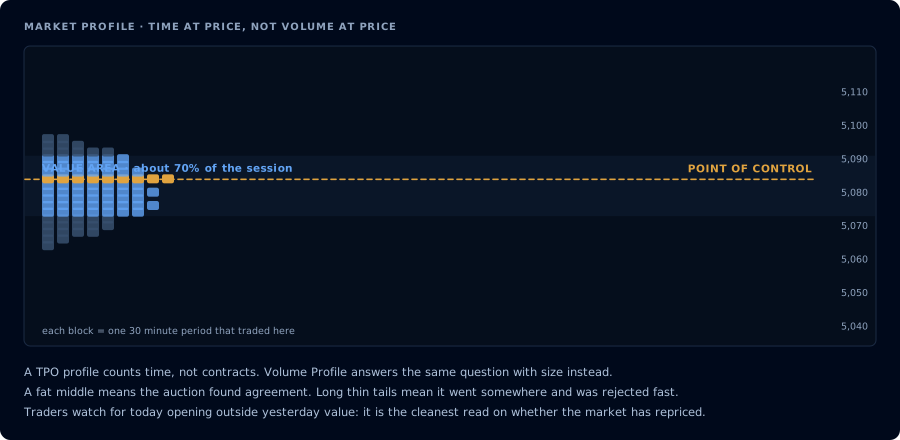
Each block is a half hour that traded at that price. Fat middle, thin tails.
The basics
Each 30-minute period of the session gets a letter:
- A = 9:30–10:00
- B = 10:00–10:30
- C = 10:30–11:00
- ... and so on
Within each period, a letter prints at every price traded in that window. By session's end, you get a horizontal histogram: prices where price spent a lot of time accumulate many letters; prices where price only touched briefly have few.
Core terms
| Term | Meaning |
|---|---|
| TPO | Time Price Opportunity — one letter, representing 30 minutes at a price |
| POC (Point of Control) | Price with the most letters — the most-time-spent level |
| Value Area (VA) | The range containing 70% of the TPOs — bounded by VAH and VAL |
| VAH / VAL | Value Area High / Low |
| Initial Balance (IB) | Range of the first hour (A + B periods) |
| Single prints | Prices with only one TPO — zones of rejection |
| Profile shape | The visual outline — "D," "P," "b," "b with tail" — each carries meaning |
Profile shapes and what they mean
D-profile (balanced, bell-shaped). Classic rotational day. Price spent time evenly around a central POC. Expect more of the same next session.
P-profile (top-heavy). Price drove up early, then spent the afternoon consolidating near the high. Buyers in control.
b-profile (bottom-heavy). Inverse P. Price drove down early, consolidated low. Sellers in control.
Trend day. Profile is thin and extended — very few repeat letters at any price. Price moved through the day without returning. Strong directional bias.
Non-trend day. Profile is compact and symmetric. Tight range, no clear winner.
Reading shape takes practice. Start by recognizing D, P, and b — those three cover 60%+ of sessions.
How to use Market Profile
POC as magnet. Price that extends away from POC often returns to it, especially on balanced days. POC reversion is one of the highest-win-rate setups in futures.
Value area as reversion zone. Trading outside value → often reverts back into value. Key signal: close back inside VAH or VAL after an excursion.
Single prints as attraction zones. Single prints are "inefficient" — price moved through that range without spending time. They often fill back in on subsequent sessions.
Initial Balance as day's reference. Breaks above IB high often continue to R1/R2; breaks below IB low often extend to S1/S2. Range-bound within IB = likely continued balance.
Market Profile vs. Volume Profile
Both are horizontal histograms; they differ in what they measure:
| Feature | Market Profile (TPO) | Volume Profile |
|---|---|---|
| Measures | Time at price | Volume at price |
| Granularity | 30-min letters | Tick-level volume |
| Best at showing | Rotation vs. trend | Actual participation |
| Legacy | Floor trader roots | Modern standard |
| Signal quality | High but slower | High and faster |
Modern retail traders mostly use Volume Profile because it's faster-reacting and available in every charting platform. Market Profile remains valuable on daily profiles and composite profiles for swing trading — identifying acceptance regions across multiple days.
Market Profile in TradingView
TradingView has a built-in Market Profile indicator (paid plans). Third-party scripts like "Session Market Profile" also work. Full manual construction in Pine Script is complex because you need to aggregate per 30-minute bucket.
For retail futures traders, the cleanest way to use Market Profile is TradingView's built-in Session Volume HD (Volume Profile) for intraday and TradingView's TPO Profile or Sierra Chart / NinjaTrader native tools for traditional TPO.
Common mistakes
- Trying to read shape on intraday timeframes. Market Profile reads best on full sessions — the shape doesn't finish until the close.
- Chasing single prints. Not every single print fills. Use them as magnets when price is nearby, not as must-fill predictions.
- Confusing POC with VWAP. POC = price with most time/volume. VWAP = volume-weighted average price over time. They're related but not identical.
Frequently Asked Questions
Market Profile vs Volume Profile — which is better?
Volume Profile for intraday execution (faster-reacting, widely available). Market Profile for longer-term context (composite profiles across days/weeks identify acceptance zones that Volume Profile tends to miss). Professional desks often run both.
What's a D-profile?
A balanced profile shape where time/volume is distributed symmetrically around the Point of Control, forming a 'D' or bell shape. D-profiles indicate rotational, range-bound trading — the opposite of trend days.
Can I trade pure Market Profile without other indicators?
Yes — many professionals do. The core setups (POC reversion, IB break, single print attraction) produce durable edge when applied with patience. It's a learning curve but a self-contained methodology.