Parabolic SAR
Parabolic SAR (Stop And Reverse) plots dots above or below price that trail the trend. When price touches the dots, the indicator flips — dots move to the other side of price, and the trend direction reverses. Designed by J. Welles Wilder (who also gave us RSI and ADX) as a mechanical trailing stop and reversal signal.
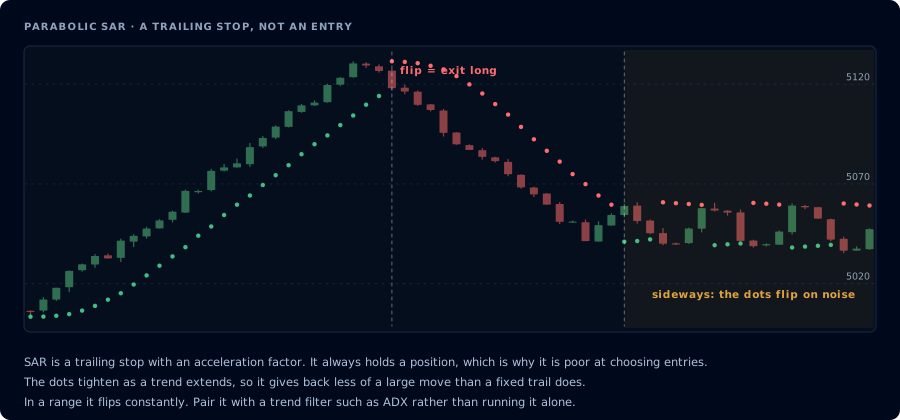
A trailing stop that always holds a position, which is exactly its weakness in a range.
How SAR works
The SAR starts below price in an uptrend and accelerates upward each bar. The closer price moves above the SAR, the faster the SAR catches up. When price finally touches or crosses below the SAR, the system flips:
- Long trend ends, short trend begins
- SAR dots move above price
- SAR now trails downward
The "parabolic" name comes from the acceleration curve — dots don't move in a straight line; they curve toward price.
The parameters
Two inputs:
- Acceleration Factor (AF) start: 0.02 (classic)
- AF max: 0.20 (classic)
Each bar that price makes a new high (in an uptrend), AF increases by the start value, up to the max. Higher AF = tighter trailing = faster flips. Classic settings give moderate responsiveness.
You can tune these for different market characters:
- Faster (0.04 / 0.30): tighter stops, more flips, better in strong short trends
- Slower (0.015 / 0.15): looser stops, fewer flips, better in noisy markets
How to trade it
Trend-following with SAR as the stop. Enter on an external signal (breakout, MA cross). Hold as long as price is on the same side of SAR. Exit when SAR flips.
SAR flip as reversal signal. Treat each flip as a new trade — long when dots go below price, short when dots go above. Simple but prone to whipsaws in chop.
Combined with ADX. Wilder designed SAR and ADX to work together. Only take SAR-based trades when ADX > 25 (strong trend). Skip SAR signals when ADX < 20 (chop).
Parabolic SAR in Pine Script (v6)
//@version=6
indicator("Parabolic SAR + Flip Alerts", overlay=true)

afStart = input.float(0.02, "AF Start", step=0.005)
afStep  = input.float(0.02, "AF Step",  step=0.005)
afMax   = input.float(0.20, "AF Max",   step=0.05)

sarVal = ta.sar(afStart, afStep, afMax)

plotshape(sarVal < close ? sarVal : na, style=shape.circle, location=location.absolute, color=color.green, size=size.tiny, title="SAR up")
plotshape(sarVal > close ? sarVal : na, style=shape.circle, location=location.absolute, color=color.red,   size=size.tiny, title="SAR down")

// Flip detection — SAR changes side relative to price
var int trend = 0
newTrend = sarVal < close ? 1 : -1
flipped = newTrend != trend
trend := newTrend

if flipped and trend == 1
    alert("SAR flipped bullish on " + syminfo.ticker, alert.freq_once_per_bar_close)
if flipped and trend == -1
    alert("SAR flipped bearish on " + syminfo.ticker, alert.freq_once_per_bar_close)
When SAR shines
- Strong trends on daily charts. SAR holds positions through small pullbacks, exits on actual trend reversal.
- Trailing stops for other strategies. Many traders use SAR as the exit mechanism rather than the entry signal.
- Cleanly trending instruments. Currencies, metals, and low-volatility futures often give SAR clean flip signals.
When SAR fails
- Choppy ranges. Every swing flips SAR. Pure SAR systems get eaten alive by chop.
- Fast intraday charts. On 1-minute ES, SAR flips 10+ times per session with heavy whipsaw losses.
- News-driven markets. Gap moves can flip SAR at bad prices.
Common mistakes
- Using raw SAR without a trend filter. The ADX filter is essential for retaining SAR's edge.
- Blindly flipping on every SAR reversal. Better as a stop-loss than as a reversal entry.
- Running it on low-liquidity markets. SAR is designed for trending, liquid markets.
Frequently Asked Questions
What do the Parabolic SAR dots mean?
The dots are the indicator's value. Dots below price mean an uptrend (the SAR is trailing below, ready to act as the stop). Dots above price mean a downtrend. When price touches a dot, the trend flips and dots move to the opposite side.
What are the best Parabolic SAR settings?
Wilder's original 0.02 / 0.02 / 0.20 (start / step / max) works for most markets. Tighter settings (0.04 / 0.30) produce faster flips for short-term trading; looser (0.015 / 0.15) reduce whipsaws. Default values are the right starting point.
Is Parabolic SAR good for day trading?
Mixed. On strong trend days it excels; on chop days it whipsaws badly. Pair it with an ADX > 25 filter to only use SAR signals in genuine trends. Or use SAR only as a trailing stop exit rather than entry signal.