FOMO — Fear of Missing Out
FOMO in trading is the urge to enter a position because the move is already happening — not because your strategy gave a signal. It feels like you'll miss the trade if you don't act now. The reality: the trades you chase are typically the ones that reverse on you. FOMO entries have measurably worse win rates than planned entries because you're buying at the top of moves and selling at the bottom.
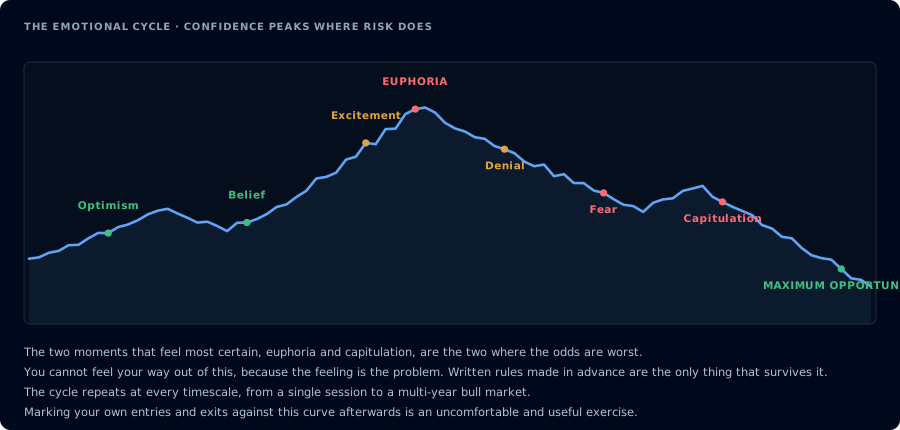
Confidence peaks exactly where risk does. That is the whole problem in one chart.
Why FOMO is so powerful
Your brain is wired for it. Three forces:
1. Loss aversion, inverted. You feel the "loss" of an unrealized opportunity (gains you didn't take) almost as strongly as a real loss. The longer the move runs without you, the more painful sitting out feels.
2. Recency bias. The last 3-5 bars of a move are most vivid in your memory. If they were strongly directional, your brain extrapolates that pattern indefinitely — "if I don't get in now, it'll keep going forever."
3. Social pressure. Watching others (Twitter, Discord, news anchors) talk about the move amplifies the urgency. You're not just missing the trade — you're being left out by your peer group.
The combination is potent enough to override carefully-built rules in seconds.
What FOMO trades look like
You'll recognize them after the fact:
- Entering after a 3+ bar same-direction move on impulse, with no defined stop or target
- Buying near the high of a sharp rally because "it can't pull back"
- Doubling size on a "guaranteed" move you didn't plan
- Re-entering immediately after a stop-out on the same idea
- Trading an instrument you don't normally trade because of news
Almost every trader has a journal full of these. They cluster on news days, after major moves, and after periods of forced inactivity (boring sessions, no setups).
Why FOMO entries fail more
By the time a move feels too good to ignore, several things have already happened:
- Most of the move has already played out. The 30-point ES rally you're chasing has 5 points left, not 30.
- Stops are now visible. Late entries place stops at obvious recent swing levels, which get swept by the next pullback.
- R:R is awful. Late entries have small remaining upside and large downside back to recent structure.
- The setup wasn't yours. You don't have a pre-defined plan, so you can't manage the trade systematically.
The result: even when FOMO trades work, the gains are small. When they fail, the losses are oversized because you're stopped out at bad levels and lost the discipline to size correctly.
Concrete rules to prevent FOMO
1. Pre-define entries. Write down your strategy's exact entry conditions. If the current move doesn't fit, don't take it. This rule alone eliminates 80% of FOMO trades.
2. Use limit orders for entries when possible. Limit orders force you to specify a price in advance. If price runs away from your limit, you don't chase — you accept the missed trade.
3. The "5-bar rule." If a move has gone more than 5 bars in your direction without a pullback, do not enter on the current bar. Wait for at least one consolidation or pullback. This stops late-cycle chasing.
4. The "I'll watch the next setup" mantra. When you feel FOMO, say it out loud: "I'll watch the next setup." This frames the missed trade as informational (one to learn from) rather than as a loss.
5. Limit screen time. FOMO is amplified by constant chart-watching. Set alerts for your specific levels and step away from the screen. You're more emotionally susceptible the longer you stare.
6. Use a daily trade cap. Limit yourself to 3-5 trades per day. Once you hit the cap, you're done — no more entries regardless of what you see. This forces you to choose only the highest-quality setups.
7. Automate your strategy. A computer doesn't feel FOMO. If your strategy is rules-based and clear, automating it removes you from the moment-to-moment temptation entirely.
When the move is real
Sometimes the move you're FOMO'ing on really is a major trend that runs all day. You'll miss it. That's okay.
The key insight: missed gains are not losses. Your account doesn't get smaller because someone else made money. The cost of the next FOMO trade — the one that reverses on you — is real money out of your account. Avoiding the FOMO trades you'd take is worth the occasional missed trend.
Over a year, the trader who skips FOMO entries and waits for clean setups outperforms the trader who chases every move. By a lot.
The journal cure
Track every FOMO trade as such in your trading journal. After 50-100 trades, compute the win rate and average P&L of "FOMO" entries vs. "planned" entries. The numbers will be brutal — and after seeing them, the urge to chase weakens. Data is the strongest cure for emotional trading.
Frequently Asked Questions
What does FOMO mean in trading?
Fear Of Missing Out — the impulse to enter a trade because the move is already happening, not because your strategy gave a signal. FOMO trades typically have worse win rates and worse risk/reward than planned entries because you're chasing late-cycle moves.
Why are FOMO trades so unprofitable?
By the time a move feels urgent enough to chase, most of it has already played out. You enter near the top (or bottom), with stops at obvious levels that get swept on normal pullbacks, and with poor reward-to-risk because the move is mostly done. Even when these trades work, gains are small relative to losses on failures.
How do I stop FOMO trading?
Three high-impact rules: (1) pre-define entry criteria for every trade and skip anything that doesn't fit; (2) use a daily trade cap (3-5 max) so you have to choose high-quality setups; (3) automate your strategy so the computer executes without emotional input. Track FOMO trades separately in your journal — the data will reinforce the discipline.
Is missing a big move really worse than chasing one?
No. Missed gains aren't losses. A trade you didn't take cannot lose you money. A FOMO trade that reverses costs you real account capital. Over time, the trader who passes on FOMO setups has a smaller, more consistent equity curve than the trader who chases — and lives to compound longer.