Overtrading
Overtrading is taking more trades than your strategy actually generates valid signals for — usually driven by boredom, excitement, or the urge to "stay engaged." It's the silent killer of profitable strategies because every extra trade has lower edge than the planned ones, while paying the same commissions and slippage. The cure is a daily trade cap that forces you to be selective.
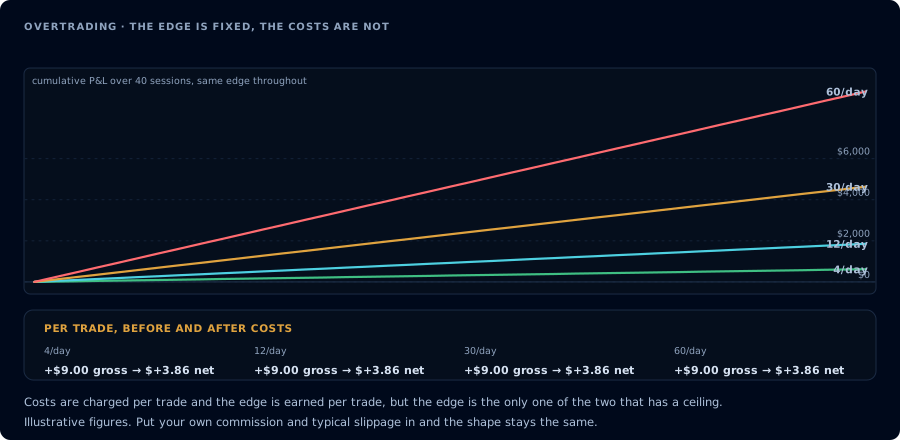
The edge per trade is fixed. The costs are not, so frequency eventually eats it.
What overtrading looks like
You're overtrading if you regularly:
- Take 10+ trades in a session when your strategy gives 2-3 signals
- Trade through entire sessions without any clear setup criteria
- Stay in front of the screen "just in case" something develops
- Take low-conviction setups because no high-conviction ones appeared
- Re-enter quickly after stop-outs to "stay in the game"
- Trade markets/sessions outside your normal scope because your usual ones are quiet
The defining feature: trades are happening because you want to trade, not because your strategy fired.
Why overtrading kills profitability
1. Each marginal trade has less edge. Your best setups are your best for a reason. Trade #15 of the day is by definition lower-quality than trade #1 — you ran out of A-grade setups and started taking B and C.
2. Commissions and slippage scale linearly. A $4 round-trip commission on ES is rounding error on a $400 winner but devastating on a $40 winner. Overtrading pushes you toward smaller-edge trades where costs eat the profit.
3. Mental fatigue. By trade #10 of a session, your decision-making is measurably worse than at trade #1. Overtrading induces fatigue, which produces sloppier execution, which produces worse outcomes.
4. Compounded discipline erosion. Each marginal trade that breaks your rules normalizes rule-breaking. A trader who accepts "one little exception" today accepts five next week.
What's a "normal" trade frequency?
Depends on the strategy:
| Strategy type | Typical trades/session |
|---|---|
| Scalping | 10-30 |
| Day trading (pattern-based) | 2-8 |
| Swing trading | 0.5-2 (per day) |
| Position trading | 1-5 per month |
If your strategy is "day trading pattern-based" but you're taking 15 trades a day, you're overtrading. The strategy doesn't generate that many signals — you're forcing trades.
The 3-trade rule
The simplest, most effective discipline tool: cap your trades at 3 per session unless you have a clear, documented reason to take more.
The benefits:
- Forces you to choose only the highest-conviction setups
- Eliminates B-grade and C-grade trades that drag down expectancy
- Reduces fatigue-driven mistakes in late-session decisions
- Naturally enforces "wait for setup" patience
- Caps maximum daily loss at 3× per-trade risk
For active scalpers or strategies that legitimately fire 10+ times per session, scale the cap to your strategy. The principle is the same: a hard ceiling on trade count is a discipline tool, not a profit tool.
When 0 trades is the right number
Some sessions, the right answer is to take no trades.
- Major news days when your normal setups don't apply
- Range-bound chop where breakout strategies fail
- Days where you're sick, tired, or emotionally off
- Holidays with thin volume
The trader who can sit in cash all day and call it a successful session has a major edge over the one who feels obligated to trade. No trade = no loss = available capital for tomorrow's better setup.
Recognizing the urge to overtrade
Common triggers:
- "I should be making money today, the market is moving"
- "I have time set aside, I should use it"
- "If I don't take this setup, I'll have nothing to show for the day"
- "Maybe this is the trade that turns things around" (revenge variant)
- "It's a slow market — let me try a different instrument"
All of these are emotional, not strategic. Your strategy doesn't care whether you're bored. Markets will reward selective patience over forced engagement.
The boredom problem
The hardest version of overtrading is boredom trading — taking marginal setups simply because nothing better is happening and you don't want to sit in front of a quiet chart for hours.
Solutions:
- Pre-define your scan criteria. Know exactly what you're looking for. Anything outside the criteria is not a trade.
- Walk away during dead periods. The 11:30am-1:30pm ET midday lull is a known dead zone. Take a long lunch. Don't sit in front of charts looking for setups that aren't there.
- Use the time productively. Review past trades. Read. Update your trading plan. Don't fill the boredom by forcing entries.
- Reduce screen time. Set alerts for your specific levels. Step away. Come back when alerts fire.
Overtraders are usually screen-watchers. Reducing screen time alone often cuts trade count in half.
Automation as the solution
The most reliable cure for overtrading: automate your strategy and stop discretionary entries.
A computer doesn't get bored. It doesn't take revenge trades. It doesn't enter B-grade setups because nothing else is happening. If your strategy is rules-based and clear, automating it eliminates the entire category of overtrading mistakes.
CrossTrade's webhook automation removes you from the moment-to-moment temptation. You build the rules; the system executes only when those rules trigger. No more, no less.
Frequently Asked Questions
What is overtrading?
Taking more trades than your strategy actually generates valid signals for. Driven by boredom, excitement, or the urge to stay engaged rather than by strategy. Overtrading is unprofitable because marginal trades have lower edge than planned ones while paying the same costs in commissions and slippage.
How many trades per day is too many?
Depends on strategy. Scalpers may legitimately take 10-30 per session. Pattern-based day traders typically generate 2-8 valid setups. Swing traders may go days without a trade. If you're consistently exceeding your strategy's typical signal count, you're overtrading.
What is the 3-trade rule?
A discipline rule capping trades at 3 per session. Forces you to be selective with setups, reduces fatigue-driven mistakes, and caps maximum daily loss. Adjust the cap to your strategy's actual signal frequency, but the principle (a hard ceiling) is universal.
How do I stop overtrading?
Three approaches: (1) hard daily trade cap (e.g., 3 trades), (2) reduce screen time using alerts so you only look at the chart when setups fire, (3) automate your strategy entirely so the computer executes only on rules-based triggers. Automation is the most reliable cure because it removes the emotional decision-making completely.