Revenge Trading
Revenge trading is taking trades — usually quickly, with larger size, against your normal rules — specifically to recover a recent loss. It's driven by emotion, not strategy. Almost every blown account in trading history has revenge trading in its final chapter. Stopping the tilt spiral after a loss is the most important psychological skill a trader can develop.
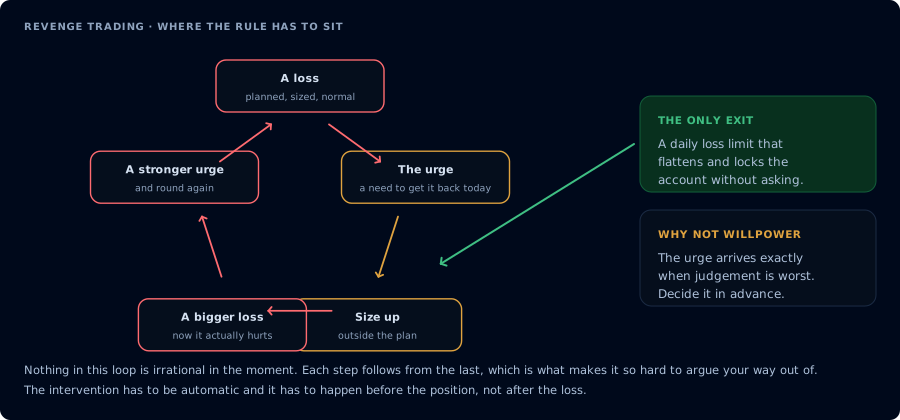
Every step follows from the last. The only exit sits before the position, not after.
What revenge trading looks like
The pattern:
- You take a loss (planned, normal — e.g., −1R)
- You feel angry, embarrassed, or determined to "fix it"
- You enter another trade — quickly, often without proper setup criteria
- That trade is larger than your normal size (because you want to recover faster)
- It loses (often more than the original because of the larger size)
- You enter again, even larger, even more impulsively
- Repeat until either a lucky win interrupts the spiral or you've blown up the account
The key tells: larger size, faster entries, weaker setups, ignored rules. All four together = a revenge trade.
Why it happens
Three underlying psychological drivers:
1. Loss aversion. Humans feel losses roughly 2× as intensely as equivalent gains. A −$500 loss feels like it requires at least a $1,000 win to "make right." This drives the urge to size up.
2. Identity threat. Losses challenge your self-image as a competent trader. Revenge trading is an attempt to immediately restore that identity by "proving" you can win.
3. Sunk cost reasoning. "I'm already down $500. Another $200 risk to potentially make $700 back is worth it." This logic ignores that the first $500 is gone — it doesn't change the EV of the next trade.
The combination is uniquely powerful in trading because losses produce immediate, measurable harm in a way that triggers the strongest version of all three drivers simultaneously.
How tilt spirals end accounts
Math example. A $50,000 account, 1% per-trade risk = $500 max loss per trade.
After one normal loss: $49,500 (−1%). Recoverable.
Tilt cascade:
- Loss 1: −$500 (planned, normal)
- Tilt trade 1: 2× size, loses → −$1,000
- Tilt trade 2: 3× size, loses → −$1,500
- Tilt trade 3: "all in to recover," loses → −$5,000
Total session loss: $8,000. That's 16% of the account in one session. You're now in a hole that takes weeks of disciplined trading to recover from — assuming you don't tilt-trade again before that.
This pattern — the cascading "make it back" sequence — is the dominant cause of blown accounts.
Warning signs (the early ones)
Catch the tilt before the second trade:
- Heart rate elevated, breathing shallow
- Feeling angry, embarrassed, or determined to "show the market"
- Mentally calculating "how much I need to make back"
- Looking at your last trade's chart wishing you could re-do it
- Adding second monitors to your view "to find the next setup faster"
- Telling yourself "I'll just take one more"
These are not subtle. The harder you have to work to convince yourself the next trade is rational, the more likely it's a tilt trade.
The rules that stop the spiral
1. The 5-minute rule. After any losing trade, walk away from the screen for at least 5 minutes. This is not optional — physically leave the desk. Make tea. The break interrupts the emotional escalation.
2. The 2-loss circuit breaker. After 2 consecutive losing trades, stop trading for at least 30 minutes. Maybe the rest of the day. Two losses might be normal variance, but the combination of two losses + your emotional state is a tilt risk.
3. Hard daily loss limit. When your daily loss limit hits — say, 3% of account or 3× per-trade risk — stop. Auto-flatten everything. Walk away. See daily loss limits.
4. No size increases on losing days. Position size should only ever decrease during a losing streak, never increase. If you find yourself thinking about doubling up, that thought is the warning.
5. Automate enforcement. Personal rules fail under emotional pressure. Software rules don't. Use CrossTrade's Account Manager or your broker's similar tools to auto-flatten at preset thresholds. The kill switch saves accounts.
When you've already started tilt-trading
If you realize mid-session that you're in a revenge spiral:
- Close all positions immediately. Take whatever loss is on the table now. It will be smaller than the loss you'd take if you keep going.
- Log out of the platform. Physically. Don't just minimize the window. Log out.
- Do not trade for the rest of the day. Not even one "calm" trade to "end on a good note." That trade is also tilt.
- Journal what happened. Write down what triggered the spiral, what you felt, what rules you broke. The act of writing it processes the emotion and prevents recurrence.
- Resume tomorrow at reduced size. Cut your normal size in half for the next 5 trading days. This gives you space to rebuild discipline without much risk.
The traders who survive revenge spirals are the ones who recognize them mid-spiral and stop. The ones who blow up are the ones who keep going, convinced the next trade will fix everything.
The long view
Every losing trade is an unavoidable part of a sustainable trading career. Even the best strategies lose 30-50% of trades. Losses are not failures of skill — they are normal variance. Treating each loss as a personal affront is the root of revenge trading.
When you accept that losses happen, are normal, and don't require immediate "fixing," tilt loses its power. The next trade is just the next trade.
Frequently Asked Questions
What is revenge trading?
Trading specifically to recover a recent loss — usually with larger size, faster entries, and weaker setups than your normal rules. It's driven by emotion (anger, embarrassment, determination to 'fix' the loss) rather than strategy. Almost universally unprofitable and a leading cause of blown accounts.
How do I stop revenge trading?
Use mechanical circuit breakers: walk away for 5 minutes after every loss; stop trading for the day after 2 consecutive losses; enforce a hard daily loss limit (2-3% of account); automate the rules so software stops you when willpower fails. The kill-switch approach saves accounts that personal discipline cannot.
Is revenge trading the same as tilt?
Closely related. 'Tilt' (from poker) is the broader emotional state where rational decision-making breaks down. Revenge trading is the specific behavior tilt produces in a trading context. You can be on tilt without revenge trading (e.g., overtrading on a winning day), but most revenge trading happens on tilt.
How much should I lose before stopping for the day?
Common rule: 3× your per-trade risk, or 2-3% of account equity, whichever is lower. For a $50k account risking 1% per trade ($500), stop at −$1,500 daily loss. Stricter is better — the goal is to interrupt the spiral before it cascades, not to give it room to develop.