The Trading Journal
A trading journal is a record of every trade you take, with the context, outcome, and reasoning behind it. It works because your memory is selective and self-flattering — you remember winners, forget losers, and rationalize mistakes after the fact. A journal forces you to confront your actual behavior with data. It's the highest-leverage habit for improving as a trader.
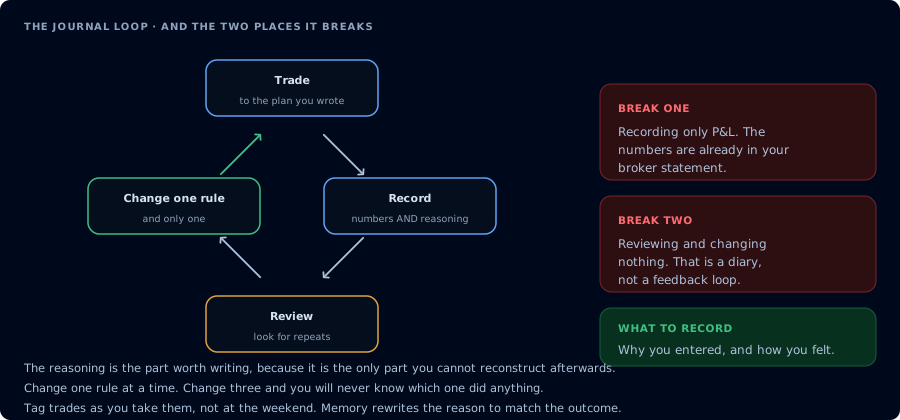
Recording P&L alone gives you nothing to review. The reasoning is the part that pays.
Why memory isn't enough
Three biases sabotage unwritten self-assessment:
1. Confirmation bias. You remember the trades that confirm your story ("I'm a great breakout trader") and discount the ones that don't.
2. Recency bias. Last week's results dominate your sense of "how I'm doing" — the prior 11 weeks are blurry.
3. Hindsight bias. After a loss, you remember "I knew I shouldn't have taken it." After a win, you remember "I had high conviction." Neither memory is accurate at the moment of the trade.
A journal beats all three because you write the rationale before you know the outcome. The data captures what you actually thought, not what you wish you had thought.
What to log per trade
Minimum useful fields:
| Field | Why it matters |
|---|---|
| Date / time | Identify time-of-day patterns |
| Instrument | ES, NQ, CL, etc. — patterns differ by market |
| Direction | Long/short |
| Entry price | Anchor for everything else |
| Stop price | Defines initial R |
| Target price | Compare planned vs. actual |
| Position size | Confirms sizing was within rules |
| R risked ($) | Normalize across trades |
| Setup name | "ORB," "VWAP reversion," "FOMO chase" |
| Pre-trade thesis (1-2 sentences) | Captures real-time reasoning |
| Exit price + reason | Hit stop / hit target / discretionary exit |
| R outcome | +1.8R, −1R, etc. |
| Notes (1-3 sentences post-trade) | Anything not captured above |
That's 13 fields. Looks like a lot until you build a template — then it takes 60-90 seconds per trade.
What to log per session
Beyond per-trade data, log session-level context:
- Mental state at session start (1-10 scale or quick descriptor)
- Sleep hours the night before
- Major market events (FOMC, CPI, NFP)
- Notable news / catalyst
- Total trade count vs. your daily cap
- End-of-day P&L
- Mental state at session end
Patterns emerge after 30-60 sessions: tired days, news days, and certain mental states correlate with worse outcomes. You can't see the pattern without the data.
What to log per week / month
Weekly review (10-15 minutes every Sunday):
- Win rate, profit factor, expectancy by setup type
- Worst trade — what went wrong
- Best trade — was it skill or luck?
- Rules broken this week
- One specific behavior to focus on next week
Monthly review (45 minutes, first weekend of new month):
- Equity curve shape (smooth? lumpy? drawdown?)
- Are any setups consistently unprofitable? (Cut them.)
- Are any setups consistently profitable? (Trade them more.)
- What patterns appear across the bad weeks? Across the good ones?
Tools
Spreadsheet (free). Google Sheets or Excel. Maximum flexibility, zero cost. Most traders' first journal is a spreadsheet — and many never need anything else.
TradingView's notes feature. Append per-trade notes directly to charts. Limited but lightweight.
Tradervue. Imports broker statements automatically; computes performance metrics. Paid SaaS.
Edgewonk. Similar to Tradervue with stronger psychological journaling features. Paid software.
Custom database. For advanced users — log to a SQL database with charts/analytics on top. Maximum control, requires technical skill.
The right tool is the one you'll actually use. A spreadsheet you maintain beats Edgewonk you don't.
How to actually use the data
Logging is half the work. Reviewing is the other half.
Daily: 5-minute review at session end. Note any rule violations and the day's lesson.
Weekly: 15-minute review. Compute win rate, average R, profit factor by setup. Look for patterns.
Monthly: 45-minute deep review. Look at the equity curve. Identify habits to keep, habits to break. Update your trading plan if needed.
Quarterly: Full strategy audit. Are the setups still working? Have markets changed? Should anything be removed or added?
The traders who improve over time are the ones who do all four. The ones who plateau are the ones who only journal trades but never review them.
Specific patterns the journal will reveal
After 50-100 trades, your journal will likely show:
- One time-of-day where you make most of your money (often 9:30-11:30 ET)
- One time-of-day where you give it back (often midday or last hour)
- One setup that's profitable, one that's a coin flip, one that's negative-EV
- Higher R-multiples on trades where you waited for confirmation vs. anticipated
- Lower R-multiples on trades after a loss (FOMO/revenge tells)
These patterns are obvious in retrospect but invisible without data. The journal is what makes them visible.
Common mistakes
- Logging only the outcome, not the thesis. Without the thesis, you can't tell if the trade was correct (good thesis, bad outcome) or wrong (bad thesis, good outcome).
- Keeping a journal but never reviewing it. Logging without reviewing is just bookkeeping. The reviews drive the improvement.
- Editing the journal after the fact. "I think I actually meant to enter at 5,003, not 5,001." No. Log the truth, even when ugly.
- Quitting after 10 entries. Patterns don't show up in 10 trades. Commit to at least 100 logged trades before judging the process.
Frequently Asked Questions
What should I include in a trading journal?
At minimum: date/time, instrument, direction, entry/stop/target prices, position size, R risked, setup name, pre-trade thesis, exit price and reason, R outcome, and post-trade notes. Per-session add mental state, sleep hours, market events, and total trade count. Per-week add review of patterns and rules followed/broken.
How often should I review my trading journal?
Daily for 5 minutes (note rule violations and lessons), weekly for 15 minutes (compute metrics by setup), monthly for 45 minutes (look for patterns and trends), quarterly for a full strategy audit. Logging without regular review is just bookkeeping — the reviews are what drive improvement.
What's the best trading journal software?
The one you'll actually use. A simple spreadsheet (Google Sheets, Excel) works for most traders and is free. Tradervue and Edgewonk are popular paid options that auto-import from brokers and compute metrics. The tool matters less than the consistency of using it.
How long until I see results from journaling?
Patterns start appearing around 50-100 trades. Real behavioral change typically takes 200-300 trades. Don't expect dramatic results in week 1 — the value compounds as the data grows. Most traders who quit journaling do so before the patterns become visible.