Double Donchian Channels
Double Donchian Channels stacks two Donchian channels on one chart — an Inner Channel (default 100 periods) for shorter-term levels and an Outer Channel (default 300 periods) for the major trend context. Bars touching either channel's bands get color-coded so you can spot breakouts, pullbacks within a trend, and potential reversals at a glance.
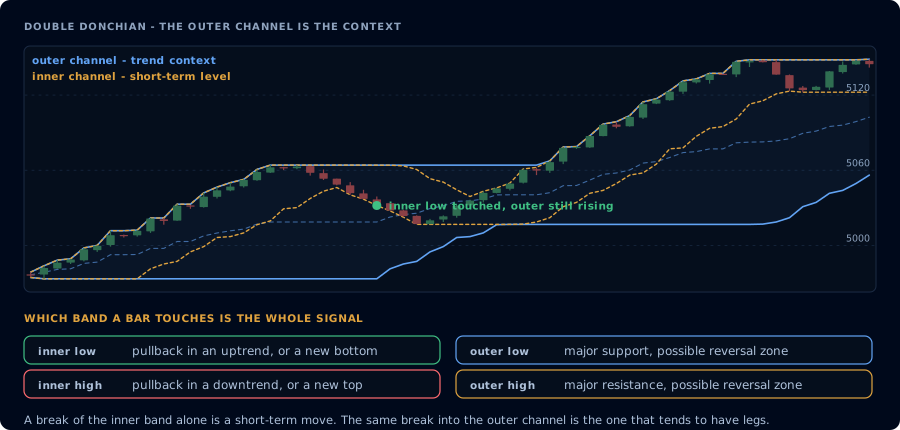
Which of the four bands a bar touches is the whole signal.
Why two channels
A single Donchian channel is the original breakout indicator — Turtle Traders made it famous in the 1980s. The mechanics are dead simple:
Upper  = highest high of last N bars
Lower  = lowest low  of last N bars
Middle = (Upper + Lower) / 2
A close above the upper band is a breakout long; a close below the lower is a breakout short. It works in trending markets and bleeds in chop — same problem as every breakout system.
Stacking a second, much longer Donchian channel solves the same problem trend filters always solve: it gives you context. Now you can distinguish:
- A breakout into the outer channel = significant move, major trend confirmation
- A bounce off the inner channel inside an outer trend = pullback within a trend, often a continuation entry
- A break of the inner only = short-term move, may not have legs
For the conceptual foundation, see Donchian Channels.
What it plots
Inner Channel (default 100 periods):
- Upper band — short-term resistance
- Lower band — short-term support
- Middle — short-term equilibrium
Outer Channel (default 300 periods):
- Upper band — major resistance
- Lower band — major support
- Middle — major equilibrium
Dynamic mid-line color:
- Each channel's middle line changes color based on the previous close vs. the basis. Green when price is establishing above; red when below. Fast visual trend bias read.
Bar coloring on touches
Four color states for bars touching the bands:
| Touch | Bar color | What it means |
|---|---|---|
| Inner low | Green | Short-term support test — pullback in uptrend, or new bottom |
| Outer low | Blue | Major support test — significant move, possible reversal zone |
| Inner high | Red | Short-term resistance test — pullback in downtrend, or new top |
| Outer high | Orange | Major resistance test — significant move, possible reversal zone |
The four-color system makes regime visible at a glance. A run of green bars (touching the inner low) inside a chart that has previously been printing orange bars (outer high) is the classic "pullback in an uptrend" pattern — a continuation entry candidate.
Pullback identification
The most useful single read from Double Donchian is pullback detection: a bar touching the inner channel while the broader trend (defined by the outer channel) is in the opposite direction.
- Long pullback — bar touches inner-low (green) while price has recently been touching outer-high (orange). Trend up, pullback in.
- Short pullback — bar touches inner-high (red) while price has recently been touching outer-low (blue). Trend down, bounce in.
Combine with momentum confirmation (RSI Momentum, a SuperTrend, or a candlestick pattern) and you have a trend-following setup with high-quality entries.
Settings reference
| Input | Default | What it does |
|---|---|---|
| Inner Channel Length | 100 | Lookback for the inner Donchian |
| Outer Channel Length | 300 | Lookback for the outer Donchian |
| Show Inner Channel | On | Toggle inner bands |
| Show Outer Channel | On | Toggle outer bands |
| Color Touch Bars | On | Enable the four-color bar system |
The inner-to-outer ratio is more important than the absolute numbers. Defaults use 1:3, which works well for intraday futures. For slower markets, try 50:200. For faster ones, 30:90.
Alerts
Four alert conditions, one per touch type:
- Inner Lower Band Touch (green)
- Outer Lower Band Touch (blue)
- Inner Upper Band Touch (red)
- Outer Upper Band Touch (orange)
Wire the alerts that match your strategy through the XT Alert Builder. For a continuation strategy, you'd alert on inner touches inside an outer trend; for a reversal, alert on outer touches.
Common mistakes
- Trading every inner-channel touch. In chop, price tags the inner channel constantly. Without the outer trend context, every signal is noise.
- Setting outer length too short. If the outer channel is similar to the inner, both fire together and the trend-context signal disappears. Keep at least a 2.5–3x ratio.
- Ignoring chart timeframe. A 100-period inner on a 1-minute chart is 100 minutes (1.6 hours). On a daily chart it's 100 days (5 months). Same indicator, vastly different meaning. Match your channel lengths to your timeframe.
- Using it as a sole signal. Donchian touches are confirmations, not standalone triggers. Pair with momentum or pattern confirmation.
Frequently Asked Questions
Is this the Turtle Trading system?
It's the same indicator family — the Turtles used 20-bar and 55-bar Donchian channels for entries and 10-bar for exits. Double Donchian uses much longer defaults (100/300) tuned for modern intraday markets, but the underlying logic is identical.
Why such long defaults compared to classic 20/55?
Modern markets (especially intraday futures) are noisier than the markets the Turtles traded. Shorter Donchian lengths produce too many false breakouts. The 100/300 default trades fewer signals for higher conviction. You can always shorten — try 50/150 or even 20/60 for a more classic feel.
What's the best timeframe for Double Donchian?
5-minute and 15-minute charts for intraday futures. The 100/300 defaults give roughly 8 hours and 25 hours of inner/outer lookback on a 5m chart — about a session and three sessions, respectively. Daily and weekly charts work too but the indicator is generally more useful for shorter-term traders.
Can I use just one channel and ignore the other?
You can hide either channel via the toggle. But the value of this indicator is the dual-context read — using only one is functionally identical to a single Donchian, in which case TradingView's built-in is fine.