Double SuperTrend
Double SuperTrend stacks two SuperTrends on one chart — a fast minor trend layered over a slower major trend filter. Buy and sell signals fire only when the minor trend agrees with the major. The result: fewer signals, but the ones you take align with the dominant move.
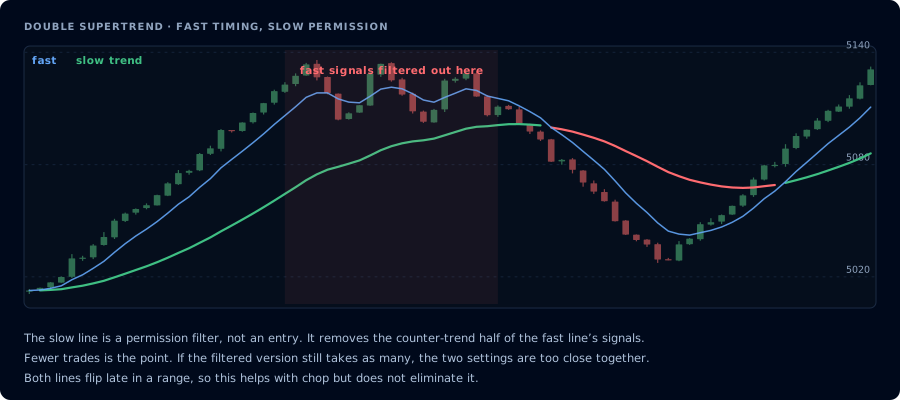
The slow line grants permission, the fast line provides the timing.
The problem with single SuperTrend
The classic SuperTrend is great until it isn't. It flips on every ATR-multiple price excursion, which works in trending conditions and bleeds in chop. A pure "buy green, sell red" SuperTrend system is profitable in backtest but rarely great in live trading because half the signals fire mid-range against the prevailing tide.
Most traders fix this by adding a trend filter — usually a long-period moving average — and only taking SuperTrend signals in the direction of the filter. Double SuperTrend bakes that filter in, but uses another SuperTrend instead of an MA.
Why a SuperTrend as the filter
A long-period SuperTrend has properties that make it a better trend filter than an EMA:
- It's a binary state. Either price is above the line (uptrend) or below it (downtrend). No "kind of bullish" — you get a clean yes/no.
- ATR-scaled. Quiet markets get a tighter major trend; volatile markets get a looser one. An EMA is the same distance off in both regimes.
- Self-adjusting flips. When the major regime genuinely changes, the major SuperTrend flips on a close — same mechanism as the minor trend, just at a different timescale.
How signals work
The indicator plots two SuperTrend lines:
- Minor trend (default ATR length 10, multiplier 3.0) — green/red
- Major trend (default ATR length 14, multiplier 6.0) — blue/purple
Signals only fire when both align:
- Buy signal — minor trend flips green AND major trend is currently up (blue)
- Sell signal — minor trend flips red AND major trend is currently down (purple)
A minor flip that contradicts the major is suppressed entirely. You won't get a buy signal in a major downtrend, no matter how clean the minor flip looks.
Settings reference
| Input | Default | What it does |
|---|---|---|
| Minor ATR Period | 10 | Lookback for the minor SuperTrend's ATR |
| Minor ATR Multiplier | 3.0 | How far off price the minor line sits |
| Major ATR Period | 14 | Lookback for the major SuperTrend's ATR |
| Major ATR Multiplier | 6.0 | How far off price the major line sits |
| Source | hl2 | Price source — high/low midpoint, open/close, etc. |
| Show Buy/Sell signals | On | Toggle the signal markers |
A larger major ATR multiplier (8.0+) will give a much rarer trend flip — fewer signals but each one is more meaningful. Smaller (4.0–5.0) reverts toward classic single-SuperTrend behavior.
Tuning for your market
The defaults work reasonably on index futures (ES, NQ) and most equities. For other markets:
- Crypto — try minor ATR period 7, multiplier 2.5; major period 14, multiplier 5.0. Crypto's higher base volatility justifies tighter settings.
- Slow-moving forex pairs — minor period 14, multiplier 3.5; major period 21, multiplier 7.0. Filters out the constant noise.
- Energy futures (CL, NG) — defaults work but expect more frequent flips during news events.
Don't over-optimize. The indicator's edge is the dual-confirmation logic, not magic numbers.
How to use the alerts
Right-click the indicator → Add alert → choose either:
- Double SuperTrend — Buy Signal (fires when minor flips green inside an up major)
- Double SuperTrend — Sell Signal (fires when minor flips red inside a down major)
Pair the alert with the XT Alert Builder to convert the signal into a CrossTrade order. Add Double SuperTrend to your chart, then point the Alert Builder's signal source at it.
Common mistakes
- Trading minor flips in the wrong major direction. The whole point is to NOT do this. If you find yourself disabling the major trend filter, you're back to single SuperTrend.
- Using identical settings for minor and major. They'll move together and produce the same signals as one SuperTrend. The ratio matters — major should be roughly 2x the minor's effective sensitivity.
- Tweaking until backtests look perfect. The dual-trend logic is robust; the specific numbers are secondary. Pick reasonable defaults and stop tuning.
- Forgetting the entry timing cost. Both SuperTrends require closes to flip. By the time both align, price has already moved an ATR-multiple. This is a trend-following tool, not a turning-point detector.
Frequently Asked Questions
How is Double SuperTrend different from single SuperTrend with an EMA filter?
Both work, but the dual SuperTrend approach gives you ATR-scaled confirmation on both timescales — quiet regimes tighten everything, volatile regimes widen everything. An EMA filter doesn't adapt that way. Practically, the signals are similar in calm markets and noticeably different around regime transitions.
Why are my signals so rare?
That's the trade-off. Requiring both timescales to align means fewer signals than single SuperTrend. If you're getting one signal per day on intraday futures, that's roughly correct. If you're getting zero, your major ATR multiplier is probably too high for your timeframe — try 5.0 instead of 6.0.
Can I use Double SuperTrend on a 1-minute chart?
You can, but the ATR-based scaling means the minor trend will flip on every micro-swing. Better to run Double SuperTrend on the 5- or 15-minute chart and use the 1-minute for entry timing.
Does the indicator repaint?
No. SuperTrend (and Double SuperTrend) confirm flips on bar close. The signal is final once the bar closes — no historical revision.