RSI Momentum
RSI Momentum generates buy and sell signals using RSI extremes as continuation confirmations, not reversals. Instead of trying to fade the RSI > 70 print, the indicator waits for momentum to briefly fade and signals an entry in the direction of the existing move. Solves RSI's biggest weakness in trending markets.
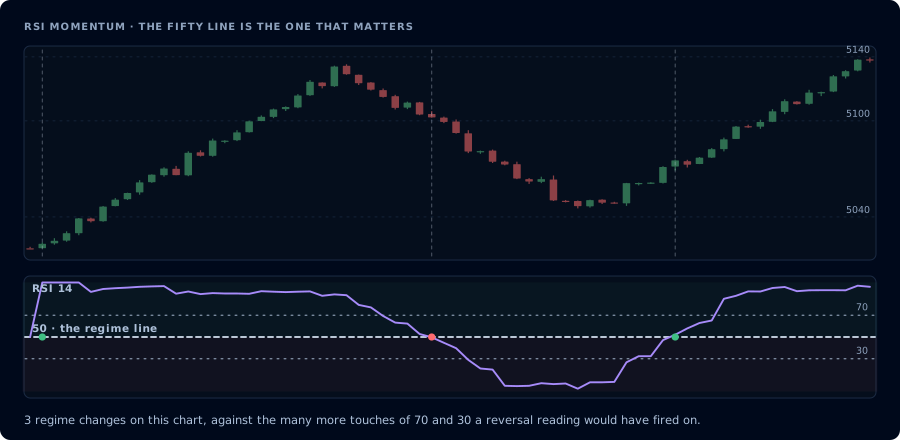
Reading the 50 line instead of 70 and 30 turns RSI into a regime filter.
The bottom-picking trap
The textbook way to use RSI: short when it goes above 70, buy when it drops below 30. Sounds great. Loses money in any sustained trend.
In a strong uptrend, RSI can sit above 70 for days. Every short you take on a "70-print sell signal" gets stopped out as price keeps grinding higher. The same trap inverted plays out in downtrends.
The classical answer is "use RSI for divergence, not threshold crosses." That works, but divergence is hard to systematize and gives you no trigger — only a heads-up that the trend is weakening.
RSI Momentum takes a different angle: use the extreme reading as confirmation that momentum exists, then enter on the small retracement that follows.
How the signals work
Buy logic:
- RSI exceeds the overbought threshold (default 70) — confirms strong upside momentum.
- RSI drops back below the momentum loss threshold for buys (default 60) — small pullback in.
- Indicator fires a buy signal.
That's a continuation trade, not a reversal. You're entering long after a strong run, on the first pullback, expecting the trend to continue.
Sell logic is the mirror:
- RSI drops below the oversold threshold (default 30).
- RSI rises back above the momentum loss threshold for sells (default 40).
- Indicator fires a sell signal.
You're entering short after a strong drop, on the first bounce.
Why this works
In trending markets, the strongest single predictor of "will this trend continue tomorrow" is "did it trend hard yesterday." Momentum is auto-correlated. RSI Momentum exploits that by:
- Filtering out signals in chop (RSI never reaches 70 in chop)
- Entering on retracements (better risk/reward than buying the high)
- Not fading the trend (the #1 rule)
The trade-off is you'll never catch the literal turning point. That's intentional — bottom-picking is a different game.
Optional: deeper retracement signals
By default, the indicator fires one signal per RSI extreme cycle. Enable Allow Additional Retracement Signals and you'll get up to Max Additional Signals more entries on deeper pullbacks within the same trend, only if each new signal's bar prints a lower low (for buys) or higher high (for sells) than the previous signal's bar.
This is for traders who want to scale into a pullback. Most users leave it disabled — one signal per cycle is plenty.
Settings reference
| Input | Default | What it does |
|---|---|---|
| RSI Length | 14 | Lookback for the RSI calculation |
| Overbought Threshold | 70 | RSI level that triggers buy momentum confirmation |
| Momentum Loss Threshold (Buy) | 60 | RSI level the pullback drops to before firing |
| Oversold Threshold | 30 | RSI level that triggers sell momentum confirmation |
| Momentum Loss Threshold (Sell) | 40 | RSI level the bounce rises to before firing |
| Allow Additional Retracement Signals | Off | Enable multi-entry mode |
| Max Additional Signals | 2 | Cap on extra entries per cycle |
For more aggressive momentum confirmation, raise the overbought to 75–80 and the buy retrace to 65 (mirror inverted for sells). For tamer signals, lower to 65/55.
Pattern reset
When RSI completes a full cycle — overbought → retrace → new overbought — the script resets and is eligible to fire a fresh series of signals. So in a sustained trend, you can get multiple entry sequences as the RSI keeps re-printing extremes. The indicator doesn't lock you out after one signal.
Pairs naturally with
- A trend filter — pair with a 200-EMA or Double SuperTrend and only take buys above the filter, sells below. Cuts the false signal rate roughly in half.
- The XT Alert Builder — point its signal source at RSI Momentum to wire entries through CrossTrade.
Common mistakes
- Treating it like classical RSI. It's not. Don't sell at 70 and buy at 30 — wait for the retracement.
- Running it on a 1-minute chart. RSI on a 1-minute chart is mostly noise. Stick to 5-minute or higher for momentum readings to have meaning.
- No trend filter. Without one you'll take buy signals into rallies that turn out to be the top tick. A 200-EMA or higher-timeframe SuperTrend cuts the worst of this.
- Over-tuning thresholds. The 70/60/30/40 defaults are battle-tested. Fiddling them rarely improves out-of-sample performance.
Frequently Asked Questions
How is RSI Momentum different from classical RSI?
Classical RSI signals call for shorting at 70 and buying at 30 — fade the move. RSI Momentum calls for buying after a strong move once a small pullback prints — ride the move. Same indicator, opposite trade direction.
Why does the indicator wait for the retracement?
Two reasons. First, the small pullback gives you better entry pricing than buying the literal high. Second, requiring the retracement filters out 'tag and continue' overbought reads where the move is so strong RSI never even pulls back — those would have been bad shorts and they're not RSI Momentum buys either.
Should I disable the additional retracement signals?
Yes, by default. The default of one signal per cycle is enough for most setups. Multi-entry mode is for traders who explicitly want to scale into a pullback — it requires position management you might not have wired in.
Can I use it without a trend filter?
You can but you shouldn't. The indicator fires continuation signals based purely on RSI mechanics, with no awareness of the broader trend. Without a filter you'll take buy signals near major tops and sell signals near major bottoms. A 200-EMA or higher-timeframe trend tool fixes this.