VIX Heatmap
VIX Heatmap tracks the daily VIX close and paints your chart background with a color intensity that escalates as the VIX rises. Configurable thresholds let you tune the heatmap to your own definition of risk regimes — from extremely calm to maximum fear. A volatility-context overlay you can run on any symbol.
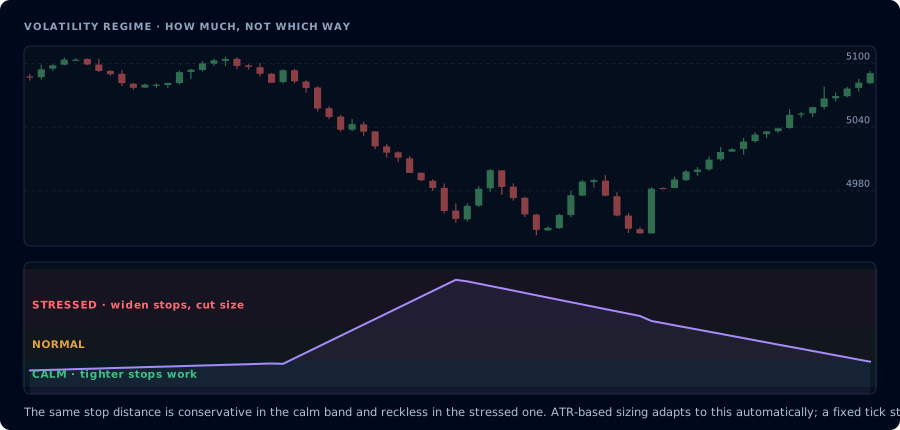
The same stop is conservative in one regime and reckless in another.
Why VIX context matters
The VIX (CBOE Volatility Index) measures the implied volatility of S&P 500 options over the next 30 days. It's nicknamed the "fear gauge" because it rises when traders are buying protection — typically during selloffs or uncertainty.
For intraday traders, the absolute level of the VIX matters as much as its direction. A VIX of 12 means traders see no risk in the next month — markets are sleepy, ranges are tight, breakouts fail more often. A VIX of 35 means real fear — ranges are wide, gaps are common, and standard intraday strategies often perform differently.
Most traders glance at the VIX once in the morning and forget it. VIX Heatmap puts it on every chart, all the time, as a background color so you can't ignore it.
How the heatmap works
The indicator pulls the daily VIX close and compares it to six configurable thresholds. The chart background gets tinted based on which range the VIX is currently in:
| Threshold | Default | Background color |
|---|---|---|
| Danger Zone (super-low) | < 12 | White |
| Level 1 | 12–17 | Pale red |
| Level 2 | 17–22 | Light red |
| Level 3 | 22–28 | Medium red |
| Level 4 | 28–35 | Strong red |
| Level 5 | > 35 | Deep red |
The "Danger Zone" naming is deliberate. Extremely low VIX readings (sub-12) are historically warnings — they often precede sharp volatility spikes because positioning has become complacent. Some traders treat sub-12 as a contrarian signal to reduce size.
What the colors mean for trading
These are general rules of thumb, not gospel:
- White / pale red (calm) — small ranges, breakouts often fail, mean reversion strategies tend to do well
- Medium red (typical) — most common state, normal market conditions, all strategies in play
- Strong / deep red (stressed) — wide ranges, gaps, news-driven moves, trend strategies often outperform mean reversion, but slippage and stops widen
You'll quickly develop intuition for which of your strategies do well in which regime. The heatmap gives you the "reduce size" or "wait for the regime to change" signal at a glance.
Settings reference
| Input | Default | What it does |
|---|---|---|
| Danger Zone Threshold | 12 | Below this is the contrarian-low band |
| Level 1 Threshold | 17 | Lower bound of typical-calm |
| Level 2 Threshold | 22 | Lower bound of normal |
| Level 3 Threshold | 28 | Lower bound of elevated |
| Level 4 Threshold | 35 | Lower bound of stressed |
| Show Heatmap Background | On | Toggle the chart-background tint |
| Show Current VIX Display | On | Toggle the on-chart number readout |
You can disable the background tint if you find it visually noisy and just keep the on-chart display showing the VIX level in large bold text.
Tuning to your style
The defaults are calibrated to recent (post-2008) historical VIX behavior. If you trade through a high-volatility regime change (think March 2020), you may want to shift the levels up to keep the visual contrast meaningful. Conversely, in a multi-year low-volatility environment (2017-style), the defaults can leave your chart looking white most of the time — shifting Level 1 down to 10 brings more nuance back.
Pairs naturally with
- VIX Bars — colors specific bars at extreme VIX readings rather than the whole background. Use both for full volatility context.
- A position-sizing rule — if you size positions based on volatility, the heatmap is a manual override signal (e.g. cut size in deep-red regimes regardless of what your position-sizing formula says).
Common mistakes
- Trading the VIX itself based on the heatmap. This is a context indicator for equity and futures charts. It's not a VIX trading system.
- Ignoring the level when the background flips. The most useful read is when the background changes color — a regime shift. Don't just glance at "it's red," check whether it's getting redder or fading.
- Treating sub-12 as bullish. Low VIX doesn't mean stocks go up. It means traders aren't paying for protection. Often the precursor to a volatility spike.
- Using on individual stocks. The VIX is an S&P 500 measure. Applying the heatmap to crypto or single stocks gives you index-context data on a chart that's not driven by index dynamics. Useful as a macro overlay, but don't expect tight correlation.
Frequently Asked Questions
What's the data source — spot VIX or VIX futures?
Spot VIX (the index itself, ticker VIX). The indicator pulls the daily close, so the heatmap updates once per day after the VIX settles.
Why is sub-12 VIX called the 'Danger Zone'?
Because sustained low-VIX environments historically precede sharp spikes. When implied vol is at multi-year lows, options are cheap, hedging is unloved, and positioning is complacent — exactly when a vol shock catches the market off-guard. Doesn't mean a crash is imminent; just that the asymmetry favors caution.
Can I use this on a crypto chart?
You can. The VIX itself doesn't measure crypto volatility, but it does correlate roughly with risk-off sentiment that affects crypto. Treat it as a macro context indicator rather than a crypto-specific volatility read.
Why do my thresholds need updating during high-vol regimes?
The default thresholds (12 / 17 / 22 / 28 / 35) are calibrated to historical norms. During a multi-month elevated regime — like much of 2022 or post-COVID 2020 — the VIX may sit between 25 and 35 for weeks, painting your chart in the same color the whole time. Shifting the bands up restores the visual contrast that makes the heatmap useful.