VWAP with Trend Alerts
VWAP with Trend Alerts is a comprehensive take on VWAP — adds up to three configurable standard deviation bands, optional bar coloring (all bars or trend bars only), and buy/sell alert conditions when bars close beyond both VWAP and the second deviation band. A classic indicator with the moving parts traders actually want.
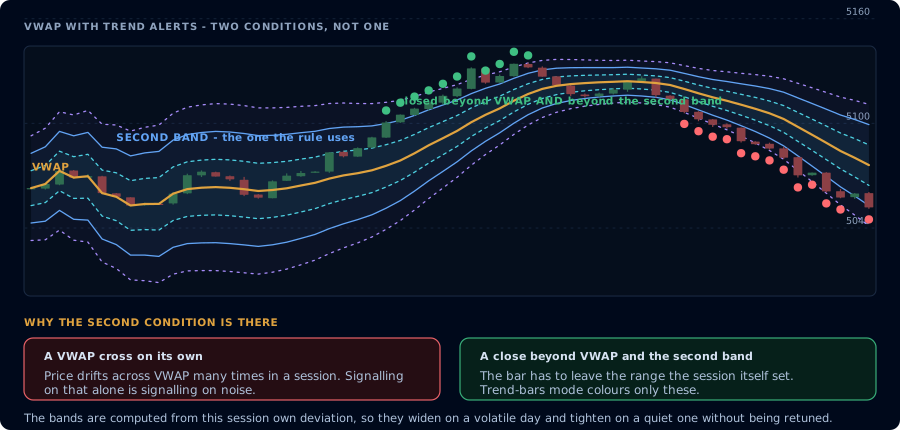
A VWAP cross alone fires nothing. The bar has to clear the second band too.
What VWAP gives you
Volume Weighted Average Price is the average price an asset has traded at over a session, weighted by volume. Think of it as the "fair price" that institutional flow has settled on so far today. Bars closing above VWAP suggest buyers are in control; below means sellers.
VWAP is the most-watched intraday level in equities and futures. Every desk has it on their screens. That makes VWAP behavior a self-fulfilling reference point — price gravitates back to it because traders expect it to.
For the indicator basics, see the VWAP learn page.
What this version adds
Three things stock VWAP doesn't have:
1. Standard deviation bands
Up to three configurable bands above and below VWAP, each with its own multiplier. These act as dynamic support and resistance:
- First band (default 1σ) — typical intraday range
- Second band (default 2σ) — extended move, breakout territory
- Third band (default 3σ) — tail event, extreme range
The bands widen during volatile sessions and tighten during quiet ones automatically.
2. Bar coloring modes
- Color All Bars — every bar gets colored green (close above VWAP) or red (close below). Best for at-a-glance reads.
- Trend Bars Only — only colors bars that close beyond the second deviation band. Quieter chart, more meaningful signals.
The trend-bars mode is what most traders prefer once they've used both. Your eye stops chasing every tick above VWAP and focuses on real breakouts.
3. Trend-bar alerts
The buy and sell signals fire only when a bar closes:
- Above both VWAP and the upper second-deviation band → buy
- Below both VWAP and the lower second-deviation band → sell
This is a strong-trend filter. You're not signaling on every VWAP cross — you're signaling on closes that genuinely break out of the day's standard deviation.
Settings reference
| Input | Default | What it does |
|---|---|---|
| VWAP Source | Default | Which price to weight by volume (default uses HLC3) |
| Show 1st Band | On | Toggle the inner band |
| 1st Band Multiplier | 1.0 | σ width for the first band |
| Show 2nd Band | On | Toggle the middle band |
| 2nd Band Multiplier | 2.0 | σ width — used for trend-bar logic |
| Show 3rd Band | Off | Toggle the outer band |
| 3rd Band Multiplier | 3.0 | σ width for the outer band |
| Color All Bars | Off | Tint every bar based on side of VWAP |
| Trend Bars Only | On | Only color bars beyond 2nd band |
The second band's multiplier is the most important setting — it defines what "trend bar" means and what triggers alerts. Lower it (1.5) to get more, smaller breakouts. Raise it (2.5–3.0) for rarer but stronger ones.
Pairs naturally with
- The XT Alert Builder — point the Builder's signal source at VWAP with Trend Alerts to convert breakout closes into CrossTrade orders.
- A larger trend filter like a higher-timeframe Double SuperTrend. Cuts false breakouts when intraday VWAP says one thing and the daily trend says another.
Common mistakes
- Using all three bands at once. The third band rarely fires and clutters the chart. Most users keep only 1st and 2nd visible.
- Treating VWAP as a magic level. VWAP is a reference, not a trade signal. Closes through bands are tradeable; tags and rejections are noise.
- Coloring every bar in choppy markets. "Color All Bars" mode looks great in a trend day and useless during a chop day. Switch to trend-bars-only when conditions warrant.
- Running on overnight charts. VWAP resets each session. Apply this on intraday timeframes (1m–60m) where the daily VWAP is meaningful.
Frequently Asked Questions
How is this different from TradingView's built-in VWAP?
TradingView's built-in VWAP plots one line. This version adds up to three deviation bands, configurable bar coloring modes, and pre-built alert conditions for breakout closes — the things you'd otherwise have to wire together yourself.
Should I use 'Color All Bars' or 'Trend Bars Only'?
Most traders end up on Trend Bars Only after running both for a while. Color All Bars is helpful for learning to read VWAP trend; Trend Bars Only is better for actual signals once you don't need the visual training wheels.
What chart timeframe works best?
Intraday — 1, 5, or 15-minute charts. VWAP is a session-anchored indicator and resets each new session. On daily or higher timeframes it loses its meaning.
Why are my alerts firing on the open?
Early in the session, VWAP and the deviation bands are still being established and one or two bars can swing the bands wildly. Some traders disable alerts before 9:45 ET to skip the noisy first 15 minutes.