Weekly OHLM
Weekly OHLM plots four critical weekly levels on your intraday chart: the weekly high, weekly low, weekly open, and the midpoint of the weekly range. Levels update dynamically as the week progresses, and the indicator fires alerts on midpoint crosses and weekly-high/low touches. Built for traders who anchor decisions to weekly structure but execute intraday.
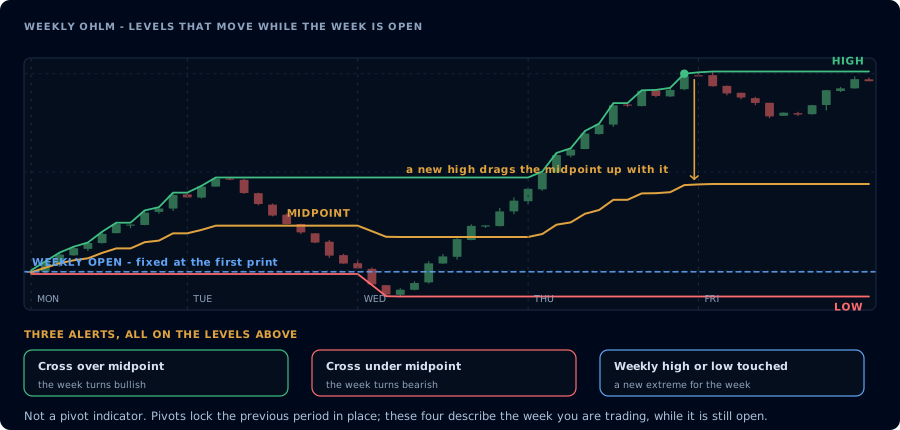
These levels move while the week is open. Pivots lock the last one in place.
Why weekly levels matter on intraday charts
Most intraday traders watch the daily levels — yesterday's high/low, the prior close, the daily pivot. Weekly levels get less attention but are arguably more important: they reflect the institutional positioning that drove the week's range, and they tend to act as bigger magnets and stronger walls than daily levels.
A 5-minute trader who only watches the day's range is missing context. A break of the weekly high on a Wednesday afternoon is a much bigger event than a break of yesterday's high — there are more stops above it, more breakout orders sitting on it, more institutional participants who care about that level.
Weekly OHLM puts those levels on the chart so you stop missing them.
What it plots
| Level | Color | What it represents |
|---|---|---|
| Weekly Open | Blue | The first traded price of the week |
| Weekly High | Green | The highest print since the week opened |
| Weekly Low | Red | The lowest print since the week opened |
| Weekly Midpoint | Yellow | (High + Low) / 2 — the equilibrium price |
The midpoint is the most actionable level — it acts as a balance line for the week. Bars closing above are in a bullish weekly regime; below is bearish. Crosses through the midpoint are tradeable inflection points.
Dynamic intra-week updates
The high and low update as the week progresses. If price prints a new weekly high on Wednesday, the green line moves up to that level. Same for the low. The midpoint recalculates accordingly.
This isn't a "weekly pivots" indicator that locks in last week's levels and plots them statically — those exist (see Pivot Points) and serve a different purpose. Weekly OHLM is about the current week and how price is interacting with its own developing range.
Bar coloring on level touches
Two visual cues:
- Bars that touch or surpass the weekly high are colored lime
- Bars that touch or drop below the weekly low are colored purple
Lets you spot weekly-high/low events at a glance without watching the price ticker.
Alerts
Three alert conditions:
- Cross Over Midpoint — price crosses above the weekly midpoint (potential bullish inflection)
- Cross Under Midpoint — price crosses below the weekly midpoint (potential bearish inflection)
- Weekly High / Low Touch — price touches or exceeds either weekly extreme (significant level event)
Wire these through the XT Alert Builder to convert weekly inflection events into CrossTrade orders.
Trading applications
Weekly midpoint as bias filter. Above it = lean long. Below it = lean short. Skip trades that contradict the weekly bias.
Weekly high/low as breakout zones. A close above the weekly high mid-week often signals continuation through Friday. Same for breakdowns. The "no new weekly high in three days" pattern often precedes a reversal.
Weekly midpoint cross as entry trigger. On flat-open Mondays, the first cross of the prior week's midpoint can be a clean intraday entry — momentum is establishing direction for the week.
Weekly open as gap reference. Distance from current price to weekly open quantifies how much the week has moved. Useful for sizing — wider weeks mean wider stops are warranted.
Common mistakes
- Trading every midpoint cross. Like all level-cross signals, midpoint crosses fire often in chop. Combine with momentum (RSI, SuperTrend) or wait for confirmation closes.
- Ignoring the day of the week. A Monday morning midpoint cross is mostly noise — the week hasn't established a range yet. By Wednesday, the midpoint is meaningful.
- Confusing this with weekly pivots. Pivot points are static (calculated from prior week, plotted as horizontal lines all of next week). Weekly OHLM is dynamic — the levels move as the current week unfolds.
Frequently Asked Questions
Is this the same as weekly pivot points?
No. Weekly pivot points are calculated from last week's high, low, and close and plotted as fixed lines for the entire current week. Weekly OHLM is dynamic — it tracks the current week's developing high, low, and open and recalculates the midpoint on the fly.
What timeframe should I use it on?
Any intraday timeframe — 1m, 5m, 15m, 60m all work. The levels themselves are weekly so they're identical across timeframes; only the candle granularity changes.
Why does the line jump on Mondays?
Each new week resets the levels. Monday's open is the new weekly open, Monday's high becomes the (initial) weekly high, etc. As the week progresses the high and low extend.
How do I use this with futures contract rollovers?
Weekly OHLM uses whatever symbol the chart is on. If you switch from ES H25 to ES M25 mid-week, the weekly levels will recalculate from the new contract's data, which can produce gaps. For continuous-contract analysis, use a continuous symbol like ES1!.