Claude for NinjaTrader 8 Trading: Strengths, Costs, and Best Harnesses
Claude (Anthropic) is the safest default for NinjaTrader work when correctness and refusal behavior matter. It writes the cleanest NinjaScript on the first attempt and pushes back when you ask it to do something risky on a funded account, which is exactly what you want from a trading agent.
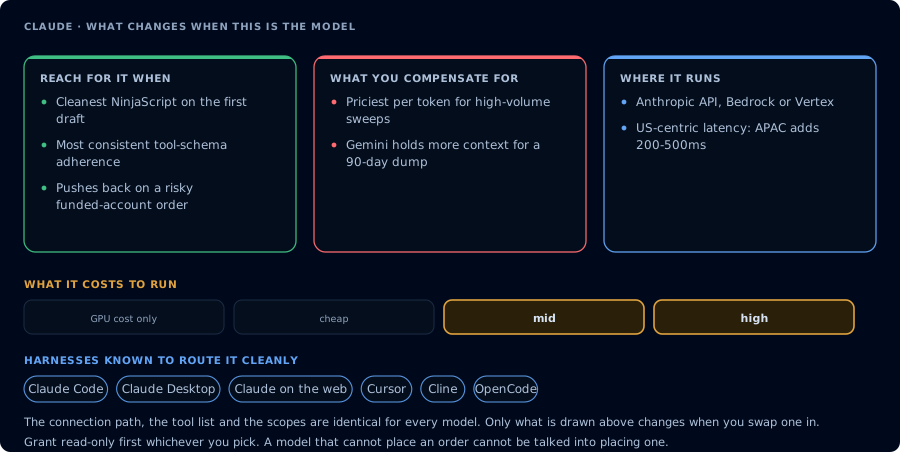
What this model changes, and what stays the same whichever one you pick.
Why Claude for trading
Three things tilt Claude toward trading workflows:
- Clean NinjaScript on first draft. Sonnet and Opus consistently produce compilable C# given a clear spec. Less time in the repair loop, fewer hallucinated NT8 method names.
- Strong refusal behavior. Ask Claude to flatten a funded account on a hunch and it will typically push back. Ask GPT or DeepSeek the same and they're more likely to just do it. For
mcp:tradework, refusal is a feature. - Reliable tool calling. Claude's tool schema adherence is the most consistent across MCP hosts. You spend less time fixing malformed
PlaceOrderarguments.
What it's good at
| Task | Notes |
|---|---|
| NinjaScript drafting | Best in class. Knows the NT8 API surface well; uses real method overloads. |
| Strategy critique | Will list real risks instead of cheerleading. |
| Funded-account safety | More likely to refuse marginal trades than other frontier models. |
| Webhook diagnostics | Good at correlating GetWebhookSignals against execution data. |
| Long conversations | Context handling in Sonnet/Opus is strong; multi-step compile loops don't drift. |
What it's not great at
| Task | Why |
|---|---|
| Cheap high-volume tasks | Sonnet is more expensive than DeepSeek V3 or Qwen 3 for the same throughput. For overnight journal sweeps, the budget math favors cheaper models. |
| Very long single-prompt context | Sonnet's context is good but Gemini's is larger. For 90+ days of raw journal data in a single prompt, Gemini wins. |
Cost and latency
- Sonnet: mid-tier price, ~1-3s first token, very high tool-call quality.
- Opus: high price, slower, best reasoning on hard NinjaScript problems.
- Haiku: cheap, fast, fine for routine inspection but not for NinjaScript drafting.
The rule of thumb: Sonnet for everyday trading agent work, Opus for hard strategy-design conversations, Haiku for cheap recurring tasks (e.g., scheduled risk briefs in n8n).
Prompt patterns that work well with Claude
Strategy spec prompt:
Draft a NinjaScript strategy. Spec: long-only MES, 9/21 EMA cross, ATR(14) trailing stop multiplier 2.0, one contract, 09:30-11:00 ET, max two trades per session, no averaging down. Before writing, call GetNinjaScriptHelp on each NT8 type. Restate the overloads you'll use. Compile in memory. On failure, LookupNinjaScriptSymbol and repair. Don't WriteNinjaScriptFile or RunStrategyBacktest unless I say so.
Claude will sequence the steps and pause at each gate.
Funded-account inspection prompt:
PROP1234 is a $50k prop-firm evaluation. mcp:read only. Compute distance to $1,500 trailing drawdown using current watermarks. List positions, working orders, end-of-day P&L. Two-paragraph risk brief. Refuse to recommend trades.
Claude reliably stays in read-only and produces calibrated commentary.
Limitations
- The Anthropic API is US-centric in latency. APAC traders may see 200-500ms extra round-trip.
- Bedrock and Vertex hosting work but require platform-specific harness config.
Pick your harness
This model works through any MCP-capable harness. Recommended pairings: