GPT (OpenAI) for NinjaTrader 8 Trading: Strengths, Costs, and Best Harnesses
OpenAI's GPT family is the workhorse for trading agents that need fast, strict tool calling. GPT-4.1 and GPT-5 follow tool schemas precisely and rarely produce malformed PlaceOrder arguments. The trade-off versus Claude: NinjaScript output is competent but usually needs a second pass on errors.
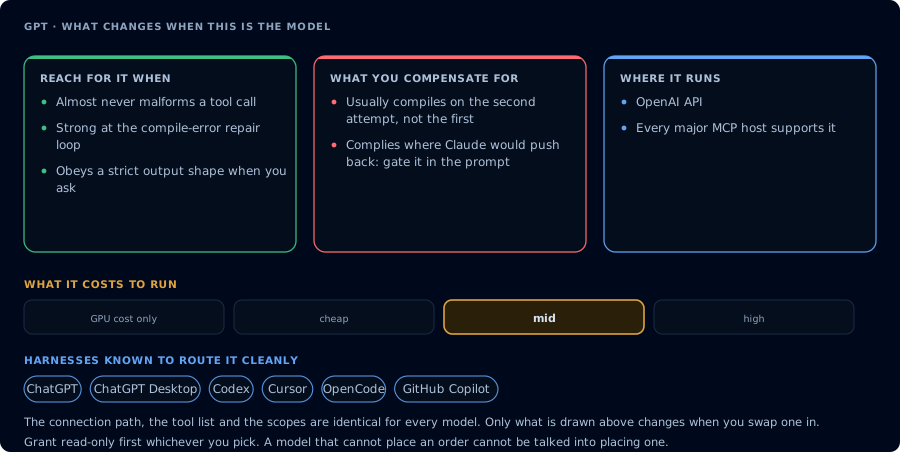
What this model changes, and what stays the same whichever one you pick.
Why GPT for trading
- Strict tool-call adherence. GPT models almost never hallucinate tool names or pass wrong-shape arguments. For an agent that runs
PlaceOrder,FlattenEverything, orDeployStrategy, that matters. - Fast first token. GPT-4.1 is fast; GPT-5 with reasoning is slower but produces tighter plans.
- Wide harness support. Every major MCP host supports GPT.
What it's good at
| Task | Notes |
|---|---|
| Tool-heavy workflows | Multi-tool plans (read state → think → write) execute reliably. |
| Repair loops | GPT is good at "compile failed, here's the error, fix" iteration. |
| Workflow automation | n8n / Zapier chains with GPT in the AI Agent step are very reliable. |
| Strict-format outputs | When you need JSON or a specific report shape, GPT obeys. |
What it's not great at
| Task | Why |
|---|---|
| First-draft NinjaScript | Often compiles on the second attempt rather than the first. |
| Refusal on marginal trades | More likely than Claude to comply with a risky request. Bake confirmation gates into the prompt. |
| Very long contexts | GPT-4.1's context is large but Gemini still wins on raw 90-day journal dumps. |
Cost and latency
- GPT-4.1 / GPT-4o: fast, mid-priced, very good tool calling. Default choice.
- GPT-5 with reasoning: best for hard strategy-design problems; latency 5-30s.
- GPT-4o mini / GPT-5 mini: cheap and fast; fine for inspection but not NinjaScript drafting.
Prompt patterns
Tool-strict prompt:
You have CrossTrade MCP. For every action, call tools only; do not make up data. Step 1: GetMcpCapabilities. Step 2: ListAccounts. Step 3: For Sim101 only, ListPositions and ListOrders. Step 4: Report a markdown table. Do not call write tools.
GPT executes the plan literally and stays in mcp:read.
Codex compile loop:
GetNinjaScriptHelp on EMA, ATR, CrossAbove. Restate overloads. Draft SampleEmaCross.cs. CompileNinjaScript(in_memory: true). On failure, LookupNinjaScriptSymbol and rewrite. Repeat until green. Don't WriteNinjaScriptFile yet.
Limitations
- Codex CLI is GPT-locked. If you want to mix Claude with GPT, use a multi-model harness like OpenCode, Cline, or Continue.
- GPT-5 with reasoning is markedly slower than 4.1 for routine work; reserve it for hard problems.
Pick your harness
This model works through any MCP-capable harness. Recommended pairings: